American Action Fund for Blind Children and Adults
Future Reflections Winter 2022 THE COLLEGE PERSPECTIVE
The Old Rules Don’t Apply: What You Need to Know about Transitioning to College
by Carol Castellano
 From the Editor: Carol Castellano is the author of four books, including Making It Work and Getting Ready for College Begins in Third Grade. In this article, based on her NOPBC workshop at the 2021 NFB National Convention, she shares her thoughts about how parents and teachers can help blind young people prepare for the enormous transition from high school to college.
As you probably know, college is very different from high school. Perhaps the biggest difference is in the level of freedom students have. At college there are very few rules. Students make their own decisions—good or bad—about what they will study and how they will behave. Parents are no longer in the loop. The kids are suddenly responsible for themselves. Parents are often surprised to learn they don't get information on grades, even if their child has stopped going to class or is flunking out, unless the student officially grants permission for the college to share such things.
"Don’t Call Mom!”
My daughter Serena lived away from home while she attended Manhattanville College just north of New York City. Here's how I found out that she was truly in college.
One day during the first week of school Serena called and said, "Mom, I got invited to a party at a senior's apartment off campus."
I said, "Oh? That's nice."
"I haven't decided whether I'm going or not," she said. "People will be drinking, and I'll have to get a ride with someone. I won't know if they drink."
Trying hard not to be a helicopter mom, I said, "How are you leaning?"
She said, "I don't know yet." Then we went on to other topics.
About three weeks into the semester she called and said, "Mom, my roommate's going to have a guy sleep over."
"What kind of guy?" I said. "Is this a friend guy who's going to sleep on the floor? Or is it a boyfriend guy who's going to sleep in the bed with your roommate?"
At that point my son, who is three years younger than my daughter, grabbed the phone and said, "Serena! When you have questions like this, you don't call Mom! You call me!"
Today both of my kids tell me with a wink that Serena didn't go to the party and that the guy never slept over. I've decided to believe them. College sure calls for a whole new set of skills for kids and parents alike!
Farewell to the IEP
Picture an IEP meeting. A cast of thousands sits around a table. A seventy-five-page document lies in front of each person. Social workers, psychologists, and teachers give dramatic readings about how your child is doing in school and all their flaws that still need to be corrected. Discussions and even arguments ensue over the fifty or so goals and objectives written into the document. Every person in attendance must provide a signature, including parents, who, of course, don't always want to sign.
Fast forward to college. There's no more IEP. The IDEA (Individuals with Disabilities Education Act), which the IEP comes from, no longer applies. There is no more team formulating a plan, and there's no long list of materials, techniques, and modifications to be employed, all in the hope of student success. At college it's all up to the student.
Honing the Set of Skills
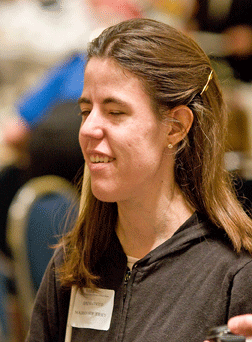 Entering the college environment requires a whole set of skills, some of which will be new to your child. Building these skills early will enable your child to make the transition smoothly.
Academic Skills: This category includes study skills, note-taking ability, technology skills, and work ethic. These are skills the successful high school student is already developing. Make sure your son or daughter is independent in these areas.
A Word about Note-taking: Sometimes blind college students are assigned a fellow student to serve as a note-taker in class. I don't think there's any blindness-related reason why our kids can't take their own notes! If there are other extenuating circumstances such as an additional disability, the situation might be different. But if sighted kids are learning to take notes, blind kids should be learning that skill as well.
A note-taker may be appropriate for blind students in certain limited circumstances. In a class that involves lots of diagrams and inaccessible PowerPoint presentations, for example, a note-taker can copy the diagram and turn it into a tactile format.
Research Skills: There are two important aspects of research skills for blind students. The first is the ability to use technology independently to do online searches and explore websites. Make sure your child has the tech skills to do all of the assignments and tasks that classmates are able to do. The second is the ability to use a live reader. The blind person directs the human reader regarding what to read and when and where to start and stop reading.
The ability to use human readers is a very important skill for our kids to develop. Although blind students enjoy accessible materials much of the time, that isn't always the case. Sometimes items aren't available in accessible formats. Sometimes they are available, but they don't arrive in time. Some research materials, such as back issues of journals or original letters and documents, may not yet have been digitized. Even if materials are accessible, technology can crash. It's necessary to have backup methods to get the job done. Giving practice in using readers now ensures that your child will not have to try to learn it in an emergency situation in college.
Time Management: Time management skills really could be called self-discipline skills. At college, students are responsible for their own learning. There are usually a lot of reading assignments, problem sets, and papers to complete. Students plan their own program for each semester and schedule how they will spend their time. Then they actually have to follow the schedule!
In their planning, students have to think about which courses they are required to take and which courses they'd like to take. Then they have to decide how early in the morning they want to get up. Often that's what determines which courses they decide to take! Not many people want to get up and out for an eight-o'clock class.
After they make all these decisions, students have to register for classes. Registration involves going online the 'second the registration process opens and racing against time—and other students—for a place in the class. It might require the student to talk a professor into letting him or her into a particular class. That requires being able to self-advocate and speak up appropriately.
A college schedule usually does not involve having classes all day long. It looks as though there is a lot of free time during the day. But during that so-called free time, students are expected to get all their reading, studying, and other assignments done. It's imperative that our kids learn to manage their time.
In addition to studying and completing homework, students have to get to classes on time. They have to get to meals and appointments with professors. They have to build in time for taking showers and doing laundry. To manage all of this, our kids have to know how long things actually take.
For many kids in high school, someone gets them up, someone prepares their breakfast, and somebody gets them out the door to catch the bus. Kids really may not know how long it takes to do these things on their own.
This is an area where you can prepare your child while they're still at home. They can set their own alarm for getting up. They can learn how long getting dressed and eating breakfast actually take. You might let them decide when to take a shower or do their laundry, and see how that goes.
Also give time-management practice in academic areas. When your child has a long-term assignment such as a research paper, there may be interim dates for different phases of the project. Teach them how to keep track of the dates when various sections are due and how to create a schedule and plan which parts of the project they're going to do when. In college, the professor will probably announce the final date when the paper is due, and that's the last time the project will be mentioned. Students will be on their own to get the work done.
Maybe your kid is a natural, one of those lucky mortals who were born with a day planner in their heads. All too often, though, kids find out the hard way that they need better skills in this area. The more they practice at home, the better prepared they'll be when they head off to college.
Create an independence plan at home: We want our kids to master age-appropriate tasks. Think about the things you were able to do when you were the age your child is now. Did you have chores? Does your child know how to do those tasks?
Suppose your child's chore is taking out the garbage. You're always reminding them, "Have you checked the garbage?" or, "Hey, the garbage is full. You better take it out." When they leave home you won't be there to remind them about the things that need to be done. The goal is for them to remember without needing a reminder. Maybe they could set an alarm in their phone that would remind them to check that garbage each night. This would then be a method they could also apply to other tasks.
The few rules and enormous freedom of college is a huge change for most students. Any experience we give them with planning, self-management, and self-discipline will help them make this adjustment successfully.
How to Win Friends and Influence People
In the first weeks at college your child is going to meet a lot of people—in orientation groups, in the dorm lounge, in class, in the dining hall. Good social interaction skills can lead to positive outcomes when meeting a roommate, going to a party, conversing in the dining hall, or interacting with professors. Here are some tips for successful social interaction.
Positions and Postures: Having relaxed positions and postures can be very helpful to social interaction. Teach some informal ways to sit and stand so your child looks relaxed and approachable. If your child has any mannerisms that aren't socially appropriate, now is the time to work on getting rid of them. It's also important for our children to develop the habit of facing the person who is speaking and speaking with appropriate volume.
Social Understanding: Social understanding is the ability to understand and interpret what is said and to respond appropriately for the situation. It includes an appreciation of other people's feelings and state of mind—what are they feeling? What are they thinking? Why are they saying what they say? What do they really mean?
People with good social understanding get the social scene. They can tell what a person meant beyond the words that were spoken, and they can react appropriately. For example, someone might say, "Beautiful day, isn't it?" when rain is pouring down. That comment requires a different response from the one a person might give if the words were straightforward. Notice whether your child gets those distinctions. The more your child understands these things, the easier it will be for them to make friends.
Conversation Skills: My advice to kids is to try to be interesting when they speak and interested when they listen. If we focus on the other person, we have a better chance of responding with something that keeps the conversation going. Our kids also need to recognize when a conversation is coming to a close. We don't want them talking on and on when others are trying to get away. Again, the more they understand the social scene, the more they will become a true part of it.
Make sure your child recognizes when an overture to conversation has been made and knows how to respond in a way that keeps the conversation going. For example, give your child practice in thinking of something relevant to say beyond a one-syllable response. Observe with your child what happens when people are talking to each other. Point out when conversation openings occur.
Does your child know how to initiate a conversation and how to ask questions that will move the conversation forward? For example, if your child asks, "Did you see the game last night?" the other person might just answer yes or no, and the conversation sputters. On the other hand, if your child asks, "What did you think of the game last night?" there's a better chance that the conversation can get going.
It's also helpful for our children to learn to extend an indefinite invitation. Suppose they meet someone they really enjoy talking with. They might say, "Hey, we should get together after class sometime." If the other person is interested, they might say, "Sure—are you free Tuesday?" If the other person isn't really interested, they might just say, "Yeah, let's do that sometime." That way any embarrassment is avoided. This has nothing to do with blindness. I'm sure all of us have used this technique at one time or another.
Roommates: Often blind students are counseled not to have a roommate. It's argued that they have so much equipment they'll be better off in a single room. Unless all students get single rooms, I feel that our kids can benefit from the challenges and the fun of having a roommate.
A sighted roommate will almost certainly expect to have to take care of a roommate who is blind—lead them around, take them to lunch, do their laundry, pick them up after class. Our kids need to have a spiel practiced and ready that can open a conversation about blindness in a comfortable, matter-of-fact way and put the roommate at ease. For example, they might say, “Most people don't know any blind people and so don't know how we find our way places and get around. I use a cane—some people use a dog—and I have this really cool GPS app ..."
This skill will be invaluable later in life, when our kids go on job interviews and enter the workforce. People usually have no idea how blind people accomplish tasks and live their lives, but they tend to be uncomfortable about asking questions. If our kids are comfortable with their blindness and the tools and techniques they use, they can subtly educate others and show that it's okay to talk about blindness openly.
Our kids certainly need to let their roommate know that they will not need to be taken care of. For that to be true, though, they need to know how to do things independently. It all goes back to being able to do age-appropriate tasks.
Dorm Etiquette: Students who live in a dormitory live with others at very close quarters. They need to know how to respect other people's space and belongings. They need to know how to keep their stuff organized and out of the way. They need to know how to plug things in, change batteries, and clean up a spill if their drink gets knocked over.
Blind kids sometimes don't realize that they should turn the lights on in their dorm room, especially at night. Since sighted people generally expect a person to turn lights on, it could be very disconcerting for a roommate to come into a dark room and find someone there.
Our kids also need to know about shades on windows. They need to know that if the lights are on and the shades are up, people can see into the room, especially at night.
Another important thing our kids need to know when they live in a dorm is the location of the exit doors. We want them to be able to get out of the building in case of an emergency.
Managing Clothes: The way we present ourselves affects how others perceive us. You can help your child understand how physical appearance and manner can pave the way to acceptance and friendship at college.
At college students have to manage their own wardrobe—matching outfits, doing laundry, and choosing what to wear for various occasions. Whether they're deeply concerned or completely indifferent to fashion and style, it's important for our kids to be aware that what they wear says something about who they are, and they need to understand what kind of statement they make with their clothing choices. They can make their own decisions about who they are and how they want to present themselves, as long as they know that they're doing it. We want our kids to have the information, understand the scene, and make conscious choices.
Going Places
One of the greatest gifts parents can give their blind kids is training and practice in independent movement and travel. Gauge your child's skills. Are they age appropriate? Does your child have the same level of independence in movement and travel as sighted peers?
Sometimes we parents are the greatest impediments to our children's independent travel. We're afraid—afraid they're going to get lost, or hurt, or kidnapped! I work with parents of teenagers all the time, and this comes up a lot. In the abstract most parents of blind kids believe their children are independent or will be independent someday, but in the meantime the kids haven't yet learned to cross the street. We may be afraid, but we must not let our fear keep our children from becoming independent!
Give your child practice in getting places independently. If your child is in middle school or high school and still has an aide walking him or her from class to class, start to wean the aide away. We don't want college to be the first time your child has ever walked alone!
Knowing how to get information for him or herself is another important travel skill. Get your child in the habit of figuring things out. Knowing how to ask good questions about directions to get the information you need and taking mobility notes are other good skills to have.
We have to get good training for our kids, give them lots of opportunities to practice, and then let them go. They can't build competence and confidence unless we let them get out there and do things. And, for the parents who need to hear this, work toward defeating your fear!
Laws of the Land
As I mentioned earlier, the laws pertaining to students with disabilities change completely after high school. In college, IDEA is out and the ADA (Americans with Disabilities Act) and Section 504 of the Rehabilitation Act are in. These are antidiscrimination laws, and they prohibit discrimination on the basis of disability. In terms of college, the laws give the person with a disability the right to access to classes, programs, and activities.
The laws offer access to "otherwise qualified individuals," meaning if you meet all the other criteria for the program, you cannot be kept out only on the basis of your disability. The ADA says that students with disabilities must be judged for college admission on the same basis as other students and may not be denied entrance just on the basis of their disability. Colleges do not have to accept every student with a disability who applies. However, they cannot deny admission of an "otherwise qualified" student solely on the basis of disability.
Colleges expect all of the students they accept—including students with disabilities—to be able to handle course requirements. The college does not have to alter content or change academic expectations in ways that would affect the nature of the course.
Reasonable Accommodations: The ADA requires the college to provide "reasonable accommodation" if needed to make classes, programs, and activities accessible.
Reasonable accommodations are intended to level the playing field so that students have equal opportunity to learn the material and to show that they have mastered the knowledge. Some typical accommodations for blind students include early course enrollment, early access to the list of books and readings, materials in alternative formats, reader service, and individual testing.
Reasonable accommodation means that the college has to provide access, but it does not necessarily have to provide access in the exact way the student desires. For instance, the student does not have a right to a particular piece of technology they might want.
Rights and Responsibilities: Students have the right to access to the full learning, extracurricular, and recreational environment. They have the right to have accommodations provided in a timely fashion. They have the right not to be discriminated against because of their disability, including the right not to be restricted by the negative ideas or stereotypes others might have about people with their particular disability. This is very important for blind people!
Students have the right to decline services they don't want. They have the right to appeal decisions made by the disabled students’ services on campus.
Students also have a set of responsibilities. To receive accommodations in college, students with disabilities must contact the person or office involved with disability services and let them know that they have a disability and would like to receive accommodations. They also have to let the college know in a timely manner so that the college has time to put accommodations in place. Some people don't want to disclose that they have a disability. They don't have to, but if they want accommodations, disclosure is required.
Choosing a College
Don't choose a college on the basis of its disability services! That's probably contrary to other advice you have heard. You may even have heard that disability services is the most important factor to consider when choosing a college and that student success depends on it. Please remember that blind people went to college for many decades before disability services existed. They managed to study and learn along with everyone else.
I think our kids need to be empowered to decide what they want in a college on the same basis as everyone else. Do they want a small college, a medium-sized college, or a big university? Do they want to be in the city, in the suburbs, or out in the country? Does the college have the program they want to study? Is it a good match for their talents and interests? Would they be happy spending four years there? You can easily find dozens of lists of questions like these online.
Visit the college if you possibly can. When we were visiting colleges, we found some campuses where people were clearly uncomfortable around my daughter. When she walked down the path and went through a door, people were falling all over themselves with nervousness and fear, and staring at us with horror. What blind person would be comfortable in that atmosphere?
On other campuses, people seemed to take blindness in stride. My daughter ended up choosing a school that truly valued diversity. They seemed to be so used to people with cultural differences that Serena's difference was easily accepted and welcome. Everyone involved—the people we saw on campus and our family—felt quite comfortable.
To recap, first find a college that you like, and then look into disability services. These services can be one of the characteristics you consider, but don't let them be the most important. Instead, empower your child by saying, "Your interests and aptitudes come first. We'll figure out the rest."
Parting Thoughts
I'm going to close with my favorite memory from when my daughter was in college. We went up to visit her and drop a few things off, and we had a very pleasant time together. Later we were outside on the quad on a lovely spring evening, and Serena said, "So Mom, are we done?" I said, "Yeah, I guess we are. Why?" She said, "I want to go and meet my friends."
She hugged me and my husband good-bye and off she went, her long hair waving in the breeze as she ran up the path. It was such a wonderful moment for me! It meant that our daughter was empowered; our daughter was free. I wish that for you and for every one of your children!
Editor's Note: Carol Castellano is working on a book about preparing blind kids to go off to college. She would welcome talking to readers about your experiences and concerns. You can reach her at [email protected].