American Action Fund for Blind Children and Adults
Future Reflections Winter 2022 THE COLLEGE PERSPECTIVE
Allyship and Advocacy
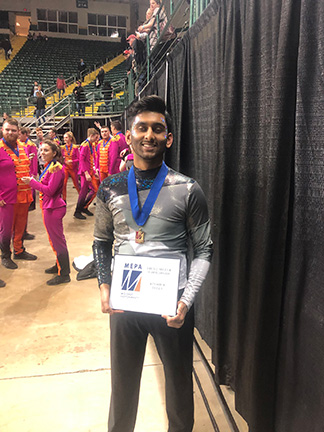 From the Editor: Kinshuk Tella is a junior at Miami University in Oxford, Ohio, where he is majoring in geology and environmental science. At the 2021 NFB National Convention he was awarded an Oracle Scholarship valued at $8,000, given to a blind student in a STEM field.
I'm sure many blind students can relate to my journey into a STEM field (science, technology, engineering, and mathematics). Like many blind high school seniors, I researched colleges, visited campuses, and talked to professors and disability service officers. By the last semester of my high school experience, I had narrowed my search down to two schools: The Ohio State University and Miami University.
To make my final decision, I visited Miami University and met with the head of the environmental science department. I'll call him Dr. S. My parents and I sat in Dr. S.'s office, talking about my interest in the natural sciences and earth science. I explained that I wanted to do research and explore various possibilities for my career path.
Dr. S. recognized my interest, and he was enthusiastic about having me enroll. He told me about a wonderful program he organized, taking undergraduate and graduate students to Zimbabwe. The students worked on hydrogeological projects to help local communities. I was sold! I couldn't wait to go to Zimbabwe with this guy!
Eventually, however, I had to bring up the issue of disability accommodations. At that time I was in a very different place in my life regarding my blindness from where I am now. I did not even own a cane, let alone use one! In a first encounter it was not obvious that I'm blind. Dr. S. was not aware of my blindness until I raised the topic myself. I had to discuss the access barriers I might encounter as a blind student in my major and explain how accommodations would make it possible for me to complete my coursework.
As soon as I mentioned blindness accommodations, the conversation shifted. Dr. S. explained that the school offered a less demanding degree in my field. I could earn a degree that involved less fieldwork, less research, and fewer presentations. There was no further talk about Zimbabwe.
As I listened to Dr. S., I didn't fully realize what was happening. Later, though, on the drive home, I started to ponder. Dr. S. was enthusiastic about the Zimbabwe trip when he wanted to encourage me to enroll at the university. Why did he suddenly change gears and start talking to me about easier options? I realized the change happened because I had revealed my disability.
Despite these concerns, I decided to enroll at Miami University. On my first day on campus I realized I had to take control of my education. I deserved a proper education like everybody else in my class, and to receive that education I had to advocate for myself. I had to work on building relationships. I had to learn to talk to my professors, to engage with them on many levels. Through my efforts at self-advocacy, I even managed to change Dr. S.'s mind about my potential. He is now one of my advisors, and he has written numerous references for me. With his help and the support of the department, I have been able to travel and present my research on several occasions. Last summer, I worked in San Diego for a power company. I worked on issues around compliance with environmental regulations. I'm now on track to earn a masters and a doctoral degree.
Geoscience is a tough field, and it gets harder and harder every semester. For a blind student, studying in a STEM field 'is very challenging because STEM subjects are taught very visually. There are endless labs and group projects that involve creating charts and diagrams. I remind myself that every field has its challenges, and what matters is to follow your passion.
The field of geoscience is the least diverse of all the STEM fields—and STEM is incredibly non-diverse to begin with. I live with the intersection of two minorities—I am blind, and I am South Asian. Living and working as a dual minority really takes a toll on you!
One of the most important things I've learned from my experiences is that allyship is your best friend. It's not only important to have allies, but to have allies who are active on your behalf. Active allies are those who understand your experiences. Not only can they help you directly, but they can model how others should treat you. One person who really understands you can make all the difference! Your ally can be a professor, an advisor, or even a peer. That person can be a model for others, showing others how to serve you better.
I have learned that proactivity and frequency of contact are vital when I communicate with professors and disability services coordinators. I arrange my first meetings with them even before I register for class. We talk about how the class is run and how I can get access to all of the course material.
It isn't enough for me to communicate with the professor and disability coordinator once or twice at the beginning of the semester. Throughout the course, I make sure to have frequent communication. We talk about labs and assignments. We discuss how my studies are going and ways my access can be improved.
Working out accommodations can be incredibly difficult sometimes! Right now I'm taking a structural geology course where the labs are based on straight-up mapping. It's very difficult for me to navigate my assignments nonvisually! We take it lab by lab and find solutions to each problem as it arises. It may take an extra week or two for me to complete the work, but I make sure I get the lab done.
If you're a person who is considered diverse in a STEM field, you often have to work harder than others to get the same results. Furthermore, you have to carry a lot of responsibilities. You may discover that you want to be an advocate for other people on your campus and beyond.
I have learned a great deal by advocating through NFB and through organizations on campus. People in underrepresented groups often are asked to serve on committees to help make the school more equitable and accessible. When work on one committee is completed, another committee pops up. If you're not careful, you may find yourself spending more time on committees than you spend on your academic work. This is where self-care comes into play. You can only serve other people when you take good care of yourself.
I'm learning all the time how to advocate for myself and how to advocate for other people as well. I truly feel that the NFB is a great community of mentors and peers, dedicated to supporting everyone. By working together, we can take control of our lives.