American Action Fund for Blind Children and Adults
Future Reflections Special Issue: The Federation in Partnership LEARNING TOGETHER
What We Learned During the Pandemic: The NFB BELL® Academy and NFB BELL® Academy In-Home Edition
by Karen Anderson and Anil Lewis
From the Editor: Launched in Maryland in 2008, the NFB BELL Academy has become one of the flagship programs of the National Federation of the Blind. In this article Karen Anderson and Anil Lewis discuss how BELL has evolved since the beginning of the COVID-19 pandemic in 2020.
For more than ten years, the National Federation of the Blind has held BELL Academies across the country each summer. Historically BELL, which stands for Braille Enrichment for Literacy and Learning, has been a two-week, in-person summer program that gives blind children ages four through twelve the opportunity to build their Braille skills. Students are mentored by blind adults, and the program is designed to help kids realize that reading can and should be fun.
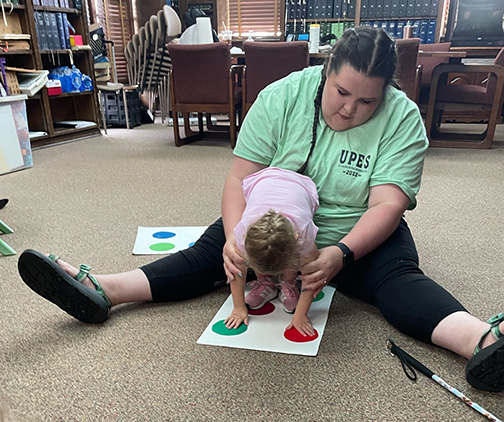 In 2020, as COVID-19 changed our world, we recognized that the NFB BELL Academy needed to change, too. Though it wasn't safe for students to gather in person, we knew that it still was important for blind children to be exposed to Braille and the alternative techniques of blindness in a fun way. For this reason we created the NFB BELL Academy In-Home Edition.
Still faced with an ongoing pandemic, in 2021 the National Federation of the Blind once again adapted our summer Braille literacy program to meet the circumstances. Three two-week NFB BELL Academy In-Home Edition virtual sessions were made available. We attempted to accommodate families' schedules throughout the summer months and to permit three levels of instruction: beginner, intermediate, and advanced. Each class was taught by an experienced teacher of blind students. In addition, families were connected with blind mentors who could work with them to answer any questions they might have. All of the activities were intended to grow students' love of reading and of Braille by having fun.
Each registered participant received a box of materials that contained everything they needed to complete the lessons through the two-week session. Each participant also received a white cane of the appropriate size. The materials list was extensive. Supplies included the following:
- Tactile graphics kit
- Braille calendar
- Bump dots for labeling
- Abacus
- Three kinds of paper: Braille, copy, and graph
- Crayons and pencils
- Ruler, rubber bands, and scissors
- Index cards and Post-it® notes
- Glue, tape, stapler
- Egg cartons
- Legos®
- Ping pong balls
It is important to note that due to the generous support of partners such as the Wells Fargo Foundation, the American Action Fund for Blind Children and Adults, the Lavelle Fund for the Blind, and Seedlings Braille Books for Children, as well as our dedicated nationwide network of members, the 2021 NFB BELL Academy was entirely free to participants and their families. These families came from a range of socioeconomic backgrounds; many did not have access to items often considered common household supplies. The NFB was committed to providing all of the materials necessary for children to complete the activities in its programming. The lack of financial resources was not allowed to be a barrier to participation.
The agenda for all three levels of the 2021 NFB BELL Academy included direct instruction from volunteer leaders across the country via video conference. Families received recorded videos to watch before and after the lessons. Social hours helped facilitate peer-to-peer interactions among blind students. These gatherings were unique opportunities for children with a low-incidence disability such as blindness. Spanish interpretation was provided during one of the sessions in order to encourage even more participation.
A portion of the agenda for the NFB BELL Academy In-Home Edition is as follows:
Day 1: Monday
Videos to watch before your meeting time:
"O&M Cane Introduction" video (older or younger)
"Slate and Perkins Lessons"
"Why Kids Wear Shades"
During social hour, we will be decorating canes and learning shades. If you are going to participate, please have your cane, learning shades, and all materials you would like to use to decorate them ready.
Day 2: Tuesday
Videos to watch before your meeting time:
"Magnetic Names"
"Seed Germination"
Materials to have for virtual lesson:
Seeds: Styrofoam plate, paper towel, seeds, cup, and water
Magnetic Names: Foam shapes, scissors, Braille label paper, and magnets
The videos from the program remain available at https://www.nfb.org/programs-services/nfb-bell-academy/lessons.
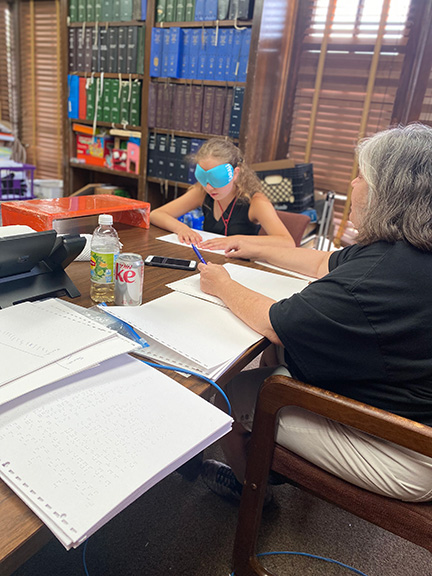 The NFB conducted a post-program survey of parents of participants to gather data on their experiences in the program, including successes and areas for improvement. The survey also asked about the participants' experiences with Braille in their general education. Sixty percent of respondents reported that they believed their child's Braille skills improved after attending the 2021 NFB BELL Academy, and 40 percent said they believed it remained about the same. Ninety-three percent of respondents reported that they were satisfied with the program, while the remaining 7 percent reported being neither satisfied nor dissatisfied. No response indicated dissatisfaction.
In response to the question "What do you believe your child/student learned at the NFB BELL Academy?", most cited the introduction to Braille. Responses included the following:
"She was exposed to Braille for the first time."
"He understood the importance of Braille and the proper way to read and write."
"We don't have access to Braille instruction outside of BELL Academy."
"We saw the importance of learning Braille. Also we saw that blind people are capable of being successful adults."
"She had no knowledge of Braille or cane walking before we started, and we are continuing to try and use what we learned at home."
Others reflected on the camaraderie with other students learning Braille:
"This was the first time Jason learned Braille with other students, which was amazing. He's one of only a handful of Braille learners in our county."
"He learned that there are other kids learning Braille (he's not the only one) and that blind people can be teachers."
"She learned how to interact with other peers who are also blind."
"She learned fun ways to learn Braille as well as so many other things like exploring money, scissors, tape. And she learned that there are other kids that need to read Braille like her."
In response to the question "What was your child's/student's favorite aspect of the NFB BELL Academy?", respondents most frequently cited the interaction with other students. This is notable due to the low-incidence nature of blindness—often students are the only blind child in their area. This isolation was exacerbated by the COVID-19 pandemic, making programs such as the NFB BELL Academy all the more important.
To the question, "What could we do to improve the program?", the most frequent response was that the program needed no improvement, followed by a desire to return to in-person activities—which was our preference as well. The next most frequent response reflected a desire to make the program longer, followed by a request for smaller group sizes. We will carefully consider how to address these recommendations from our participants and their parents as conditions allow.
This summer we are excited that several states are getting back to in-person BELL Academies. There is nothing like the opportunity for blind children to gather in the same space with peers and successful blind adults. Again they will spend time working on Braille, cane travel, and other skills of blindness while having fun and being exposed to a positive philosophy of blindness. In-person learning offers incidental learning opportunities that are not as frequent in the virtual environment. In a face-to-face program children may discover how to put a straw in a juice box independently, how to open a snack by themselves, or how to locate their own cubby to put away their art projects. We are very excited to welcome students back to in-person BELL Academies across the country.
However, we have been fundamentally changed by the COVID-19 pandemic. We have realized that the virtual model presents a unique opportunity to reach participants who would be unable to travel to a BELL site. We recognize the ultimate necessity to develop new ways to reach these families more effectively and efficiently. Based on lessons we learned over the past two summers, we will infuse our future in-person programming with virtual components that enhance the experience for on-site participants and extend the benefit to those not in attendance.
In addition to returning to some in-person NFB BELL Academies, we are offering one three-week NFB BELL Academy In-Home session to those students who can only access the virtual experience. We hope this program will give them more exposure to the lessons and positive philosophy of the National Federation of the Blind. Moreover, we will continue to offer social hour for all of our NFB BELL Academy In-Home participants. The social hour gives students the opportunity to get to know each other while they enjoy scavenger hunts throughout their homes, do yoga, listen to stories read in Braille by blind adults, and talk about some of the things they experience as blind kids growing up.
In the face of an ongoing pandemic, we have worked to counter the isolation felt by our students, their parents, and their teachers. We strive to connect them with a community of blind mentors and peers who can show them they can live the lives they want, that blindness does not hold them back. Through lessons learned we have grown stronger and more committed to the work ahead.
For more information about the 2022 NFB BELL Academy, or to apply for your child or student, visit nfb.org/bell. Thank you for helping us change what it means to be blind for your children and/or students.