American Action Fund for Blind Children and Adults
Future Reflections Special Issue: The Federation in Partnership LEARNING TOGETHER
Of Braille and Beanstack, Contests and Collaboration
by Sandy Halverson
 From the Editor: The promotion of Braille as a means to literacy has long been a tenet of the National Federation of the Blind. In this article Sandy Halverson, a longtime Federationist from Virginia, remembers how the Braille Readers Are Leaders (BRAL) contest evolved over more than three decades and highlights this year's competition.
In the mid-1980s the National Federation of the Blind recognized that a Braille reading contest could motivate blind children to do more Braille reading. The contest, known from the beginning as Braille Readers Are Leaders, also could encourage the increased production and distribution of Braille materials. Although I was never a contest participant, I have had multiple opportunities to be involved over the years. In the early days I hired a reader who read hundreds of print pages of Braille Readers Are Leaders entry forms and reading logs. Later my team and I determined winners by combing through computer-generated participant entries. This year, for the first time, we worked with the online platform called Beanstack, which served as the primary mechanism for gathering contest information. The contest is operated through the generosity of the American Action Fund for Blind Children and Adults. Since the Action Fund currently produces and distributes annual, free Braille calendars and promotes a monthly, free Braille books program for school-age children. Previously compiled a tactile art supplies kit to encourage blind children and adults to experiment with art. It seemed appropriate to include the Braille Readers Are Leaders contest as one of our programs.
Through most of the history of the contest, participants kept track of the number of Braille pages they read during the contest period. However, we learned that many summer reading programs for children find it more inclusive to judge reading contest entries by the number of minutes spent reading instead of page counts. We decided to change the Braille Readers Are Leaders (BRAL) contest so that participants could log the number of minutes they spent reading.
As we planned the 2021-2022 contest, we tested the three most popular reading contest platforms used by libraries and schools. We determined that Beanstack was the platform most accessible for screen reader use. The Beanstack staff was eager to answer our questions and to include features to meet our contest parameters. They have graciously worked with us to make improvements that we continue to identify.
With any transition from a relatively well-known process to a totally different system, things will not always happen as planned. How many participants would register? How many prizes would we need, and by whom would they be provided? How many participants would need assistance getting their information recorded in Beanstack? What kind of grand prize would be worth reading lots of minutes? Would we give each participant a "Braille Readers Are Leaders" T-shirt as we have done in past years?
With the support of the National Federation of the Blind, we formed a Braille Readers Are Leaders Committee to research possible prizes and define reward levels for minutes read. The committee suggested grand prize entries at certain milestones and approached producers of Braille products who might consider becoming donors. The American Printing House for the Blind (APH) quickly offered to donate two Chameleon 20-cell Braille notetakers; Seedlings Braille Books for Children and National Braille Press gave gift certificates. Horizons for the Blind provided a variety of tactile pictures of animals, birds, and flowers, all labeled in Braille, at a greatly reduced price. Additional art- and Braille-related prizes were donated by the American Action Fund.
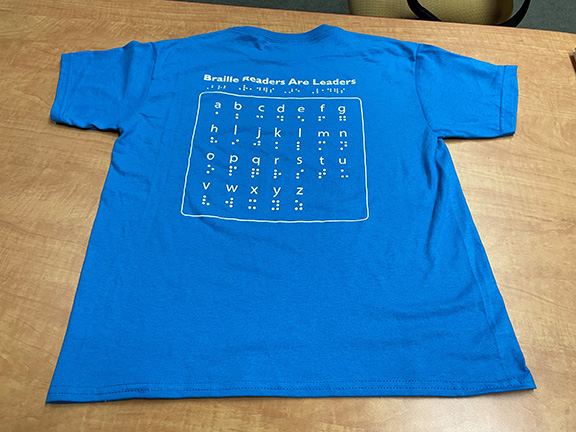 We used email and social media to recruit contest participants. After the first contest announcements we began to hear from parents of blind children and teachers of blind students. A parent reported, "I haven't received my daughter's T-shirt yet. I was wondering if it had shipped. I was hoping to film a morning announcement with her wearing the shirt so that she could teach the other students about the contest and reading Braille." A middle- and high-school Braille teacher at the Indiana School for the Blind registered fifteen students. "Thank you for keeping this amazing contest so successful," she wrote. "It is so important to highlight our Braille readers!!!"
By the end of the contest, 508 participants had registered and 280 had submitted reading logs. This was the largest number of participants we have ever had. Participants represented thirty-six states; in addition, one child from an APO military family and one Canadian Braille reader also took part. Contestants read Braille a whopping total of 471,770 minutes. That amounts to 7,862 hours, or 327 days of Braille reading!
On March 4, in recognition of Dr. Seuss' birthday, the first-, second-, and third-place winners in each grade category were announced at an American Action Fund Facebook Live event. In addition to the prize packets sent to all participants, winners received a check for $25, $15, or $10 for first place, second place, and third place respectively. Here are the winners for the 2021-2022 Braille Readers Are Leaders contest.
Adult
First Place: Carol Ann Weeks, South Carolina, 30,525 minutes
Second Place: Nicholas Wilcox, Iowa, 28,356 minutes
Third Place: Angela Randall, Ohio, 28,322 minutes
Kindergarten and First Grade
First Place: Mila Chow, California, 1,588 minutes
Second Place: Hope Gernster, Montana, 1,005 minutes
Third Place: Jane Gacioch, Missouri, 855 minutes
Second and Third Grades
First Place: Maeve Erb, Utah, 1,585 minutes
Second Place: Baylynn Lluveres, Minnesota, 1,524 minutes
Third Place: Madison McCombs, New York, 1,224 minutes
Fourth and Fifth Grades
First place: Gabriel Wahlberg, Florida, 5,000 minutes
Second Place: Narjis Karimipour, Louisiana, 2,713 minutes
Third Place: Salome Cummins, Missouri, 2,599 minutes
Sixth through Eighth Grades
First Place: Divanai Miguel, New Jersey, 9,402 minutes
Second Place: May Resendiz, Indiana, 8,433 minutes
Third Place: Amare Laggette, North Carolina, 3,755 minutes
Ninth through Twelfth Grades
First Place: Faith Switzer, New Mexico, 2,925 minutes
Second Place: Hayden Roswell, Colorado, 2,505 minutes
Third Place: Maria de Nooy, Michigan, 1,928 minutes
Luis Villanueva from Maryland read 155 minutes and earned our Breaking Reading Limits Award; which is presented to a participant who has overcome significant barriers to reading Braille.
Our Facebook Live event ended with the grand prize drawings for the two APH 20-cell Chameleon Braille displays. Our adult winner was Elizabeth Rouse from South Carolina, and Faith Switzer from New Mexico was our winning high-school student.
The National Organization of Parents of Blind Children (NOPBC) received a very generous donation specified for technology for blind students, and they asked that a winner from each of the remaining categories be drawn to receive either a Focus 40 Braille notetaker or the IRIE Buddy Braille embosser. These winners were Boon Dumrong, grades 6-8, Washington; Salome Cummins, grades 4-5, Missouri; Madison McCombs, grades 2-3, New York; and Kindergarten-first grader Jane Gacioch, Missouri. It was a privilege to contact each winner, assuring parents that I was not a telemarketer and explaining that their child really did win something of great value!
Several parents expressed their appreciation for the American Action Fund for Blind Children and Adults and the National Federation of the Blind. After the contest one parent wrote, "I just wanted to take this opportunity to thank you, the NFB, and the NOPBC, not just for the prize but also for all the support you have given us over the years and continue to give us and so many other families. We went to our first NFB Convention twelve years ago in Detroit. Since then, you all have been our role models, shown us time and time again that we are not alone, and given us the support and guidance that we've desperately needed to help advocate for our son. It is largely because of your influence that he holds himself to such high standards. He doesn't feel limited by his blindness, and it hasn't stopped him from pursuing his many goals and passions."
As a child I loved having hard-copy Braille books under my fingers. I read on my grandmother's front porch, on the bus, or in bed under the covers—until I heard my mom get up to put the book away. Darn the noise of those turning pages!
These days, refreshable Braille displays make it possible and convenient for us to have access to as much Braille as we can manage. Many of our school-age contest participants have choices that people of my generation never imagined. No matter how many school districts insist that recorded books or computers with screen readers are better than Braille as a primary means of reading and learning, our Beanstack minutes logged show a tremendous and exciting commitment to Braille literacy.
There will be another Braille Readers Are Leaders contest during the 2022-2023 school year. The American Action Fund for Blind Children and Adults is pleased to partner with the National Federation of the Blind to strengthen Braille literacy and to create opportunities to put Braille in the hands of blind children and adults.