American Action Fund for Blind Children and Adults
Future Reflections Special Issue: The Federation in Partnership PARTNERS IN ADVOCACY
Adventures at the Capitol: Blind Children, Blind Adults, and Families Making a Difference
by Carla Keirns
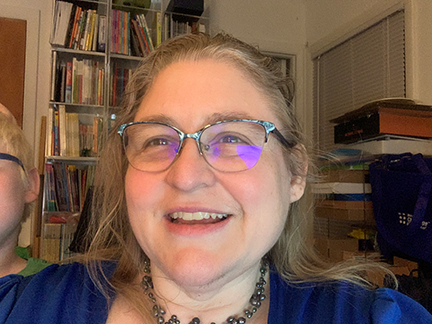 From the Editor: Carla Keirns is a member of the Kansas City Chapter of the NFB of Missouri, and she serves on the national board of the National Organization of Parents of Blind Children (NOPBC). She is the sighted mother of a blind child.
A year ago my first-grader and I set out on our way to the state capital. On the drive we talked about the hearing we were about to attend and the bill for which we would testify. I had written my testimony, but my seven-year-old couldn't read yet. Whatever he had to say to the legislators was going to be short, simple, and from memory or coaching.
We talked about the bill and what it would do for blind kids. I told him what he could say about how the bill would help him and kids like him. After a while, Russell said, "Mommy, I'll pay the bill."
Oh. Hmmm. We'd skipped a step.
This wasn't our first lobbying trip together, but it was the first time Russell was going to advocate for himself. Clearly he didn't have the big picture yet. Civics is taught much later in school, and he had never seen the Schoolhouse Rock videos with the songs I learned from. Once we got to the capitol, we looked them up on YouTube and listened to "How a Bill Becomes a Law."
It was pouring rain, and when we reached the hearing room we were soaked to the skin. The hearing was just about to start, and we found our friends near the front of the room. Gary Wunder, former president of the NFB of Missouri, was ready to testify, reading his statement from his Braille notetaker. He went first and gave a passionate speech about inclusion, opportunity, and fairness. He explained that we wanted a chance to participate in education and employment like everyone else. I followed, speaking as a mother about our experiences with Braille instruction and how we were hoping to see higher standards for our kids. Russell handed out Braille alphabet cards and showed the legislators his Braillenote Touch Plus.
This year when we went back to Jefferson City, the Education Committee staff remembered us. I don't think they get many eight-year-olds lining up to testify! Now my son can read, and he testified for himself. When I asked him what a bill was, he said, "A bill is a law idea." The little guy from Schoolhouse Rock would be pleased! Maybe he can even get his seal and be a law soon.
Our friends in the NFB have been teaching both of us to advocate. They've been sharing their experience in disability policy, governmental affairs, and personal persuasion since we met them. We made our first trip to a state capital when Russell was twenty months old. We got dressed early, took a ferry from Long Island to Connecticut, and drove to Albany, New York, for our first legislative seminar. Russell wore khaki pants, a blue polo shirt, and a tiny blue blazer. We brought snacks and milk, and we were excited but uncertain. It was our first family advocacy trip to the state legislature. We went to explain to our representatives about the laws we hoped they would pass and why.
Our partners on that trip were about twenty-five members of the NFB from across the state of New York. Many of them had been advocating for decades for themselves and others. Now they came with specific asks. The bills we supported had been developed either at the state or national level, and they were focused on issues that are critical to the blind community.
One issue we discussed was the accessibility of the state's General Educational Development test, known as the GED, or high school equivalency exam. In New York at that time the test was available in Braille, but it was not available in large print or audio formats. Test-takers could not choose one format for one section and a different format for another—for instance, they could not do the math sections in Braille and the language sections using audio, even though many blind people find different tools work best for particular tasks. My toddler was not yet ready for the GED, but already we had seen some of the accessibility issues around educational materials.
Other issues were on board as well. Funding was important, of course. We discussed the right of blind people to parent. We pointed out that blind people often are seen by social service or medical staff as incompetent, unable to care for their own children. In recent years many states have passed laws to protect parental rights. We had a great visit to Albany, and more than one legislator or staffer looked at my white-haired little boy and said a version of, "That's your best argument right there."
I had been to Congress and to state capitals before with doctors, scientists, and public health groups. I discovered that the blind were better at constituent lobbying than these groups of professionals. In the blind community we are able to share personal stories. We give specific examples of how public policy affects specific individuals. We have decades of experience, and we build on the work of disability civil-rights advocacy going back nearly a century. And we always come to the legislators with specific requests.
I've learned that raising general awareness is important, but when we meet with legislators we need to respect their time. We're most effective when we ask them to support a few specific pieces of legislation. When we go to the state capital, we focus on things that are managed, regulated, or funded at the state level. In Washington we focus on federal issues. All of this may seem obvious, but it was striking to me how clearly our community breaks down these strategies for new advocates of all ages.
I have been to Washington Seminar and our state capital several more times since that visit to Albany when my son was a toddler. We moved to Missouri just before his second birthday, and we got to know our new community and our new state. (Russell’s dad lived in Missouri as a child, so the state wasn’t completely new.) At five and six years old, Russell wanted to join us, but I was worried it would be too long a day for him.
Last year, when Russell was seven, the NFB of Missouri found a legislator who was willing to introduce the BRITE Act. BRITE stands for Blind Students’ Right to Independence, Training, and Education. On a cold spring morning, we drove from Kansas City to Jefferson City, hoping to testifying in support of the bill. I still thought Russell was a bit young, but he really wanted to come. We decided it would help the legislators to hear our story and to be reminded who and what the bill was really about.
According to the "Braille provision" in IDEA (the federal Individuals with Disabilities Education Act) and provisions in Missouri state law, Braille is the default literacy medium for blind and visually impaired children. Under these laws students have a right to Braille instruction unless it is shown to be inappropriate for them. The burden of proof is on the school district to show that the student doesn't need Braille now and won't need it in the future; the child and family are not required to show that Braille is needed. The BRITE Act builds on that legislation to address the provision of services by certified professionals. These professionals include teachers of the visually impaired (TVI or TSVI) or teachers of blind students (TBS), certified orientation & mobility specialists (COMS) or instructors with National Orientation and Mobility Certification (NOMC), and instructors certified in assistive technology for people with visual impairments (CATIS).
We don't know whether our bill will advance this year. Maybe we will be back next year, asking a new group of legislators to help us. We do know that the lifetimes of experience and perspective in the blind community are critical to making the world better for all of our kids.
This lifetime perspective on blindness, from lived experience and study by blind people themselves, offers a counterpoint to the advice families often receive from helping professionals in education and rehabilitation. We need both. How does the development of early skills in literacy, mobility, and access technology lead to school success, employment opportunities, and independence? Where are the roadblocks? How can we catch kids before they fall behind? What do we know about how different eye conditions evolve over time? How can we help our kids succeed so they can do what they want in life?
Our blind mentors know how the disability laws have evolved over time. We need their wisdom. And our kids need all of us. One of our friends recently voiced frustration that we are fighting some of the same battles they thought we had won forty years ago with laws about inclusion. I said, "Take the weekend off. On Monday, we storm the castle. Again. What else can we do. If you don't feel up to it, can you lend us the map?" Our kids need us. All of us.