American Action Fund for Blind Children and Adults
Future Reflections Special Issue: The Federation in Partnership PARTNERS IN ADVOCACY
Carrying the Message: Reflections on Washington Seminar
by Kevin Strehy
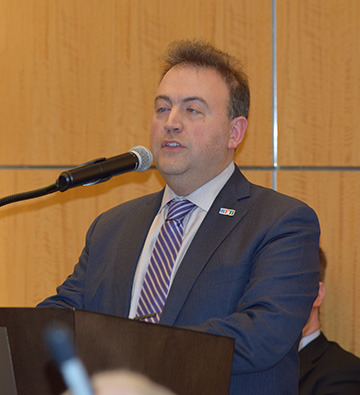 From the Editor: When we as Federationists visit legislators, we are careful to prepare our talking points and build the case for our legislative agenda. As one parent points out, however, our very presence as blind people, speaking for ourselves, may have the greatest impact.
The annual Washington Seminar is a time when Federationists from all over the country gather in our nation's capital to meet with legislators about issues that have an impact on people who are blind and/or have low vision. For me as the parent of a blind child, Washington Seminar offers an especially powerful opportunity to affect our children's future in lasting ways. Sometimes the issues at stake already have an impact on our children. At other times the proposed legislation breaks down barriers our children would otherwise face when they are older.
I have attended Washington Seminar both in person and in its virtual format. While the two formats were very different from each other, they both allowed legislators to hear directly from blind/low-vision adults and parents of blind/low-vision children.
It is a misconception to assume that Federationists only advocate during meetings with legislators. On the contrary, there is no understating the powerful effect of proud, capable, polished professionals confidently navigating congressional hallways, using long white canes and guide dogs. Our very presence makes a powerful statement, even before anyone begins to speak. To the sighted onlooker, a professionally dressed cane user in the nation's Capitol communicates the message, "I am here. I have rights. These freedoms are for me, too. I am here to speak on my own behalf."
As a fully sighted parent, I was proud to uphold my own important role at in-person Washington Seminar. Like the presence of cane users themselves, my impact did not require speech. Most congressional staffers do not have visible disabilities, and none that I have encountered thus far has been blind or had low vision. Inevitably, fully sighted staffers, if even by accident, would look at me while asking a question. It's impossible to discern whether this is due to unconscious bias or simply because most group members are physically unable to return eye contact. Either way, it allowed me the important job of immediately shifting my gaze to the blind leader of the group who was more educated, more experienced, and more capable of answering any question the legislators or staffers might ask. This subtle gesture communicates the message, "Sighted people are not the experts on matters of blindness. Ask the people who live this every day; they are the experts."
Thanks to the COVID-19 pandemic, we also got to experience Washington Seminar in a virtual format, via Zoom. This time, I had more to say, as did all parents, sighted and blind alike. We spoke passionately on behalf of our children who, by and large, were cast aside as school districts embraced virtual learning. Often districts failed to ensure that blind students had access to appropriate assistive technology such as refreshable Braille displays or Braille embossers, and often students lacked the training to use this technology. Districts threw incredible amounts of money at ed tech vendors, often without communicating accessibility needs during the procurement process. As a result, district-procured apps and website-based virtual learning programs largely were not compliant with Web Content Accessibility Guidelines (WCAG). Therefore, they were inaccessible to many students with disabilities, including blind/low-vision students. After months of being denied a voice at the district level, it was refreshing to share these experiences with legislators who truly seemed to listen.
A few things surprised me about Washington Seminar, in both in-person and virtual settings. One surprise was that it was impossible to predict via political party who would support our legislation. Sometimes the lawmaker I expected to support the legislation was the first to disregard it. At other times the one I thought wouldn't care at all was the first to truly listen and be supportive. Often lawmakers shared their personal experiences of having a friend or family member who was blind or had low vision. One legislator told us of watching an intelligent blind college roommate excel despite accessibility barriers with college textbooks. Another talked about a favorite aunt who was blind. Yet another spoke of a blind colleague who made great contributions to the field of rocket science. It seemed to me that the greatest predictor of support was not which political party a legislator or staffer belonged to, but whether they personally knew a blind/low-vision person in real life.
This realization drove home another point that was important for me to remember when attending Washington Seminar or similar legislative advocacy events at the state level. My child will be judged by the success or failure of every other blind/low-vision person out there. It didn't matter if a particular issue applied directly to my own family. If it mattered to one blind/low-vision person (and it's safe to say the issues at hand matter very much to many, many blind/low-vision people), it mattered to my family. If even one blind/low-vision child has poor reading skills, one blind adult is not gainfully employed or cannot access the basic features of household products, my child will be judged according to that person's experiences. Likewise, my child will be judged by successful blind scientists, blind lawyers, blind engineers, and by every proud, cane-using professional walking the halls of the Capitol. One blind person's success is the success of all blind/low-vision people now and in the future. Every voice is needed to advocate on behalf of the legislation that impacts blind/low-vision people.
To contribute to Washington Seminar, it is not necessary to be a professional lobbyist or even to have experience speaking with legislators. There will be a paper with talking points to help you understand the issues at hand, and there will be fully capable blind group leaders who will give you great advice on how to get your point across. If you can tell your story in a way that is authentic, polite, and professional, you will be persuasive. Often legislators and their staffers just need to hear your experience so that they can better represent all their constituents.
Please consider attending Washington Seminar, and please speak to your state affiliate about attending state-level legislative advocacy seminars as well. Your experience is valuable, and your voice is needed.