American Action Fund for Blind Children and Adults
Future Reflections Convention 2022 NOPBC CONFERENCE
Sharing Our CORE Values: Creating Opportunities, Raising Expectations
by Carlton Anne Cook Walker
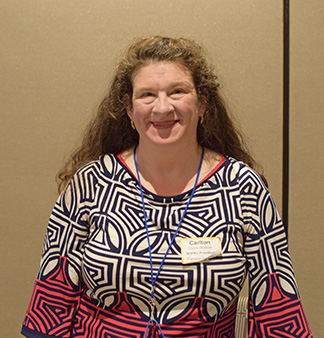 From the Editor: Since 2007 Carlton Anne Cook Walker has worked tirelessly to promote the Federation's positive message about blindness to parents and colleagues throughout the nation. Below is the presentation she delivered at the opening session of the NOPBC Conference at the 2022 Convention of the National Federation of the Blind in New Orleans.
Welcome to the opening General Session of the 2022 National Organization of Parents of Blind Children (NOPBC) Conference here at the National Federation of the Blind (NFB) Annual Convention.
This conference would not be possible without support from the NFB and volunteers from around the country (including our NOPBC board members) who are dedicated to providing our children with what they need to thrive: blindness skills, role models, high expectations, and a commitment to nurture and support our children throughout their lives.
The theme of our conference this year is "Sharing Our CORE Values—Creating Opportunities, Raising Expectations." We are excited to embark with you on a week of exploration, learning, and relationship-building.
I am Carlton Anne Cook Walker, president of the National Organization of Parents of Blind Children (NOPBC), a proud division of the National Federation of the Blind (NFB). That's a real mouthful, so please feel free to call me Carlton, president of the NOPBC, and a member of the NFB. Also, please note that I will refer to "blind children" in this address. This reference is not meant to divide us or to delve into the academic and functional implications of a child's degree of vision. When I use the word blind, I mean it as an inclusive term. I use the word blind to describe any individual whose vision (or ability to use vision) poses obstacles for them that individuals with typical vision do not face. In fact, my own child is legally blind, but she identifies as blind because blindness skills and tools help eliminate those obstacles for her.
I attended my first NOPBC Conference and NFB Convention in Dallas, Texas, in 2006. At that time I was an attorney in South Central Pennsylvania, trying to rebuild my law firm. My firm concentrated in the areas of estate planning and administration, real estate, and municipal law. Little did I know that my husband, our five-year-old child, Anna Catherine, and I were about to embark on an incredible journey.
We learned so much at that NOPBC conference in 2006! I met so many amazing people, including many who are here with us today. While my family went to Dallas focusing on the NOPBC and other parents of blind/low-vision children, we discovered so much more! We discovered blind adult NFB members, people who had never met us or our child before, who cared for and mentored us as if we were family. Over the years these relationships have grown and blossomed. These individuals have served as aunts and uncles to Anna Catherine, helping her and us find and unlock doors to new opportunities. They showed us, as parents, how to escape the mindset that blindness has an adverse impact on personal fulfillment.
As president of the NOPBC, I have the privilege of sharing with each of you our CORE values. Remember, I'm an attorney, so I must start by referencing our founding document. According to the NOPBC Constitution, "The purpose of this organization shall be to:
- to create a climate of opportunity for blind children in home, school, and society
- to provide information and support to parents of blind children
- to facilitate the sharing of experience and concerns among parents of blind children
- to develop and expand resources available to parents and their blind children
- to help parents of blind children gain understanding and perspective through partnership and contact with blind adults AND
- to function as an integral part of the National Federation of the Blind in its ongoing effort to eliminate discrimination and prejudice against the blind and to achieve for the blind security, equality, and opportunity.”
These are our CORE values. We have focused on these values since our founding in 1983, and that's what we continue to strive to do. Through COVID we hosted online workshops, open houses, and informal online chats. Throughout the year we host an active Facebook group with more than five thousand members. We have an email listserv, we support the quarterly magazine Future Reflections, and we maintain a treasure trove of information on our NOPBC.ORG website. Our seasoned members spend countless hours on the phone and in person with parents and families, sharing the opportunities that exist for our blind children. They strive to instill the confidence that it is both acceptable and proper to keep our expectations high—regardless of what society or educators or even family members might tell us about blindness and low vision. For my family, this support was invaluable.
The year after we went to Dallas, we attended an Early Childhood Conference called "Beginnings and Blueprints" at the NFB's headquarters in Baltimore, Maryland. When we went home we started making plans for Anna Catherine to get training in some blindness skills. AnnaCat could see some, but her opportunities were limited by her vision loss. At the "Beginnings and Blueprints" Conference we learned that, even with some usable vision, our child could benefit from learning blindness skills.
But we were met with resistance. School personnel dismissed our concerns. They told us, "Anna sees too well to learn Braille," and "Anna doesn't need a cane." Our families offered no greater support. You see, no one in my family or my husband's family had any experience with blindness or low vision. While most members wore glasses from young ages, their vision was fully corrected. The idea of blindness was not only foreign; it was scary. It was emotionally safer to ignore the impact of Anna Catherine's vision loss than it was to dig into an unknown world connected with a word they feared: blindness.
Without the support of the NFB and of NOPBC leaders, we never could have found the strength to advocate for our child's right to have access to all opportunities—to maximize our child, not our child's vision. Through meaningful and authentic relationships with blind peers and adults, Anna Catherine learned to advocate for these opportunities. Now, at age twenty-one, she still does! Over time school staff and family members learned that skills, not vision, dictated Anna Catherine's potential to succeed, and their expectations rose—not as high as ours, but higher than theirs had ever been before.
Today is jam-packed with panels and concurrent sessions. This conference will help you gain the knowledge and resources you want and will allow you to make the connections and relationships you need to support your blind child, your family, and yourself in the years to come.
But please note these words of caution: Sometimes, in my zeal to increase Anna Catherine's opportunities, I ended up curtailing them. This is an easy trap to fall into—replacing negative stereotypes with positive ones. Positive stereotypes are still stereotypes, and they obscure the individual within. I was determined to free Anna Catherine from stereotypes based on disability, gender, etc. I did not want anything to restrict my incredible child! I wanted Anna Catherine to engage in every opportunity that arose, and I wanted the entire world to be open to my child. While this, in and of itself, is not a bad thing, it went too far. Sometimes I focused more on breaking negative stereotypes than I did on my child's particular wants and needs.
The funny thing is that my parents did the exact same thing to me. They didn't want me to limit my goals to traditional "female" roles, and they nurtured my interests in math, science, and advocacy. Unfortunately, they also actively discouraged my interest in teaching—even as an additional major in college. When I got my law degree and my MBA, I had fulfilled their dreams. But for me, something was still missing. I found that something a decade later when, with my husband's full support, I finally pursued a teaching degree and began teaching blind and low-vision students. Please don't misunderstand—I love the law! I would not give up my legal and business-school education for anything. I am who I am because of the path I took, and now I have the perfect job for me: educational consultant and advocate.
Though I have no regrets, and I am fulfilled now, I spent a lot of years feeling like an outsider in my own life. I had pursued new opportunities and had successfully broken traditional societal stereotypes. But by rushing through those newly opened doors, I found others slammed shut. After all, how common is it for an attorney with a successful law practice to go into classroom teaching? Even now, many people are shocked that I became a lawyer first and then became a teacher.
And then I did the same thing to my Anna Catherine. I fought off negative blindness stereotypes by focusing on what I considered a positive path of high expectations, encouraging her to pursue a four-year degree immediately after high school. I was substituting a negative stereotype for a positive one. By focusing my efforts on changing societal prejudices about blindness, I failed to provide the supportive environment needed to nourish my child's personal aspirations based on her individual wants and needs.
Only recently have I stopped fighting obstacles and started listening to the young adult in my life. I'm so glad I did! The more I stepped back, the more we moved forward together.
I am still a staunch and steadfast advocate for my blind child and for all individuals with disabilities. I also recognize that people are far, far more interesting, creative, and valuable than any stereotype—even a positive one.
Please don't make the mistakes I made. I focused on the CORE—creating opportunities and raising expectations—but I assumed that the CORE had to be an apple core. All apples have cores, so shouldn't all cores be apple cores? And, after all, there are many varieties of apples: Fiji, Golden and Red Delicious, Rome, Granny Smith. All this variety provides enough space for individuality, doesn't it? If not, let's look at other fruit with cores, such as pears and quince. Shouldn't that be enough?
Instead of focusing on the core, we must focus on the reason for the core. In fruit, the core performs two main functions. It provides the structure that allows the fruit to grow and mature, and it provides seeds containing DNA, the blueprint for the future.
Our CORE values do the same. We raise expectations by sharing the accessible, nonvisual tools and techniques that enable blind individuals to build their futures, unhampered by the low expectations of our vision-centric world. Our philosophy provides the structure, the framework for individuals to pursue their own goals. Like DNA, our core values serve as building blocks that bring forth new life and set the stage for the transformation of the world as we know it. Our CORE values provide the foundation for growth and ensure that the ecosystem of blindness need not define individuals or limit their lives.
Focusing on the purpose, the reason that a core is important, I began to embrace this analogy in new ways. CORE values need not be limited, at least not in any way that interferes with the purpose of the CORE value. Now we can move beyond apples and pears to all fruit, including oranges, blackberries, and plums. While they do not have actual cores, they have inner architectures that provide foundations upon which the fruit may grow; they provide resources for the future.
Then I wondered: Can the analogy stretch to vegetables, too? I think so. Some vegetables, such as cabbages, grow above ground in layers. Others flourish when hidden from view, like potatoes and onions. No matter what path they take, they can thrive only when they have a structure in which to grow and the nourishment they need to move ahead.
Similarly, our CORE values can embrace all individuals, without regard to additional disabilities, race, gender, or other societal prejudices. We reject societal prejudices against blind individuals, and we can reject them for all individuals. Every living thing needs a core, and we wholeheartedly offer you our CORE values and ourselves.
We welcome you to the NOPBC Conference and to our NFB family.
The National Federation of the Blind is our garden. Here you will find the soil, the sun, and the water of life. Here we do not practice container gardening; we do not judge or define you. Here we welcome new shoots and unknown seeds. We cannot wait to share our garden with you so that each of us may support one another in our diverse and bountiful harvest. We look forward to sharing with you our CORE values—creating opportunities and raising expectations—throughout this week and throughout our lives. Welcome!