American Action Fund for Blind Children and Adults
Future Reflections Convention 2022 NOPBC CONFERENCE
Ambitious Interdependence
by Chancey Fleet
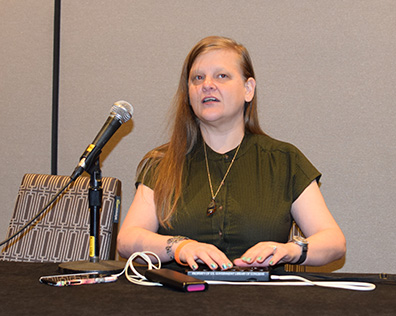 Introduction by Carlton Anne Cook Walker: I'm pleased to introduce you to an incredible young woman. I love hearing her! I love knowing that her brain is on this earth! She serves as assistive technology coordinator for the Andrew Heiskell Braille and Talking Book Library in New York, and she also serves as president of the NFB Assistive Technology Trainers Division. She freely shares her heart and her knowledge, and she has important information for us as parents and supporters of blind children. With her we will enter a world of opportunity.
Chancey Fleet: Good morning, everyone! My role at the New York Public Library Andrew Heiskell Talking Book Library (a very small branch with a very long name) is to curate the accessible technology that is available in the branch. I coach and run a team of volunteers who do one-on-one free coaching for any library patron who has a print-reading disability. I collaborate across the system to make things more accessible. I also created the Dimensions Lab, which is a free and open tactile graphics laboratory.
Today I want to talk about what binds my reasons for being here at the National Federation of the Blind Convention to the reasons why I'm at the library. I chose both paths for the same reason, and maybe it's a reason you'll find in yourselves as well.
I'm at the library because it's a place where I can cultivate and be part of a community of ambitious interdependence. We all know that independence is the watchword. Independence is important so we can express ourselves, so we can move through the world, so we can do what we want on our own schedules, direct our own futures—whatever that looks like for each individual. If you're here, you're probably on board with the fundamental fact that independence is key.
We all know that in reality we live in an ecosystem of interdependence. However you got to this floor today, you did not put in the elevators or the escalators that got you here. You did not provide the chairs. You didn't walk from your home town to get here. Interdependence is always happening. You're always contributing—one hopes—and always receiving the contributions of other people's labor, time, expertise, and perspective.
I'm here, in the Federation and in my library work, to support the ambitious interdependence of our community. To me that means that we give each other, intentionally, consciously, the space, the tools, the ideas, and the time to ensure that each of us can rise to our potential. For a lot of us, for maybe some of the teens and tweens here, and for newly blind adults and newly ambitious adults, when we fill up a lobby like this we are giving each other space. We are taking it back from everyday business. This is now a new space where anyone can practice cane travel and get lots of tips and information, knowing they're not alone. We can do a microcosm of that in a lot of ways in the National Federation of the Blind and in other communities of mutual support. I think that's a beautiful thing.
Discovering Community
For me, ambitious interdependence started early on in my family. My parents weren't expecting a blind kid, but they were really prepared for it. They advocated for me from early on. I have Leber congenital amaurosis, or LCA, and I can read print—at five words a minute. That was the plan my school system had for me! That was not my family's plan. Their plan was that I would have an early intervention specialist and start learning Braille at my kitchen table at age three. That's what we did.
My parents advocated for Braille. They sent me a couple of blocks along the little dirt road in our town (town is a strong word, it was mostly soybean fields) to the store. We dealt with whatever the people at the store had to say about the seven-year-old blind kid reaching for the milk.
I got a laptop in first grade. By the way, I'm turning forty, so a laptop in first grade was really a lot back then! I realized early on that having technology in the classroom meant that I could get my thoughts straight to my teacher without an intermediary. That was huge!
My parents split up when I was little, and they didn't always get along. But somehow they always got it together at IEP time. They got it together when it was time to discuss why I would get Braille and technology services every single day. They helped me find my first allies.
When I was nine my father used to drive me up to the library at VCU (Virginia Commonwealth University). They had an accessibility tech office in the back. There were no college kids, because it was a Saturday. Dad would say, "Have fun, sweetie! I'll be back in four hours." I would walk up to the college library desk and say, "Hello, may I please have the key to the accessibility lab?" For some reason they handed it to me. I would go in and get books. I could sit there and read Lois Lowry for four hours!
I don't know how my parents figured out that such a resource was there. They figured out that the staff was friendly and they would be my allies. They figured out it was a safe place where I could explore technology that we didn't have and couldn't afford.
That is one of my earliest memories of finding community and finding resources. We didn't have those resources in the family, and I certainly didn't have them within myself.
The Dignity of Risk
Shortly after I started college I went to my first Washington Seminar. I knew I was going to have a good time when I called Saville Allen, who was my mentor. I was used to people being very concerned about my travel, wondering if I would be okay and whether I would need a whole long list of things. Saville just said, "All right, you get off the Amtrak train and you go find the Green Line. Then you'll transfer, and we'll meet you at the station." The dignity of risk there was a form of care. Interdependence involves knowing what to give and what to empower the person to do on their own.
I was trusted at that Washington Seminar and from then on. I think the biggest reason I stayed in the movement is that folks trusted me to get stuff done. This morning for the keynote I came in five minutes before my scheduled time. Nobody was blowing up my phone to make sure I'd get here. It's understood in the Federation that you will in fact get where you need to be. I was trusted at Washington Seminar to learn the issues and speak to members of Congress. I was an eighteen-year-old kid. I assure you, no one else in my college life or my work life trusted me to speak with any authority on anything!
Giving each other space to see how much we can handle and what we're capable of doing is a form of care that we exercise toward each other. It can happen in your circles of support at home. You can look for the people who do that.
Back in 2010 I was working at a traditional vocational rehabilitation agency job, teaching technology. We had a lot of cookie-cutter contract situations. We couldn't serve people who were undocumented; we couldn't answer questions about social media. Basically, I wanted to do improv, and they wanted me to be on a script. That started to get uncomfortable.
Coaching Technology
At the same time, the National Federation of the Blind of New York heard a rumor that the Braille books at the New York Public Library, which had always been on shelves where anyone could grab them, were being packed up to go to a warehouse in New Jersey. Moving the Braille books would make room for administrative purposes. We did what the NFB does: we showed up to meetings, not always having been invited; we called reporters; we started a petition. The books came back on the trucks and back onto the shelves! At the end of that saga the chief librarian said, "Congratulations! And thank you for preserving the collection. However, if you guys don't start coming into the library and using the space, they will go back to the warehouse."
I started thinking about my frustrations at work, and I started thinking about this big, beautiful space at the library that apparently was underutilized. I started thinking about the joy I find in helping other people in this community solve their tech problems. I thought, This is the way I want to be in the tech education field.
We approached the library and said, "Can we start a tech coaching clinic on Saturdays as volunteers?" That was a new form of interdependence. The library gave us space, and we brought patrons to the library. That created the synergy that got me where I am now. I joined the library staff in 2014, and it has been my greatest adventure so far.
Shortly after I got hired, they hired two other former volunteers. We're gearing up this summer to hire our fourth staff member, which is amazing to me. It all happened because we had the nerve to ask for what we needed and to identify a need that the library had. We're able to accomplish something that's bigger than any one of us.
We do about one hundred and fifty hours of one-on-one coaching every month now. Due to the pandemic a lot of what we do is group work on Zoom, and anybody can come and check us out.
At first I was operating within my comfort zone, but not for long! In 2017 Kirk Adams, who was the CEO of the American Foundation for the Blind, reached out to me and said, "Hey, I'm moving to New York City. I would like to get a five-borough map that's tactile." I admitted to myself that I didn't know where Kirk could get such a thing. I started to reflect, and I grew angry thinking about it.
A Brand-new Adventure
Sighted people have the technology to print images, and so do we. Sighted people are born curious and unafraid to draw, able to find beauty and clarity in lines on a page, and so are we. What didn't we have? I realized that we didn't have the means of production.
Most tactile graphics embossers belong to educational institutions. Graphics are made for us. Most of the time we don't select what's going to be made. There's seldom a straightforward path between our curiosity and a particular image that we want to experience. More than that, many of us don't have an ecosystem of ambitious interdependence to figure out how we can acquire images and end the image poverty in our community.
I started our Dimensions Lab, which we believe is the world's only free and open tactile graphics lab. It's a place where anyone, blind or sighted, can come to make embossed swell-form graphics, 3D printed thermoforms, or accessible hand-drawn graphics. Blind people can download pre-existing images, draw by hand, scan things in, and collaborate with a sighted person who's using Illustrator. We can learn to code using 2D and 3D designs, using what's called SPG. We can do it with code, we can do it together, or we can do it by hand.
I had to reckon at this point with an uncomfortable truth. I had never had enough access to tactile graphics over the years to be as fluent as I wanted to be. My drawing skills were and are pretty shaky. Ambitious interdependence isn't about finding yourself on a pinnacle of achievement where people congratulate you. There is no such thing as a pinnacle if you're doing this correctly! I learned to draw in 2017 because of this project. I draw like a five-year-old because it's been five years. My drawing is joyful, it's legible, and sometimes it's shaky. It is not normative. I ask library patrons and Federationists to trust me to guide them through their early drawing and tactile literacy experiences, which means that I need to be vulnerable as well. I have to trust myself to use the tools I say I believe in and see how far I can go with them.
One of the most vulnerable moments, and one of the most freeing for me, was walking into a session at a mainstream, sighted-people conference for art and design educators. I took a drawing class with a partner who was a stranger. I walked in, the teacher looked at me and looked at my guide dog, and it was, "How's this gonna work out?" I pulled out my Sensational Blackboard and a couple of other tools, and I just did the thing without a lot of comment.
Ambitious interdependence means figuring out where the safe spaces are and showing up where you can do a thing, even if you're not polished. It means being honest with yourself about where your skills are not as big as your hopes. It means having the sense of self-worth to put some work into cultivating those skills, even if it's embarrassing, and asking for what you need.
Circles of Support
I arrived in New York right after college, and I lived with roommates for years and years. Then I met my husband. He's a wonderful cook, and just wonderful in general.
I was so busy excelling at technology that somehow I didn't cook for fifteen years. Oops! My parents look back and say, "Oh, we're so sorry we didn't teach you to cook." The fact is, you as parents cannot do it all. You will miss things, and your child may not figure out what they are until they're forty. The question is, can they—can anyone—find the circle of support they need when it's time to level up.
When the pandemic hit I received the gift of an empty kitchen. My husband is an essential worker, and I was a Zoom worker. I enjoy learning things while not being watched by my sighted husband. I could have struggled alone and figured out all the things I wanted to learn to cook. I had to make the choice to come out about my big skill gap to a bunch of blind people who I knew respected me. Nobody judged me. I got recipes, and I got commonsense tips. People walked me through things.
I'll give you one tip that's super obvious to me right now, but if I hadn't asked I would not know. When you think about using a spatula, you want one that's metal and rigid like a cane. You do not want one that's silicone, because from a sensory feedback perspective you may as well have a pool noodle. If I hadn't asked, I wouldn't know.
I'd been meaning to try lathe-turning woodworking, for six or seven years. A few weeks ago a blind friend said, "Hey, I'm going to Tennessee, I'm going in two weeks." I thought, power tools are scary! And then I thought, This guy has taught about a hundred blind people, and they're all still reading Braille, which means that their fingers are all still present.
I went to Tennessee, and it was not scary. It was therapeutic and beautiful and not what I had imagined. I put myself in what I knew were capable hands. I trusted that I would learn something and that I would be safe. That was huge!
Wherever you are on your journey, whether you're working on tying shoes or doing a first drawing or learning a sport or taking an internship—whatever it is, ambitious interdependence means we're always in an ecosystem of support. We should always be looking out to see where we can help, and also looking out and seeing who is a safe ally. Where is a great space to practice? Where can you trade skills—hey, I can help you with Braille if you can help me with cooking.
I love solving other people's puzzles with them. I don't want to hear them say, "I'm slow, I'm done, I'm bad." The beginner's mind is a beautiful thing. I'm no longer afraid to show people when I'm feeling stuck. Sometimes learning can be awkward. Sometimes I have to pipe up and say, "Hey, I'm not computing this, and I have to hear it and be supported in a different way." I am never actually stuck. I'm just working on it.
That's my ask to all of you. Look around you. See who your supports are. Look within yourself, see where your skill gaps are. See if they don't match up with what you hope for yourself. Bearing that in mind, get out and do the thing. Do it this week. We are here to work on ourselves together.