American Action Fund for Blind Children and Adults
Future Reflections Convention 2022 NOPBC CONFERENCE
Entering A World of Opportunity
by Joshua Olukanni, Lauren Altman, and Tameria Brooks
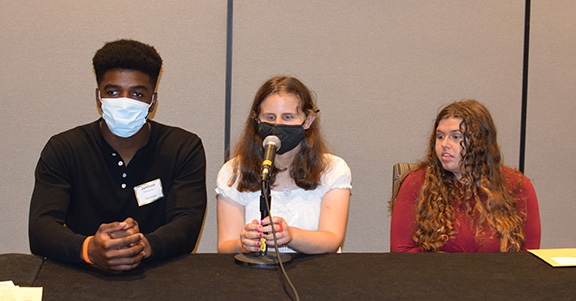 From the Editor: At the NOPBC Conference parents heard from three blind postsecondary students. Responding to questions from NOPBC President Carlton Anne Cook Walker, the panelists described the journeys that led them to seek training in blindness skills.
CARLTON ANNE COOK WALKER: Before we get started, I'd like each of you to briefly introduce yourselves.
JOSH OKULANNI: My name is Joshua Okulanni. I currently go to the University of Minnesota, and I love playing goalball.
LAUREN ALTMAN: Hi, my name is Lauren Altman. I'm from New Jersey, and I'm eighteen. I love art and reading and all things creative, and I'm going to be starting at Ramapo College in the fall.
TAMERIA BROOKS: My name is Tameria Brooks. I am nineteen, and I am going to be starting at Dalton State in the fall.
CARLTON: Could each of you tell us a bit about your childhood and your school experiences? We'll start with Lauren.
LAUREN: When I was a baby I had bilateral retinoblastoma. Growing up I had 20/160 vision in my left eye, and I was totally blind in my right eye. I did the stereotypical thing where I had a disability, but I didn't really disclose it to anyone. I read large print, and I did not use a cane. I used magnification devices, and for the most part everyone was good about accommodating me with large print. Then in my junior year in high school I lost my remaining vision very suddenly and unexpectedly. At school I mostly asked for things in digital format, and my teachers were pretty good about accommodating me with that.
TAMERIA: I didn't start losing my vision until I was in sixth grade. At that point I kind of shut myself off from everything because of my vision loss. I was very hesitant to use magnifiers or Braille because of how I thought people would look at me. I didn't start using a cane until I was a senior in high school.
JOSH: I currently have 20/200 vision in my left eye and 20/400 in my right eye. That's what I grew up with. I went through high school trying to pretend I could see, and it didn't go too well the majority of the time. I would try to go out for sports, and inevitably I would embarrass myself. People would be like, "How are you so bad when you're so tall?" I kind of brushed it off and said, "I guess I need glasses." I really didn't get any formal training when I was a kid, because my TVI and my classroom teachers thought I had too much vision for Braille or cane travel. I didn't start learning those skills until I went to the CCB [Colorado Center for the Blind] summer program and then the adult program at BLIND, Inc.
CARLTON: Each of these young people is a graduate or soon-to-be graduate of one of our NFB training centers. Each of them will talk about the center they went to and how it transformed the path they were on.
TAMERIA: I went to the Colorado Center for the Blind. Honestly, before I got there I was a little iffy on being blind. I didn't have a lot of confidence in myself, and my family didn't let me do much stuff. Once I got to the center I learned to cook and clean and all those basic things.
LAUREN: I'm a proud graduate of the Louisiana Center for the Blind. Independence was always super important to me growing up. Losing my vision when I was sixteen and not being able to have that same level of independence was really difficult for me. I knew right away I wanted my independence back. One of the biggest areas where I saw that was in mobility. At first I was afraid to walk beyond my driveway. At the center one of the graduation requirements is an out-of-town trip, so I traveled to Chicago by myself. That was a very empowering experience!
JOSH: I'm a graduate of BLIND, Inc., in Minnesota. I realized I really needed to go for training, because I couldn't cook or do anything in the kitchen by myself. Man, I couldn't even crack an egg! I thought, I really need to fix this! I got in touch with vocational rehabilitation. People in Georgia like Derrick Scott and Jackie Anderson talked to me about the training centers. I loved the fact that BLIND, Inc., was in Minneapolis and it had everything I wanted.
CARLTON: We have parents and teachers here. Please share how you got to a center and what you got out of it.
JOSH: This is a long story, but I'll shorten it. Before I knew anything about blindness or the NFB, my TVI started talking to me and my brother about an agency called VR that helps blind people do different things. VR put us in touch with Garrick Scott and Jackie Anderson. They were running the program called [NFB] BELL®, so my brother and I went out to help them. Garrick and Jackie said, "You need training." We said, "No, we don't need training! What is that anyway?" We were kind of iffy about college at that time, because our skills weren't up to par. Finally, though, I realized I did need to go to college and I needed training first. I decided on BLIND, Inc. We had to start the stereotypical battle with the VR counselor. She said, "You can go to Center for the Visually Impaired (CVI)." That's the training program in Georgia. Spoiler alert: It's not that good. I said, "I don't want to do that. I want to go to BLIND, Inc." She was adamant that I should go to CVI.
That's when my connections started to come into play. I reached out to people in the NFB to push the process along. No lie, it took a solid nine months to get me to this training program! The span it takes for a baby to be born! It took me that long! But finally I ended up at BLIND, Inc., and I've become a new person with the skills I've learned there.
LAUREN: Likewise, I definitely had to do some convincing of my state VR. I might have had a slightly easier time than Josh. When I was sixteen one of my mentors was a graduate of the Louisiana Tech program, which has a major connection with LCB (Louisiana Center for the Blind). She asked me if I had considered training. She said I might be able to learn a lot of skills in the year and a half before I graduated from high school, but I might need some extra time to work on them. LCB gave me the opportunity to focus on myself. It was the best investment I could have made in my future!
I love to read. Losing my vision and no longer being able to read was a very sad experience. I was learning Braille, but I kept seeing statistics that said if you didn't start learning when you were five years old you would never be fluent. But from Day One, my Braille instructor at LCB said, "You're going to build your reading speed, and you're going to read these full-length books. You're not just going to use Braille for elevator signs." Now I'm reading full-length novels, and that's really exciting!
TAMERIA: My Braille teacher in high school talked to me about what I was going to do after I graduated. We talked about college and how I'd need skills like cooking and travel. We talked about the training centers, and I got to pick among the three. I knew I wanted to go somewhere with sleepshade training. I decided to go to the Colorado Center for the Blind. Honestly, before that, I didn't even like to go outside by myself because what if I ran into something. I definitely think that when you go to a training center there is a transformation. It's awesome to see that in everybody! It's awesome to see it in yourself!
CARLTON: Thank you, all! Thank you for your willingness to share your experiences. You have enriched all of us. Thank you!