American Action Fund for Blind Children and Adults
Future Reflections Convention 2022 NOPBC BOARD MEETING
Getting Into That Rhythm
by Scott McCallum
2022 Distinguished Educator of Blind Children
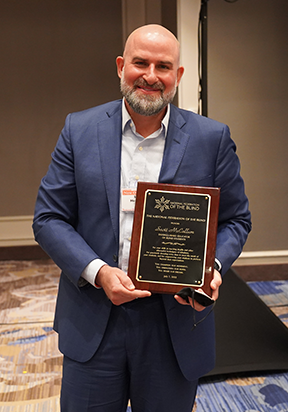 From the Editor: At the board meeting of the National Federation of the Blind during the 2022 NFB National Convention, Carla McQuillan presented the Distinguished Educator of Blind Children Award to Scott McCallum, Superintendent of the Washington State School for the Blind (WSSB). Mr. McCallum received a check for $1,000 and a plaque that read,
"For your skill in teaching Braille and other alternative techniques of blindness, for graciously dedicating extra time to meet the needs of your students, and for empowering them to exceed all expectations. You champion our movement, you strengthen our hopes, you share our dreams." At the annual meeting of the National Organization of Parents of Blind Children (NOPBC); Mr. McCallum gave the following address.
I'm so honored to be named this year's Distinguished Educator of Blind Students! I'm currently the superintendent of the Washington State School for the Blind, and lest I disappoint any of you, there is absolutely no connection between the title of my presentation and what I'm about to say. Carla reached out to me a couple of weeks ago and asked me, "What's the title of your speech?" Honestly, I had no idea! I really hadn't given it much thought. In addition to being superintendent of the Washington School for the Blind, I'm also working on a doctorate in educational leadership, and I'm nearing the dissertation phase of my program. So I've been kind of busy. I wanted to think about what I bring to the table, what I can offer all of you that might be helpful. With nearly twenty-five years in the field of education of blind children under my belt, what should I say?
Before I get to say anything helpful, I thought I should share my positionality with all of you. By that I mean I want to share where I'm coming from and what colors my perspective.
I want to start by acknowledging that I enter this space with a lot of unearned privilege. My parents met in college. My father was a little older than my mother and back from fighting in the Vietnam War. They both earned teaching degrees; my father never actually taught, but my mother did. My father started his own business.
I knew from an early age that I wanted to be a teacher like my mother. I earned a bachelor's degree in elementary education with a minor in special education. Intrigued by the opportunity to learn Braille, I enrolled in a graduate school program to learn to teach blind children. I'd only learned about the program months before. I honestly had no idea what I was getting into! For whatever reason it felt like an opportunity I couldn't pass up. The truth is, I had never actually met a blind person until I enrolled in that program.
I completed the program and moved to Colorado with a plan to spend a year there and establish residency so I could go back to school at the University of Northern Colorado and earn a master's degree in orientation and mobility. I fell in love with O&M with the intro to O&M class I had in my TVI program. But things didn't go quite as planned. A snowboarding accident resulted in a broken arm. It forced me to get a job and recalculate.
I moved to Eugene, Oregon, and became an itinerant teacher of blind children. We had a great crew of professionals there who were extremely committed to the students and families we served. We worked with children from birth to twenty-one in a variety of settings. My very first Braille student happened to enroll in a preschool at a local Montessori program owned and managed by Carla McQuillan. Some of you may know her through the National Federation of the Blind. Carla was the boss.
Though Carla wasn't directly involved with this student, she was a powerful role model for the parents and other family members, and for me as well. I have no doubt that this one fairly insignificant and somewhat peripheral detail in this young boy's life set a tone of possibility and hope that resulted in the high expectations through which he thrived and achieved.
The opportunity to continue teaching while taking summer and online classes to earn my master's degree in O&M came shortly into my teaching career. It wasn't long before I was working as an itinerant teacher and O&M specialist. The lens of O&M provided yet another perspective into the lives of my students, and I loved my job even more.
I continued teaching for many years, and I never expected to do anything different. Being a teacher and O&M specialist for such a range of students was complex and challenging work. I loved the continued learning that was required for the students and families I served.
My students, their families, and I enjoyed the benefits of a supportive administration and ample resources to pursue a variety of options and opportunities. We were able to address identified gaps in services and supports that our students and families experienced. The longer I taught the more opportunities I had to practice leadership at the regional and state levels.
One day my boss called me into her office to tell me two things. She said, "Scott, I plan to retire fairly soon, and I think you should consider earning your initial administrator license and following in my footsteps." I was pretty flattered, but honestly, I wasn't very excited about it. I loved being a teacher, and I'd never contemplated a move into administration. If any of you are involved in education, you know there's a bit of an us-versus-them mentality.
My wife was also a teacher at the time (she was a special-education teacher in a middle school). On the exact same day that I had that conversation with my boss, she was tapped by her boss for the exact same reason! And she was really excited about it!
I went home that day and told my wife what my boss had said, and she told me what her boss had said. We decided that it was probably in both of our best interests to go through the administrative program together and see what happened next.
In 2009 the Oregon legislature passed a bill that effectively closed the Oregon School for the Blind and created a fund to provide additional support services for blind children. In 2010 I was hired to lead the implementation of that bill. I led a team of teachers and O&M specialists serving blind students across a four-county region in northwest Oregon. By this time in my career I had a pretty good understanding of what it meant to be a strong service-providing entity, but I had no idea what I was getting into with the implementation of this bill language. It was a horrible situation! Our school had been around for well over a hundred years.
We made lemonade out of lemons. With the closing of the school for the blind, we expanded opportunities for blind and low-vision children in Oregon. We created a system through which the regional programs and school districts were provided access to additional funding. This funding helped provide and enhance supports and services available to blind children. I felt it was too much responsibility for me to figure all of this out, so I established an advisory committee. It included the NFB, the American Council of the Blind, and parents of blind children, as well as many other stakeholder representatives. All of your voices matter, and they should matter all the time. We increased the opportunities and options for blind and low-vision children in Oregon to include a statewide track meet, a state goalball tournament, and a Paralympic experience that was led by accomplished blind athletes. We offered regional summer programs that focused on those often neglected and marginalized components of the Expanded Core Curriculum, and we provided additional training and resources for teachers and other service providers.
One of our more significant efforts included being a part of our state's objective to create the nation's first online adapted state assessment that is accessible to Braille readers. Through that effort every student who was learning and/or reading Braille in Oregon was provided with a forty-cell refreshable Braille display, an updated JAWS screen reader, a tactile graphics embosser, and Braille translation software—and I mean every student! Our effort also led to an assessment system that was later adopted by the National Assessment Consortium and used in many states throughout the country.
To be honest, I'm not a big fan of standardized assessments. However, because of this effort connected to assessment, blind students in Oregon began to receive more technology-focused supports and services at an earlier age than ever before. All students, sighted or blind, were expected to take online assessments in language arts and math, beginning in the third grade. We made sure that every kid, including first-graders and kindergarteners, had access to that technology.
Another significant effort involved establishing a relationship with the Washington State School for the Blind as a placement option for Oregon students who could benefit from that intensive level of support. To this day WSSB programs welcome students from Oregon.
I loved this job! I got the nickname Santa Claus, because in many ways I was able to take the concern over cost completely off the table. When I started in that role I was provided $5.8 million from the legislature to meet all the needs of blind children in Oregon. This allowed the focus of IEP teams and school districts throughout Oregon to remain where it should be, on meeting the needs of the students and providing a free and appropriate public education.
I honestly had no plans for moving on. It's pretty nice when you're Santa Claus! But when the WSSB superintendent of thirty years announced his retirement, the recruiting firm that had been hired by the Washington Governor's Office included me in its outreach efforts. Emily Coleman is here, and Emily Coleman is superintendent of the Texas School for the Blind. She's partly responsible for getting me to the school. I was at the annual meeting of the American Printing House for the Blind, and Emily and the principal of the school came and tried to recruit me. One thing led to another, and I was ultimately selected from a national pool to be the eleventh superintendent of the Washington State School for the Blind since it was established in 1886.
In June 2016 I started in my role of superintendent at the Washington State School for the Blind. Once again I really didn't know what I was getting into! WSSB is both a state agency and a public school. Though our history is that of a residential school for the blind, we're so much more! We have a significant range of programs, services, and supports for blind children in Washington and beyond.
I didn't realize the full extent of this opportunity when I started in the role. When I first considered applying for the job and met with the former superintendent, he described the role as that of being a reality dreamer. He suggested that we, at WSSB, have the opportunity to identify and address barriers and challenges faced by the families we serve. While we have to deal with the bureaucracy of a government agency, we have access to extensive resources and supports. We've benefited from a very supportive governor and legislature.
In my new position I became part of a national group of, in most cases, like-minded individuals from across the country. On Tuesday, President Riccobono told this group, "We make a difference by working together." That couldn't be more true! That idea has served as a constant throughout my career. I often quote Helen Keller where she says, "Alone we can do so little; together we can do so much." That has become something of a mantra for us at the Washington State School for the Blind. I alone as a teacher have not accomplished much, but through our many collaborative efforts I have been able to positively impact change. We have so many partners in this work! I just finished my sixth year at WSSB. We have an amazing staff and a wonderful and vast array of partners to do this work with us.
Why do I tell you all this? I suppose so you will trust me, and in other ways so that you will give my next point some attention and thought. When I think back on those twenty-something years I spent as an itinerant teacher, O&M instructor, regional coordinator, and state grant administrator, and now as superintendent, some things remain consistent. The power of high expectations, positive relationships and community, and access to a variety of options, opportunities, and information are critical. I've worked with a lot of students and families over the years, and I've noticed that one of the most impactful and important elements of success are high expectations. Obviously I emphasize this because it's important to all of you to maintain those high expectations for your children. But just as important as having high expectations for your child is the fact that you should have high expectations for others, those in the education community—your child's teachers and mentors and the options and opportunities that they provide or should be providing. To this end it's also important for you and your child to meet regularly and engage with blind role models. The fact that you are here says a lot.
Most of the professionals in this space are extremely committed to your child's success. I encourage you to build strong working relationships with your child's education service providers. Have open and honest conversations with them about the hopes and dreams that you and your child have for their future. Seek out a community of support.
NFB is a perfect example of one of those options, and I commend you all for being here. You, my friends, are the super-stars! You and your child will undoubtedly benefit from this wonderful opportunity, and I hope you will consider staying engaged at the local and national level.
If I could go back in time, knowing what I know now, I'd recommend that every family engage with an organization like the NFB. If you have the opportunity, please share the benefits you and your child realized through this opportunity with other parents. Not everybody has been fortunate enough to get here.
Blindness in children is considered a low-incidence disability, impacting fewer than 1 percent of the overall population. An unfortunate aspect of that fact is that it leads to what I call low-incidence awareness of appropriate options, opportunities, access, and information. This leads me to my final suggestion. I encourage all of you to connect with your state or regional school for the blind, regardless of whether your child has any interest in enrollment. Like WSSB, many if not most of these schools provide a significant range of options, opportunities, access, and information. Many of our programs and services are specifically designed to target the needs of children who don't attend our schools. Largely due to that low-incidence nature, keeping track of what's available for you and your child can be daunting, downright overwhelming. It's likely that the school for the blind is an entity that doesn't just provide a range of options; it is also aware of the many opportunities that are provided by other schools. Schools for the blind can be another option for you when you're seeking a community.
I always love observing the students and family members and other partners when they connect at our annual track and field events on campus. It's an incredibly empowering event! Finding that community where you feel like you belong, where you are respected, and where you can form relationships with others is important for your child and for you. A school for the blind may turn out to be that space.
The impact of having high expectations is undeniable. One of the best ways of informing your expectations, as President Riccobono said on Tuesday, is to surround yourself with that community. Organizations like NFB provide a rich and robust opportunity to surround yourself with this community. There are other options to consider adding to your toolbox, and one of those may be your local or regional school for the blind. Get to know them and learn what they have to offer. If nothing else, they may fill that space that serves as a hub of information and access. It takes a village, and I'm honored to be a contributing member of our community. Together we can change this world for the better and give everyone a chance to live their best life.