American Action Fund for Blind Children and Adults
Future Reflections Convention 2022 GENERAL SESSIONS
Living the Life He Wants: Stoking Employment Opportunities through Movies, Sports, and Achievement
by Jack Chen
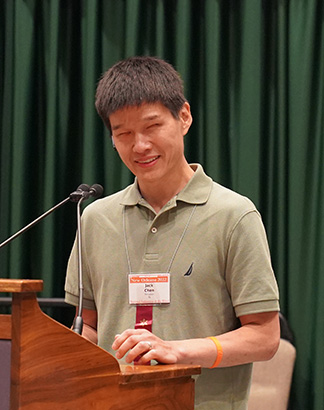 Introduction by Mark Riccobono: The presenter for this item is a blind person who is using his life experience to raise expectations for all blind people. He is a blind person who is pursuing his dreams in many ways. One way he has raised expectations in his own life is by riding a bike from coast to coast. He has committed to using his story to bring attention to the underemployment issue that exists for the blind community and the low expectations that are at the root of our underemployment) We got to know him virtually during the pandemic, so it's great to have him here in person at this convention.
I first got to meet him in person a couple of months ago at our national office. I got to meet his whole family. Here to talk to us about his experience and the work we've done together is Jack Chen.
When I was growing up people didn't look at me like they do today. I am Chinese American, and my extended family lives in Taiwan. My brother and I both are visually impaired. When we were growing up our relatives in Taiwan wrote us off. They didn't know what to do with us. They had no experience with people who are blind or have low vision. I want to tell you a bit of my story, but it is really with the help of other people that I've been able to do what I have done in my life. I want to thank my wife and my four kids, and also my God whom I serve.
New Orleans is a city of resilience. You may not know, but there was a fire here in 1788 that threatened to wipe New Orleans off the map. They started to build the city back up, and then, six years later, in 1794, another fire came and threatened to wipe New Orleans off the map again.
During the Civil War political unrest and daily torchings again threatened the city. Then came Hurricane Betsy in the 1960s, Katrina in 2005, and most recently, Ida—that one-two punch! They thought they could take New Orleans down, but they couldn't. New Orleans is a cultural icon in our country. Everyone knows New Orleans for great music and great food.
New Orleans is a city of resilience, and for me this has been a powerful homecoming. I was here thirty-one years ago. I came to New Orleans for a cornea transplant. I went to Louisiana State University Eye and Ear Hospital, and as I flew here from New Jersey, I remember seeing the blue sky above and the white clouds below. I thought to myself, How much more will I see on the way back? They told me I would be able to read a newspaper! I would be able to go shopping and see the price on a box of cereal!
This happened during my sophomore year in high school. I had been to New Orleans many times in the past before 1991 for other cornea transplants that didn't go well. This time, though, they said they had developed DNA technology that would help them find a tissue donor that my body would not reject.
When I came out of the surgery they had put a big thick gauze patch over my eye and taped it up tight. I sat in my bed for a couple of days before I went to the examination room. I remember sitting on a big hard plastic chair. I remember the doctors coming over and peeling off one layer of bandages. My mom and the doctors were in the room. Nobody moved. I was puzzled; I wondered, What's going on? Impatient as I was, I touched my face, and when I felt the skin of my eyelid, I knew something was very wrong. I couldn't see anything. I had become totally blind.
Despite the sweltering weather outside I felt like someone took a bucket of ice and poured it to the deepest reaches of my soul. I was without hope. I was completely fearful about what the future was going to be. I imagined myself walking down a long hallway, and a door on the left was slamming, and a door on the right was closing, and there were closing doors behind me and above me and below me. What could I do but put one foot in front of the other? The alternative was terrifying—to sit down and do nothing.
So I put one foot in front of the other.
Before I went to New Orleans I was studying for my SATs. To block out the fear, I went back to study for my SATs when I returned home. I put one foot in front of the other, not knowing what was to come. I was a mediocre Braille reader at the time, I have to admit, but I dug hard into my studies. Does anyone here remember the 3,500-word Barron's SAT book? I decided to memorize the whole thing. (That's not a testament to my ability, but to my pigheadedness!) The SATs were in three months, and I was going to give it all I had.
I was frightened to go back to school. I had always gotten around with my limited eyesight, and navigating the school with a cane was frightening to me. Most of my friends wouldn't hang out with me anymore. Seeing another young person go through something so difficult was hard for them, and they didn't know how to react. Their fear left me alone.
I was on the wrestling team as a sophomore, and I jumped back into wrestling. If my record were to predict my future success, it would be one win and a whole lot of losses.
In December of that year my SAT results came back. My parents opened the envelope for me, and I was shocked. I had scored just ten points lower than my brother, who was off at his freshman year at Harvard. I could not believe what was happening!
At the end of the wrestling season, past results were not a predictor of future success. I wound up with a winning record for wrestling at Districts. But the biggest test of all was coming. My friend Oliver and my friend Ryan and I walked into the guidance counsellor's office for that fateful call to the college admissions office to find out whether you got in. Only one person from my school each year had ever gotten into Harvard. When Oliver got on the phone he whooped and hollered and said he had gotten in. I was so happy for him, but I was fearful for myself. Then I got on the phone and managed to stammer out my name. I heard, "Mr. Chen, you have been accepted to Harvard!"
I felt as though my whole future had been squeezed into a really tight package. I had cut off the zip tie, and it was exploding. My future had seemed really dark, but now it started to have some light and some life. It was kind of like what I said about New Orleans, how it rose from the ashes again and again.
Harvard wasn't easy. I only had about 20 percent of the reading materials I needed. Going to class was hard. It was like putting together a thousand-piece jigsaw puzzle. I had some lectures and some readings, but that was the easy stuff. That was like the edge pieces and the corner pieces. But you had to extrapolate all the stuff in the middle. You had to guess. Sometimes you were right, and sometimes you were wrong. But I did get through, and I managed to graduate.
I graduated with a computer science degree, and I went to work for a startup building home automation technology, way before the internet was even a term. They asked me to manage the data center at the company, but the operating system for those sophisticated pieces of equipment wasn't accessible, and I couldn't read what was going on. I couldn't see the lights on the front of the machine to know whether I had to replace the hard drives.
At the same time they also asked me to help design the second generation of their product. In doing so I helped them build a patent portfolio. I emerged from the company a few years later with my name as a listed inventor on over forty patents.
I got a little tired of computers and jumped into law. I went to law school at night and graduated, and then I went to take the bar exam. The National Conference of Bar Examiners told me, "Mr. Chen, you're not going to be allowed to use a computer to take the test. We'll give you a cassette tape, and you can take the exam on tape." It was like taking a two-hundred-page exam on a one-line teleprompter! I did pass, in New York and New Jersey.
I've been blessed to work on so many things in my lifetime. I've had so many experiences! I have the most wonderful family ever. I've had the chance to work as product counsel for Google for over ten years. I worked as a member of the public policy team as a product manager for Chrome LS. For the past year and a half, I've had the opportunity to support the product team that builds the technology that supports 99 percent of Facebook's revenue. I've run marathons and Iron Mans, and I climbed Mount Kilimanjaro. Do I share all these things to tell you how great I am, or to inspire you, to show you that blind people can do anything? No, not really.
Let me tell you a story. Five weeks ago I had the opportunity to go to my twenty-fifth college reunion at Harvard. I was standing in Harvard Yard having lunch one day, and my friend Edwin Lin came up to me. He told me, "Jack, I have one big regret from college. I couldn't help you more." I said, "What do you mean?" He said, "Remember, you and I were roommates for one summer. You had to take Differential Equations, a math class. I volunteered to go with you to class and help you understand what was going on on the board. I went with you that first day, and the teacher was going so fast and was putting so many things in the equations up on the board that I couldn't help you. It was impossible."
He watched me struggle and suffer for the next three years, but he did see me graduate with honors. Edwin is now a senior executive at City Group, and he told me this story. "I had the opportunity to interview a blind person for my group." He said that when he was about to extend the offer letter, his coworkers told him, "You must be crazy! Do you think a blind person can be successful at an organization like ours?" And Edwin said, "Yes, he can. I know, because I've seen it done before."
That sentiment inspired me and my cofounder, Dan Berlin, to create a movie about blindness and success. Here's the trailer.
[The trailer introduced the film "Surpassing Sight," with vignettes of Jack Chen, Dan Berlin, and other successful blind people. It presents the idea of a bike ride across America.]
Race Across America was a 3,100-mile cycling race from San Diego to Annapolis, crossing thirteen states and three mountain ranges and including 175,000 feet of elevation gain. Put forty people into two 400-square-foot RVs, give them no sleep, make them work sixteen hours a day, bring eight cyclists from one country to another—nothing can go wrong. Right? Actually that trip was the toughest thing I've ever done in my life by far!
On the second day of the race, I got a calf cramp. Who gets a calf cramp on the second day of a nine-day race? What was I going to do? If I dropped out, our chances of finishing would be less than 30 percent.
Then I got an infection in my toe. The crew chief had to go online to YouTube to watch a video on how to do minor surgery to lance somebody's toe. I got yelled at by a number of people on my team for something I said. We had to stop the race and have a come-to-Jesus moment because it threatened to tear the whole team apart!
Like I said, you work sixteen hours a day and shove people into a tight confined space, and nothing will go wrong . . .
In the movie my cofounder, Dan Berlin, said, "It's in the deepest struggles that you will find the vitality of life." My friend Edwin personally watched me struggle, and he watched me find victory and rise from the ashes. The thing that really impacted me and Dan was the fact that some statistics say that 70 percent of college-educated blind people in America can't find a job. Dan and I wouldn't stand for that! Dan was the CEO of his own corporation, a very successful vanilla extract company that produced 75 percent of the vanilla extract in our country. I was an attorney working for Google, having been transferred over to Facebook later on. The two of us said, "We have to do something about this."
When you think about Edwin, when you think about what other people see in us, when they see us becoming victorious and surmounting challenges, we tell our own stories. We wanted to tell our own story, but we could only do it on a one-on-one basis. I know each of you does that as well. We wanted to solve this problem at scale. We said, "We're going to take on the toughest cycling race in the world, and we're going to do it as blind professionals. We want to tell a story of success, both on and off the bike." We wanted every person, every hiring manager, and every chief executive of every corporation in America to see our story and have that Edwin experience. We wanted every fully sighted person in the world to say, "Yes, he can, because I know. I've seen it done before."
To close, I ask each of you to come on this journey with us, to partner with us. First of all, we're incredibly honored that the National Federation of the Blind has partnered with us as an executive producer of this film, and that we'll have the worldwide premier at this convention. Each of you is invited. It will be shown at an independent theater at 333 Canal Street, on the big screen.
I want each of you in this room and each of you online to tell people about this film. When the full release comes out, I want everybody to see it. Please help us spread the word!
For the folks in the room who are blind or have low vision, sometimes it feels like the doors are going to be slammed in your face. I've had that experience myself. You have no idea where things are going to go. But when we face those challenges together and we emerge victorious, you know you lift me up. I'll continue to do the same, battling through challenges; I hope I'll lift you up as well. Together let's create more Edwin Lins in this world, people who can say, "Yes they can, because I've seen it done before." Together we're going to take the 70 percent unemployment rate and knock it down to 7 percent or lower!