American Action Fund for Blind Children and Adults
Future Reflections Convention 2022 GENERAL SESSIONS
Sharing Our Stories
by Peggy Chong
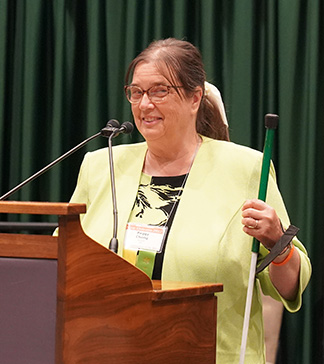 Introduction by Mark Riccobono: Peggy Chong is a longtime Federationist. Some of you have worked alongside her in the movement for decades, while others may simply know her for the work she has done as the Blind History Lady. In 2018 we awarded her efforts with one of our Dr. Jacob Bolotin Awards for her work to preserve the stories of people who have contributed to our shared movement.
Earlier in this convention I called each and every one of us to action around the museum of the blind people's movement. She has been helping us with the feasibility work and talking with us about how we collect stories. I am grateful to her for what she has done to champion and preserve the stories of blind people and how those blind people have come together to create a movement. Here to share the importance of our stories is the Blind History Lady, Peggy Chong!
To own our own story! To tell our own story! That is so powerful, and it is so rare.
If you go on the Internet, if you go to a library, if you go to a state archive and ask for the information on blindness, you get governmental reports, university studies, and home teacher reports. They tell just a small portion of the lives of blind people, and mostly they put it in a not favorable light.
The Jacobus tenBroek Library has a lot of information, but it's a lot of puzzle pieces. When you go to state archives and pull reports on the home for the blind or the asylum for the blind, you have a puzzle with corners and edges. Our history is a puzzle, and it has a lot of missing pieces. It's up to us to find those pieces. We are up to the task. We have old records in our files, in our basements, in our closets. We have the children of our blind ancestors who have gone on. They probably have books and letters, diaries and scrapbooks. We should gather them up and collect them. We might not really understand what is in those puzzle pieces that we're bringing to the Jacobus tenBroek Library, the basis for telling the story of our movement. But we will have other pieces to go with it.
Let me tell you some about my gathering of puzzle pieces. About forty years ago I got the opportunity to clean out the files at the home for the blind in Minnesota. It was a treasure trove of papers—news clippings, letters, meeting minutes, books. We were moving into much smaller spaces. Most of it had to go. I tell you, I regret today every piece of paper I threw away!
When I was going through those letters and artifacts, every once in a while I'd stop and read something. I read a letter that really made me say, "Whoa, what have we got here?" It talked about meeting with our blind congressman over the Robinsville. I didn't know what the Robinsville was, and I kept looking for that blind congressman, but he wasn't there. So I had a puzzle piece that needed a whole bunch of pieces to go around it. I took that puzzle piece and set it aside.
I found another puzzle piece from the 1920s, again regarding the Robinsville. They were reaching out to a blind man in Nebraska named F. Edgecombe, asking that he help, that he use his influence to help with the Robinsville. How did this blind guy, F. Edgecombe, have influence? Who was he? I set that puzzle piece aside.
I found out that the congressman was Thomas David Shaw, who went on to the US Senate and tried several times to introduce legislation that had to do with blindness. Frank Edgecombe was the blind man from Geneva, Nebraska. He set up a newspaper empire—and by the way, his great-grandchildren are still running it today. He left a long legacy.
The reason they asked Frank Edgecombe to help was because he was involved in the national Republican Party, and he had an opportunity to talk to Republicans across the country.
I'm digging around in the 1930s information, and I come across correspondence regarding the Pennsylvania affiliate, or what would become an affiliate soon. They had sent a blind man to Congress named Matthew Dunn. The blind people sent him to Congress because there were a lot of changes going on. The Social Security program was being developed, and it was going to impact blind people. They thought blind persons should have some say in how it was developed. The same was true with the federalization of rehabilitation. So I learned about Matthew Dunn. I set those puzzle pieces aside.
I took all my puzzle pieces, and I moved to Iowa. In Iowa I found a whole bunch of puzzle pieces. Those puzzle pieces were pretty well filled in from about 1860 to 1930. They highlighted how graduates of the Iowa College for the Blind could go to North Dakota, which was way out west at the time, and they could get teaching positions because no one wanted to go to North Dakota to teach. But as more people went to North Dakota, and it wasn't just prairie land anymore, and there were actually towns with houses and churches and schools, more sighted folks went who had qualifications to teach. Pretty soon the blind teachers' contracts were not renewed. They went off to other occupations. They owned their own businesses, built houses, became musicians. There was a graduate of the Iowa College for the Blind who went off to law school. She graduated in 1890 and became one of the first female attorneys in the country.
I picked up all my puzzle pieces, and I moved to New Mexico. I found a whole bunch of puzzle pieces surrounding Pauline Gomez and Albert Gonzales. Pauline Gomez graduated from college in the 1940s. She wanted to be a teacher. She was well qualified, but no one would hire her. Pauline decided if no one would hire her, she'd hire herself. Out of the back of her home, she opened the very first kindergarten in the state of New Mexico. Through her family connections she had the opportunity to educate young children from some of the most prominent families in Santa Fe.
When New Mexico wanted to have a kindergarten program for all of the five-year-olds in the state, they went to Pauline. Pauline pretty much wrote the curriculum for the first kindergarten classes that were ever taught in New Mexico. She had an impact on who would be hired, what the qualifications were for teachers, how the classrooms should be set up, and so on. Pauline built the framework for the kindergartens of New Mexico.
Albert Gonzales was blind from his youth. He served in the state legislature in the 1940s. He didn't really know any other blind guys, but he knew times were not good for blind guys in New Mexico. He tried to have legislation passed for a commission for the blind, even brought out Helen Keller, but it went nowhere.
Albert Gonzales was a lawyer, and he enjoyed being a lawyer. However, his children tell me that he didn't usually get paid in greenbacks. He got paid in chickens and chilies, fruits, vegetables, occasionally a piece of land, and lots of potatoes. When he did get paid he invested his money in land, buildings, and businesses that allowed his law practice to continue until his death.
Both Pauline Gomez and Albert Gonzales left correspondence, news articles, and a state newsletter. They left the state newsletter behind to tell us a lot more about themselves and the things they were doing. They also shared in those papers what some other blind folks were doing. Again, more puzzle pieces to find.
I picked up my puzzle pieces, and I moved to Colorado. In the basement of the CCB were all sorts of puzzle pieces. Unfortunately, a lot of them were handwritten, dating back to about 1915, so they were not very accessible. However, we're nearly finished with our preservation of historical documents, and we have had them digitized and transcribed into accessible files. Pretty soon any person who wants to go to internet libraries will be able to access the history of the movement of blind people in Colorado.
In those files there was a big push all across the state by five individuals who had put together a relief act for the blind. The act would provide for consistent funding for blind people who were on welfare, and it also set the foundation for the Commission for the Blind. The records told us more about two of those people, and I found that one of them was a state representative.
James Downing was in the legislature. He had been a very successful attorney working for the mining companies up in Aspen. He made a lot of money. He went blind around 1910, and all his money could not buy him any services, any training, any education on how to be a blind person. He decided he would go to the state legislature and create those laws. He didn't know what he was going to do, exactly, but then he met up with the United Workers for the Blind, which became an affiliate of the NFB in 1941, and he met Elias M. Ammons. I thought, that name sounds awfully familiar! There's Ammons Way and Ammons Drive, Ammons this and that all over Colorado! There's got to be a reason that man is famous.
When I checked him out, I found that Elias M. Ammons was governor of Colorado from 1913 to 1915. Was there a blind governor? More puzzle pieces!
In my research beyond our files I found that Elias M. Ammons served in the State House and in the State Senate. He didn't identify as a blind person. Back then if you were blind it meant that you didn't see anything. But he used a reader to conduct his business. When he was a senator he had a reader who was appointed by the senate. He had a secretary, and sometimes he used a human guide. He wasn't a very good traveler, but he found a lot of people who helped him get where he needed to go. Sometimes they gave him information about some of the legislation he was working on. He figured that striking out on his own and facing the possibility of getting lost could be an opportunity for him to find out more about the legislation he was supporting or not supporting.
Sorry, New York!—I believe Colorado had the first blind governor in the United States! His descendants tell me that by the time he was governor Elias Ammons did not recognize people who walked into the office until they spoke to him. He definitely did not have any reading vision for at least twenty years before he became governor. He had a huge funeral that was absolutely wonderful.
There are still more pieces of the puzzles missing. Our puzzle doesn't have corner pieces. It doesn't have edges. It's a multidimensional puzzle that keeps growing and growing and growing. We have heard this week about breaking the record for the fastest person driving blindfolded. Dan Parker has contributed a lot of audio and video and written documents and artifacts to the Jacobus tenBroek Library.
Who does not remember Erik Weihenmayer? He's a generation back. He was a blind man from Colorado who was supported by the NFB, and he became the first blind man to climb Mount Everest. We have audio and video and written documents, we have artifacts from that climb. They're going to be a great part of our museum.
We don't have that grandma who tells us every Thanksgiving about how she had to walk to school uphill both ways in a snowstorm for six months of the year. We don't have a family member to tell us that story over and over again. But now we have the opportunity to have this museum where we can tell our story our way, from our point of view. We need you to collect the pieces.
We've talked about Dr. Jacob Bolotin. He was one of three blind doctors at that time in Chicago, the other two being Robert Babcock and George Dobbins. Why were there three? Why are there no blind doctors in Chicago today? These stories need to be told, because as soon as our ancestors go away, as soon as we stop doing what we're doing, society forgets. People go back to the stereotypes and the fears.
Let's all collect our puzzle pieces and bring them to the Jacobus tenBroek Library. Let's contribute them to the history of the blind movement museum and tell our story our way. Even if you're not sure who a person is, we'll find another puzzle piece to go with it. Now is the time, and we have the place!