American Action Fund for Blind Children and Adults
Future Reflections Fall 2022 PLAY
The Power of Play
by Michelle Murrey and Sarah Erb
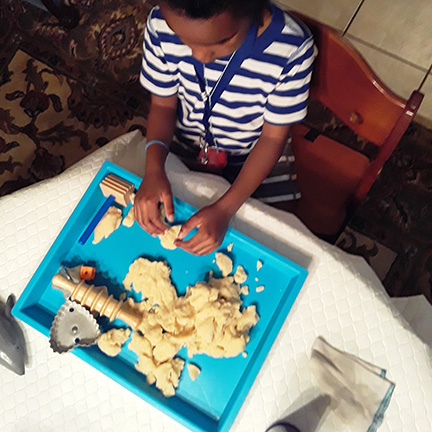 From the Editor: Play is the essence of childhood. Through play children develop creativity, discover principles such as cause and effect, and learn to interact with others. Parents of blind children sometimes worry that their children don't play in "normal" ways; they don't interact with toys the way most sighted children do. To complicate matters further, stores are packed with games and toys that depend on colored tiles or flashing screens. How can parents find toys that will appeal to their blind children and provide opportunities for learning and fun?
Sarah Erb and Michelle Murrey have spent years collecting information about toys that are fully accessible for blind children. In this article they tell their stories and share what they have learned.
MICHELLE MURREY: When my daughter was an infant, I remember being overwhelmed when I thought about toys. Walking through the toy section at Walmart or Target left me feeling discouraged. I couldn't imagine how my child would ever play with the toys that were so popular with sighted children I had known. Since my daughter has no light perception, I felt I had to start from the beginning and reframe what "play" meant in our home.
SARAH ERB: Before my child was born I was pretty confident about raising children. Then we learned that our five-month-old was blind, and I realized I had a lot of learning to do. We learned about various parenting and educational pedagogies, including R.I.E., Montessori, and Waldorf. We also had input from our child's early-intervention team. I've learned to select what works for us and our child and leave the rest.
Reframing Play
MICHELLE: A few philosophies guided me on my journey. I was drawn to the clarity provided by Kim John Payne's Simplicity Parenting approach, based on the idea that "less is more." The child-driven approach of Maria Montessori also appealed to me, allowing my daughter to learn independence, practical life skills, and self-determination in the midst of play. R.I.E. (Resources for Infant Educators, founded by Magda Gerber) reminded me to slow down and then slow down some more, to observe, and to give my daughter space and time to learn about the world in her own way.
Connecting with Others in the Blind Community
MICHELLE: Sarah and I met through Facebook in the middle of the night while we were assisting our toddlers with their sleep schedules. We talked about our journeys, each of us parenting a blind child and learning new ways to understand the world. We discovered empowerment and appreciation for the development of our children as we observed them play in fascinating and clever ways, often quite different from the play we observed in sighted toddlers.
SARAH: I often shared with Michelle what I had observed recently in my child's play, only to find that she was observing something very similar in her household. This validation was very reassuring for me as a first-time parent, especially as my child didn't seem to follow the traditional, linear developmental milestones given by the pediatrician at her well-child check-ups.
Each time I received the milestones handout at a check-up, I would look it over critically. I didn't feel critical of my child but of the norms that were referenced in the document. I realized that nearly all of the milestones had a visual component. This realization made it easier for me to follow my child's lead, to "learn as we go" and "learn as we grow." Michelle and I often explored the question "How does my child's brain grow best?" The answer was the same every time: My child learns best through play.
Instead of observing how others interacted with materials while perched in a high chair, our girls engaged with the world with their whole beings. They explored every object with all their available senses. They smelled the doll, stroked the doll's hair against their cheeks, and dropped the doll over and over to experience its weight and the sound it made when it hit the floor.
MICHELLE: Em used her lips to feel the textures of handheld items that she wanted to explore further. It was as if the tactile input she received from her hands was not enough. I remember thinking how clever it was that she used her lips as a second set of hands to gain more tactile input.
This discovery sparked some definite parental anxiety. I worked to ensure that my child understood at an early age what was safe to put in her mouth and what was not. Ironically, she didn't have much interest in bringing foods to her mouth, other than a bottle of milk or water. Enter food play time, where Em got to learn about the many different foods we use in our daily meals.
Parental Guideposts
MICHELLE and SARAH: Here are some parenting guidelines we have utilized in our households as powerful teaching tools for our families over our years of "parallel parenting" a blind child.
- Our children are whole beings.
Our children are unique, complete, and whole. They are capable of learning as they go and learning as they grow.
- We can observe without interfering.
We set aside a yes space for our children where they can learn to develop their attention span and discover independently. A yes space is a safe space where a child can explore without getting into anything 'dangerous, harmful, or inappropriate.’ It is a space that is totally safe and available for the child to use.
Like sportscasters we can narrate what our children are doing without interfering or interrupting their play physically or verbally.
- Our children learn by doing.
Active learning is key in our children's "play lab." Their brains need ways to create the neurological pathways that sighted folks call hand-eye coordination. We think of it as hand-brain coordination.
- Children who are not receiving information visually receive that information through input from the other senses.
Auditory, tactile, olfactory, gustatory, proprioceptive, interoceptive, and vestibular input provide a wealth of information. Our children's brains are still "seeing" their world, but not in the same way the brains of sighted folks do.
Toys for Our Kids
MICHELLE and SARAH: Over the past several years, we have devoted ourselves to exploring toy options and learning which toys our children most enjoy. Here are some pointers.
In general toys that do less are best for building attention span, as they encourage the child to do more.
Every new experience is an exciting experiment; every repeated or similar experience is a hypothesis waiting to be tested in our children's play lab.
Give yourself and your child permission to play with a toy differently from the ways a sighted child might play with it.
It often took patience on our parts when our girls were learning new skills. Sometimes we had to walk away to avoid the impulse to interfere. While they practiced new skills we presented playful challenges that could facilitate what they were learning. But in their own way, at their own pace, the girls figured it out.
Everyday objects are often preferable to fancy toys.
An empty cardboard box and a blanket can provide hours of imaginative play. We did not need fancy or expensive toys to bring a wealth of play into our homes. Instead of a pretend tea set or pretend kitchen utensils, we introduced pots, pans, child-safe knives, and kitchen appliances. Our children became familiar with the actual objects used in the kitchen instead of the small (often inaccurate) representations offered in most toy stores.
Moving Forward
Now that our girls have reached school age, we relish their imaginative spirits. They create limitless stories, amazing characters, and imaginary lands that they inhabit on any given day. Couch cushions become islands populated with stuffed animals.
It is a joy to observe how the girls navigate the world, advocating for themselves in shops and at school. They use the tools they have gained through play to engage with their communities.
Wherever you are on your parenting journey, we encourage you to slow down and observe your children. Give them the gift of space and time so they can find their place in the world in their own unique ways.
We would love to share the information on fun and accessible toys that we have gathered over the past years. Please view our spreadsheet on accessible toys at https://docs.google.com/spreadsheets/d/12xKYJvp-8yp3izRns-fHNi7XeI6JA_5Zx0BnuzG91ok/edit?usp=sharing
You can reach Michelle Murrey at [email protected].
Resources
Lansbury, J. "Yes Spaces—What They Really Are and Why They Matter." https://www.janetlansbury.com/2021/06/yes-spaces-what-they-really-are-and-why-they-matter
Payne, K. J. Simplicity Parenting: Using the Extraordinary Power of Less to Raise Calmer, Happier, and More Secure Kids. Ballantine Books, 2010.
STAR Institute. "Your 8 Senses." https://sensoryhealth.org/basic/your-8-senses