American Action Fund for Blind Children and Adults
Future Reflections Fall 2022 PLAY
Bells and Drums: Fun and Learning with Outdoor Percussion Play
Based on a Conversation with Susan Wiedder and Amber Haer
From the Editor: Headquartered in the UK, Percussion Play is a family-operated company that makes large percussion instruments for outdoor installations. Percussion Play instruments can be found in parks, on the grounds of hospitals and senior living centers, and at schools in sixty countries worldwide. According to cofounder Jody Ashfield, "Constraints of volume and space disappear outdoors, and players can experiment and explore the sounds of these large-scale percussion instruments freely." Percussion Play was named a winner of the 2021 Queen's Award for Enterprise, one of the most prestigious awards a UK-based company can receive.
Recently the Western Pennsylvania School for Blind Children (WPSBC) installed Percussion Play instruments on its campus in Pittsburgh. This article is based on a conversation with Development and Communications Director Sue Wiedder and Board Certified Music Therapist Amber Haer. They describe how outdoor percussion play provides fun and learning for their students.
SUE WIEDDER: We acquired our first Percussion Play instruments at our school during the pandemic, and they were installed and ready for the students to explore when everyone came back to campus. We have two Petal Drums, which are large percussion instruments shaped like flowers. The Petal Drums are circular, and they have metal petals. There are cutouts around the center of the drum, so you produce a different sound by tapping in different places.
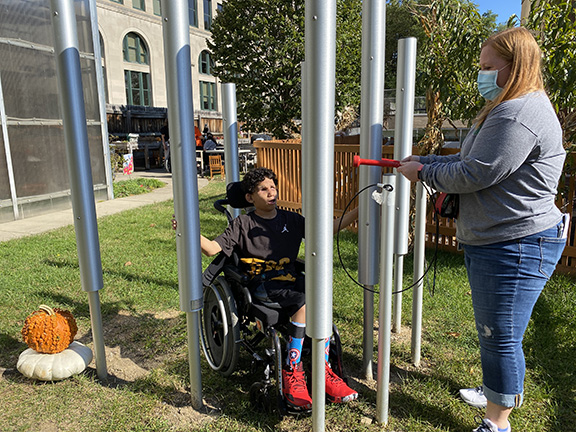
We also have a set of seven Tubular Bells. They are tall aluminum tubes rooted in the ground. Each one produces a different pitch when you strike it with a stick or mallet or even just with a hand. You can play simple songs on these chimes, or you can just enjoy the sounds you create. The Tubular Bells produce vibrations that differ depending on the pitch.
AMBER HAER: I'm a music therapist, and I'm also a percussionist in training. With my background, it's pretty easy for me to come up with ideas for using the equipment. The Percussion Play website also is very helpful with offering ideas.
In a typical lesson we might explore the concept of high and low pitches. We make sounds with the bells and encourage the students to make high and low sounds with their voices. We also can use the chimes to play simple songs such as "Twinkle Twinkle Little Star" and "Mary Had a Little Lamb." Sometimes we have one student per chime, and sometimes one student plays all of the chimes.
SUE: The chimes are rooted in the ground in a large horseshoe arrangement, which means that players can stand or sit inside the curve to feel the chimes resonate. About 75 percent of our students use wheelchairs, and they can easily get into the space where the chimes are set up. The instruments are fully accessible for all of our students.
AMBER: All of our students are legally blind, and nearly all of them have additional disabilities. Our students who are deaf or hard of hearing really enjoy the vibrations when they play the instruments. They can tell the difference between the high and low notes through touch. They can place their hands on the bottom of the chime and hit the top with the rubber mallet. Some students like to put their foreheads against the chimes for more sensory input. We can explore the different intensities and durations of the vibrations from different chimes.
SUE: In addition to using the instruments for educational purposes, the students also can have fun with them. The chimes are located outside our greenhouse, which is run by our horticulture therapist. After they have a class at the greenhouse, the students sometimes go to the chimes for some independent music-making time. They can be guided by their own imaginations.
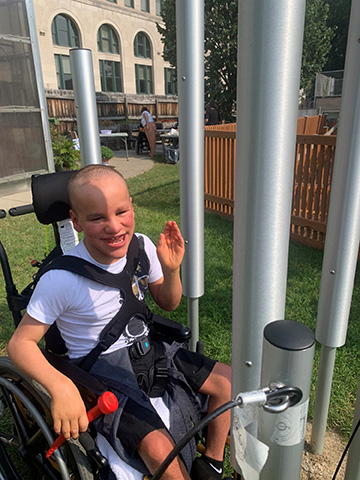 The instruments open the way to increased engagement and heightened enjoyment. Some students become more expressive when they interact with the instruments. Some will vocally match the pitch of the chimes when they play.
One of our students, Isaiah, is profoundly deaf and blind with some light perception. He's primarily a tactile learner. Within the classroom he uses sign language for core vocabulary words such as eat, drink, go, more, and finished. He uses tactile symbols and physical prompts to help him throughout the school day.
Isaiah really enjoys the Tubular Bells. He feels the movement of the bells as they are played, and he can feel the vibrations that come from striking the bells. Isaiah loves movement and gross motor activities, so it's not a surprise that he enjoys the bells as much as he does.
We are planning to renovate a large outdoor space that we call the Children's Garden. We will expand the number of and kinds of Percussion Play instruments that we install in this space. We look forward to adding instruments called Stepping Stones. Children can make sounds by running and jumping on them or rolling over them in their wheelchairs. Each Stepping Stone makes a different sound.
The students do so well with these instruments that we want to increase their opportunities. Our school has a little more than five acres of green space in the middle of Pittsburgh. We're celebrating our 135th anniversary this year. We've been around for a long time, and we're planning for the future.
You can learn more about Percussion Play by visiting https://www.percussionplay.com.