American Action Fund for Blind Children and Adults
Future Reflections Fall 2022 JOURNEYS
Half-Blind
by Janelle Perez
 From the Editor: Janelle Perez is a speech and language therapist who lives in Winter Haven, Florida. She works with stroke survivors and with people who have a variety of other conditions that affect speech, swallowing, and/or cognition. She dreams of starting a community-based center that brings together people with these challenges for support, enrichment, and natural communication opportunities. She has five children, ranging in age from twenty to five, and members of the family play instruments including piano, guitar, violin, and percussion, as well as singing in church.
"Manny, can you tell us about your vision? What can you see?"
For the hundredth time Manny patiently answers the questions with his ready-made responses. "I can't see shapes or colors. I can't see how many fingers you're holding up, but I can see shadows." Then, with a twinkle in his eye and a sideways grin, he adds, "And I can see when my Dad is putting his hand on my plate."
"Are you blind?"
"No, I'm half-blind."
Half-blind. Like most people unfamiliar with vision development and visual impairments, I used to think blindness was a pretty easy thing to define. You know, the lights are on or they're off. You can see or you can't. Okay, some of us can see better than others, but everyone could be assigned an acuity level from the trusty Snellen chart. Unless, of course, they were totally blind.
Over the past several years I've learned that defining blindness is not so simple, especially when we're talking about the perplexing condition called cerebral visual impairment (CVI). But I'm ahead of myself. I'd like to tell the story of my son Manny's journey with CVI. I've learned so much from others' experiences and stories, and I hope ours might help someone else on this journey to feel a little less confused, or at least a little less alone.
An Unexpected Crisis
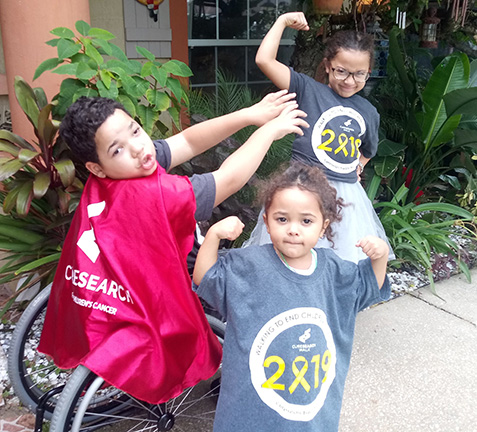
From the time Manny was a toddler, he was a strong-willed bowling ball of a little boy who was as rambunctious as he was affectionate. He loved playing outside and wrestling with his much gentler older brother, Lucas, who still bears battle scars from their scuffles. His dad signed him up for T-ball as a three-year-old, and he proudly wore his "Born to Retire" team jersey and played his heart out with the big kids. With no family history of serious illness, and with a little boy who was the picture of absolute health, the farthest thing from our minds was the dreaded word cancer.
But in the summer of 2012, our very active little Manny suddenly and uncharacteristically became sluggish. He was diagnosed with Stage IV acute lymphoblastic leukemia with features of Burkitt's lymphoma. His chemotherapy started immediately, and so did a tsunami of complications. One week into his planned six-month course of chemo, there was a sudden change in Manny's vision. He started seeing things that weren't there, and his gaze was unfocused. It seemed as though he was looking through things, not at them. He stopped watching the TV and preferred to listen to the sound. His brain imaging revealed that he had posterior reversible encephalopathy syndrome (PRES), and he had a small hemorrhage in the right frontal lobe of his brain. Soon after, he experienced a massive hemorrhage in his brain that required the removal of a large section of his skull. Manny was in a coma for the next two months.
In the fall of 2012, our Manny was stable enough to come home from the hospital, but he was unable to communicate or control his movements. There was no smile, no hand squeeze, nothing. He just slept and moaned and cried. His vision was the least of our concerns.
Breakthrough
 Then came the amazing day when Manny showed us that he was still "in there." He broke through to us by moving a maraca that we often placed in his hand. Usually he seemed to move it absently, without any real purpose. Then one day something changed about the movement. He gained enough control of his arm to shake it, and we were able to get functional communication. Shake the maraca for yes, leave it quiet for no.
"Do you have a brother?" The maraca rattled.
"Is your brother's name Pedro?" Quiet maraca.
"Do you want applesauce?" Quiet maraca.
"How about cheesy mashed potatoes?" A definite yes!
I thought I was hallucinating in the middle of the night when I first heard a faint croak from the direction of Manny's bed, which we had pulled next to ours. "Mama." But the next night, there it was again. "Mama." And soon after, there was no doubt, he was saying words—barely audible, precious words that required herculean effort for him to utter.
Manny grew stronger, and his communication kept improving, along with his movement and strength. That's when we realized our boy couldn't see. It didn't bother him at all. He didn't even seem to notice. He was just living life and loving on his family, especially his baby sister, who went from the fragile newborn he remembered to a sudden bundle of clumsy toddling, wet kisses, and curious feeding-pump button-pressing.
Journey into Rehab
Manny's radical improvement meant that he was ready for rehab. We went back to the hospital for intensive therapy. At that time we had no clue what to do about his vision, and neither did his therapists. We did what seemed to make sense and started teaching him basic adaptive skills such as tactile exploration. I read whatever I could get my hands on about cortical blindness. That was the label he first received, but it was quickly swapped out for cortical visual impairment (CVI), the more comfortable/acceptable term. (Comfortable for whom? you ask. Good question! More on that later.)
After we were discharged from inpatient rehab, we sought out the professionals who, we hoped, could help us better understand what was going on with Manny's vision. It was a frustrating experience! The people we expected to fill us in didn't seem to know how to assess our son. They assumed that Manny couldn't identify the objects on the modified Snellen chart due to a cognitive impairment. He was prescribed glasses, which of course didn't help. We reached out to Lighthouse for the Blind, and they provided vision therapy services. I read Dr. Christine Roman-Lantzy's textbook on CVI, and on multiple occasions I administered the CVI-range tool she developed. I purchased the recommended vision therapy apps, diligently observed Manny's vision therapist, and tried to incorporate the strategies she suggested to rehabilitate Manny's vision.
Full disclosure here, I'm a speech therapist myself. One driving force behind rehabilitation is that we know the brain can heal and reorganize after an injury. When Manny's injuries occurred and I learned about CVI, I believed at my core that he could regain some visual function if we applied the principles of neuroplasticity. I also knew it was equally important for him to have the tools to navigate the world with vision impairment, so we introduced adaptive strategies, including Braille, very early on. However, the strategies for rehabilitating vision and the strategies for encouraging tactile exploration and teaching Braille are in direct opposition to each other.
After two years of vision therapy, Manny still couldn't recognize anything by sight, and it didn't bother him in the least. It bothered me, though. I felt like a failure whenever we went to see the low-vision specialist. Apparently the standard strategies work in about 90 percent of CVI cases, and the child goes on to develop some degree of functional vision. For all my training and the research I had done, I still was not confident about our approach to this puzzling situation.
Sage Advice
Enter Erin, an adult with CVI and a fellow mom. She responded to an SOS I posted in an online support forum for parents with blind children. In one heartfelt post this dear woman did what I couldn't do with all my hounding of specialists. She helped me let go of my mom guilt and provided me with much needed clarity on what it's really like to grow up with CVI. She gave me the best advice I've gotten from anyone on this journey: to accept and embrace Manny's blindness. Or half-blindness. "You aren't teaching your child to be blind," she said. "He is already blind. Allowing and acknowledging that isn't giving up. Giving him blindness tools doesn't make him blind, it makes him more successful when he already is blind, just using different techniques." Her advice gave me the confidence I needed to focus our time and effort on what was working and to let go of what wasn't.
Recently I read an article by a neonatologist and neuroscientist who explains that the diagnosis cortical blindness given to babies becomes inappropriate as the baby's vision improves and develops. The neonatologist said the term should be dropped in favor of the term cerebral or cortical visual impairment. Her rationale is that cortical blindness is a "no-treatment" diagnosis that effectively delays timely and appropriate therapy. She goes on to say that, unlike cortical blindness, CVI can be treated.
I understand the intention of avoiding an incorrect label and the need to reflect accurately a child's visual progress in the diagnosis. However, I think that the "cortical blindness is a no treatment diagnosis" mindset lies at the heart of the confusion surrounding CVI. It reflects the idea that blindness can't be remediated, and therefore the term should be avoided. Why should cortical blindness be considered a no-treatment diagnosis?
Wouldn't it be more helpful for families like mine to understand early on that the term blindness encompasses a whole range of abilities, and that there is an array of services and tools to make life easier? Wouldn't it be helpful for therapists like me to work closely with parents, vision therapists, and teachers of the visually impaired to understand and utilize strategies for dealing with blindness—both rehabilitative and compensatory—in our service delivery? We have a lot to learn from each other.
Not long ago I talked with another mom whose sixteen-year-old son has CVI. She felt defeated because, after years of vision therapy and adaptations by the school system, her son still had no access to literacy. He had some vision, and the professionals had advised against teaching him Braille until now, as he was going into his senior year of high school. "I just wish I'd had the sense to get him learning Braille a long time ago," she lamented. That was mom guilt talking.
I was able to offer some hope, thanks to Erin, the mom whose advice helped me so much. Erin taught herself Braille as an adult and graduated from college with honors.
I wonder what could happen if we got over our collective fear of blindness. Maybe we would be better able to help people access the tools that work for their unique situations. Those tools could be vision strategies or blindness strategies or some combination of both.
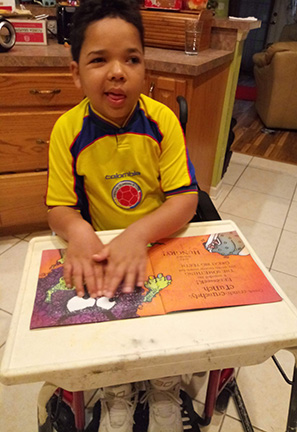
To a sighted person, learning to read Braille can seem like an impossible task. People sometimes assume that those with cognitive disabilities can't learn the system. Manny is proving them wrong. Do his cognitive disabilities slow down his progress? Sure. Do his daily seizures make learning impossible sometimes? Yes. Are there days when I wonder whether learning to read Braille is really worth all the time and effort? I have to admit that sometimes it's true.
I watch Manny zipping around the house in his wheelchair, clearly using his vision not to crash into the walls, and I'm thankful he can use his sight in that way. (Now if you left something you care about on the floor, you might want to pick it up, or risk getting it run over!) I think about Manny confusing me for his Dad when he's not expecting me. I remember how he often asks, "Who is that looking at me?" and it could be a chair or a painting or a hat, and I'm thankful for his adaptive strategies. He loves his audiobooks, and he learns a lot through the auditory medium.
I don't know whether Manny will become a fluent and efficient Braille reader beyond basic literacy. I do know that the grit it takes for him to tackle the challenge will help him build the cognitive resilience he needs to face other challenges that are sure to come. I smile as Manny learns to read basic sentences and triumphantly declares, "This is so easy I can do it with my eyes closed!" I believe the day is coming soon when he'll be saying the same thing when he's reading to learn, a task that not long ago seemed completely out of reach.
Resources
https://karenpapemd.com/myths-and-truths-about-cortical-blindness-baby-brains-do-recover/
Roman-Lantzy, C. Cortical Visual Impairment: An Approach to Assessment and Intervention. Louisville, KY: American Printing House for the Blind, 2018.