American Action Fund for Blind Children and Adults
Future Reflections Fall 2022 JOURNEYS
It's Not Because I'm Blind: A Second Look at Sensory Integration Challenges
by Amy Albin
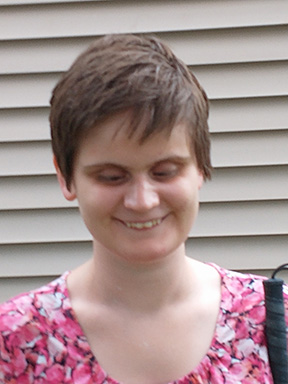 From the Editor: Amy Albin is about to graduate from Montclair State University with her master's degree in industrial/organizational psychology. As a 2019 National Scholarship winner, she has previously been active in both the New Jersey and National Blind Students divisions. Amy currently works at Vispero (which owns Freedom Scientific—the makers of JAWS) as a human resources intern, combining her HR background with her experience as a blind person to make a difference at the leading company for blindness accessibility solutions.
After I graduated from high school in 2017, I decided to attend a residential blindness training center to improve my sorely lacking independent-living skills. Within a few weeks I noticed I was progressing much more slowly than the other students. While they were walking around the block, I continued to get lost in the center building. While they were cooking meals, I struggled to measure flour into a cup. I spent weeks in my ADL class (activities of daily living) struggling to learn the seemingly simple task of putting a fitted sheet on a bed.
Why was nearly every spatial task so hard for me? It wasn't that I didn't know how to learn; I'd gotten A’s throughout my school career in honors and Advanced Placement classes. Throughout my life people told me my problem was that I didn't practice these skills enough. That was true. Every time I tried to practice hanging a shirt, for example, I would feel the hanger and the shirt in my hand and have no idea what to do with them. I knew that somehow the shirt had to go onto the hanger, but that wasn't enough information to help me figure out what my hands needed to do to accomplish the task. So, after trying a whole bunch of strategies, I would give up practicing.
I received occupational therapy throughout my K-12 schooling, but the skills they taught never seemed to click for me. I thought it was because the therapists didn't know how to teach blind people. I hoped that when I went to a blindness training center things would change. But at the blindness center the teachers told me to get occupational therapy!
With the help of Joe Ruffalo, who was president of the NFB of New Jersey at that time, I contacted Carol Castellano. I had met her previously, and we had discussed training centers. Now I told her about my problems and asked her if she knew anything about sensory integration, which was the phrase that someone had advised me to use.
Sensory integration disorder is not an official diagnosis in most places. However, it often occurs in the presence of other challenges such as prematurity. In my case, we are unsure of the reason for the condition, as I was born at full term.
Carol knew exactly what I was talking about from raising her daughter, Serena Cucco, who had sensory integration challenges. We decided to meet in person so Carol could evaluate me, drawing upon her experience and observation. She discovered that I couldn't tell a square from a rectangle. I could verbalize the difference: "A square has four equal sides, and a rectangle has two short sides and two long sides." My verbal skills allowed me to trick everyone, including myself, into thinking that I understood concepts that I actually did not understand. When I examined a figure, I couldn't tell which were the long sides and which were the short sides. I couldn't tell whether it was a rectangle or a square. No wonder making a bed was hard for me!
Carol discovered that I didn't know the significance of turning my hands palms up or palms down, and I didn't know when to use which position. Palms down means putting my palms down on the table with the back of my hands off the table and exposed. Palms up is the opposite, where my palms are off the table and exposed, and the backs of my hands are on the table. Without this understanding, no wonder I couldn't clean crumbs off a table!
At our first meeting I told Carol that I never crawled as a baby. She told me to get down on my hands and knees on the floor and move my palms in and out. She explained to me that, for some reason, I have to teach my body and my brain things that most people seem to be born knowing. For me that teaching has come in the form of exercises Carol has given me to practice throughout the years. I can keep coming back to those exercises and expanding upon them as I progress through my sensory integration journey, which started on that fateful day in 2017 and continues to the present.
I wrote this article as a follow-up to an article written by Carol Castellano in 2019. Her article is linked below. If you haven't read it, please do so before you visit any of the other resources presented.
Castellano, Carol. "Maybe It's Not Because They're Blind: How Sensory Integration Exercises May Help Our Children."
https://nfb.org/images/nfb/publications/fr/fr38/4/fr380407.htm
Carol recommended the following article:
A Parent's Guide to Understanding Sensory Integration
Sensory Integration International
https://www.efrconline.org/admin/files/Parent%27sGuideToSI.pdf