American Action Fund for Blind Children and Adults
Future Reflections Fall 2022 STEM
Stretching the Dimensions of Nonvisual Learning: Blind-Led Youth Programming and Engineering
by Natalie Shaheen
Based on a Presentation at the 2022 NFB National Convention
 Introduction by Mark Riccobono: The next presentation will be partly in the room and partly virtual. A number of people who are participating in this presentation have been part of our efforts to stimulate the education of and innovation for blind people in science, technology, engineering, and math. This is always a powerful moment in our convention, especially when we can hear from the next generation who have been impacted by the work we've done. This is a good time for us to think about how we can transform our own learning in ways that impact not only blind people but the broader community.
For a number of years you've heard about ourSpatial Ability and Blind Engineering Research (SABER) program, which we have been undertaking to teach and explore spatial reasoning and understanding and to stretch the dimensions of what nonvisual access means and how we can contribute to the broader understanding of engineering. Here to lead us in this presentation is someone well-known in many parts of this convention. She serves as director of our NFB SABER program. She also has the distinction of being a Dr. Jacob Bolotin Award winner. Here is Dr. Natalie Shaheen.
NATALIE SHAHEEN: As you may have deduced from the announcement and the materials that were passed around earlier, this session is going to employ a pedagogical approach that's a little different from what you're accustomed to.
NFB EQ is a program to help develop the spatial abilities of blind participants. We held face-to-face programs in Baltimore in 2018 and 2019 and remote programs in 2020 and 2021. As you will hear from the students, the face-to-face programs involved a project in which students designed and engineered a place of their own and then constructed a scale model of their place. The remote programs focused on the art and math of paper-folding, as well as its engineering applications. Students learned about the mathematical laws that govern origami.
That's right—there are four mathematical laws that govern origami. The laws are two-colorability, mountain-valley counting, angles around a vertex, and layer ordering. If you want to learn more about the mathematics of origami, I recommend the work of Doctors Robert Lang and Thomas Hull.
Madeline Mau, a 2021 NFB EQ online participant who hails from New Jersey, is here to share her NFB EQ experience. Here's Maddy.
 MADELINE MAU: Hi everyone! Thank you so much! There are many things middle-school science classes might be known for: long lectures, zany teachers, and Periodic Table t-shirts, or group labs devolving into good-natured horseplay among classmates. My science education had some of those things—mostly the former—but there was an even bigger component many people overlooked, the inaccessibility of STEM education. Since early childhood I have been given a science education far less adapted for my learning needs than that of my sighted peers. This manifested in myriad ways: teachers using inaccessible materials, sloppy or nonexistent tactile graphics, reduced opportunities for my participation in labs, and my needs being given less importance by the teacher, to name a few. These patterns caused me to become apprehensive about pursuing STEM as a career or subjecting myself to more rigorous STEM education. I feared all of it would be similar to what I had previously experienced.
My freshman year of high school was filled with hurdles and challenges similar to those of my middle-school career. Teachers continually underestimated me or tried to put me in classes at a lower level than those I should have been allowed to take. They didn't want to deal with adapting complex material for me, or they thought I was incapable of understanding the concepts, even though the only difference between me and my peers was my blindness.
I started to gain a new perspective when I enrolled in the National Federation of the Blind's EQ program for high school students last summer. It has been almost a year since the program ended, but I still treasure the lessons and techniques it has taught me. I cherish the connections I made with other blind students and members of the Federation.
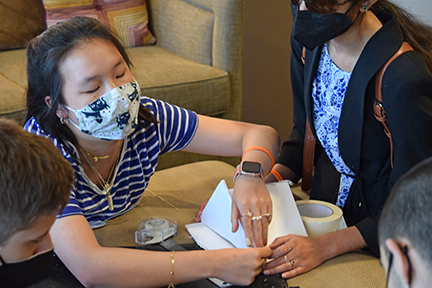
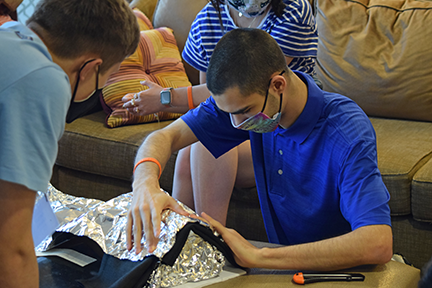
The curriculum is rigorous, with many activities devoted to developing spatial reasoning skills through technical drawing, paper folding, and puzzle solving. My peers and I were given many challenging assignments that encouraged us to reframe how we thought about STEM as a whole. We learned through conversations with blind STEM professionals and resources about blind people in STEM fields. We were also provided with many manipulatives that enabled us to participate in hands-on activities such as folding origami boxes, making fractals with index cards, and drawing multiview sketches of various objects in our daily lives.
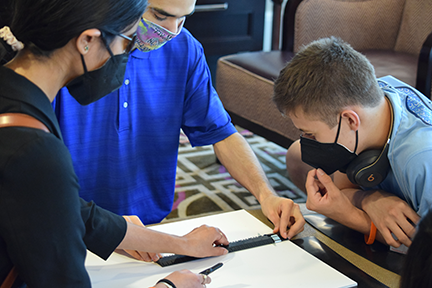 There were also ample opportunities for combining spatial reasoning with recreation. We were encouraged to build with LEGO®s using nonvisual instructions or given origami popup books to deconstruct and analyze. Though this curriculum contained vastly different activities from those in my standard science education, it has proven to be far more valuable. It introduced me to advanced spatial reasoning concepts, gave me transferable skills I could use in my mainstream classes, and showed me how fulfilling accessible STEM could be, complete with advice from successful blind people in the workforce.
Not only did the EQ program offer engaging activities and lessons, it also had a student showcase where my peers and I presented projects inspired by what we learned. The showcase was one of the biggest highlights for me. It demonstrated everyone's unique perspective on what we learned in addition to our skill sets and our other interests. Some students who knew about web development created websites sharing EQ resources such as origami patterns and LEGO instructions in adapted formats, as well as new patterns they created. Others used the skills they learned at EQ to make detailed paper creations that highlighted their spatial thinking and inventive mindsets. Others, like me, wrote about their positive experiences and takeaways to tell the world about the benefits of adapted STEM education and explain why it is essential for all blind students, STEM-inclined or not.
After reflecting on my experiences in the NFB EQ program, I still don't know if STEM truly is for me. I worry a lot about what my future science education will look like, or whether higher level STEM classes will be accessible so I can succeed. As I am speaking to you today I am a rising junior in high school, and I have just finished a school year filled with the same unadapted STEM materials and uncooperative teachers, on top of a more demanding course load and the daunting prospect of choosing a career. However, I now understand how STEM can become more than inaccessible experiments and inflexible teachers. I've been fortunate to experience how an accessible and engaging science education can boost confidence and open up new possibilities for me and my blind peers. I hope others will have easy access to such opportunities in the future. Thank you!
NATALIE: Thanks so much, Maddy! Now, are you all ready to be active learners? Before we get started, a couple of notes about mindset. First, we all come to today's activity with different knowledge and experience. In the Federation we have some skilled origami artists. I'm not one of them. Today's activities are for you, whether you're a skilled origami artist or someone who has never folded paper. Each of us will have different takeaways from today's activities. Your takeaways might be how to fold paper to make interesting shapes, or they might be about how to support others in developing that knowledge. Second, each of us uses a different combination of supports to learn. Your learning supports might be personal capacities like your sense of touch, digital tools, analog tools, or other humans. Whatever combination of supports works best for you is perfect. From my perspective, learning supports do not exist in a hierarchy. I encourage you to use whatever combination of supports suits you today.
Here are a couple of supports specific to these activities that are available for those who prefer to read. You will find written instructions for the activities in the transcript, which is linked on the Crab-pass app and on the tweet I posted this morning. Our NFB EQ students, mentors, and staff are on the floor to provide human supports. You will also find human supports all around you. It's the Federation way to help each other out. I am sure the folks around you will be pleased to support your learning.
[At this point Natalie gave instructions for people in the audience to fold squares of origami paper to create a cube and to teach another person the process.]
NATALIE: Next, we have recorded presentations from five of our NFB EQ students.
ABBY DUFFY: Hi! My name is Abby Duffy, and I'm from New Hampshire. I participated in NFB EQ in both 2019 and 2020. In both of these programs I was able to learn a lot about science, but I also was able to have a lot of fun.
In 2019 some of my favorite memories are making new friends and experiencing new things. Also we built really cool wooden models that I still have to this day. In 2020 I also participated in STEM EQ. This time it was a virtual EQ, but I made a lot of friends there as well. I learned a lot of cool things and listened to a lot of cool speakers. I'm really glad I got to participate in both of these programs.
RONALD EGLESTON: Hello, I'm Ronald Egleston from Virginia. I was one of the participants in the NFB EQ virtual program in summer session. I believe that the most valuable skill I took away from the program was how to think and design in three dimensions, which I learned through the lessons in origami. Now this skill helps me when I navigate through buildings and when I design STEM related projects.
 ANDREA CATAQUIZ: My name is Andrea Cataquiz, and I'm from Illinois. In 2021 via Zoom I attended the NFB STEM EQ program, where we did a variety of fun activities such as origami. We ended the program by creating a project where we could share our experiences and the things we learned.
GABRIEL MONIZ FRANCES: Hello, my name is Gabriel Moniz Frances, and I am from Alabama. I participated in the NFB EQ program in 2019. Most of the other STEM programs I've been to have been kind of concept-based or theoretical. They show you what you have to do, but they never actually show you how to do it. This time we actually went hands-on with the project. We had to study architectural engineering. After that, we applied some of those concepts by looking at different ways they could work bit by bit. Ultimately we made a final project, a structure of our own. It was completely creative, no guide rails. I built an observatory, and I actually have it to this day.
MAURA: My name is Maura. I am a college student, and I am from Nebraska. I participated in NFB EQ in 2019. It was a really great experience. We got to build little models of rooms we would like to have someday. Mine was a Netflix room. Don't ask me why! It was a really fun time. We got to make drawings and measure the balsawood as much as we could with the angles we had. Mine was a hexagon. At the end of the week we got to do an exhibition in front of a lot of NFB leaders. I got to answer some really cool questions. It was fun to see people who were truly invested in my future and didn't see my blindness as an obstacle.
NATALIE: Many thanks to Abby, Robert, Andrea, Gabe, and Maura.
Remember Maddy mentioned making a fractal out of index cards at the beginning of this presentation? Well, that's what we're going to do now! Don't worry—you don't have to have a deep understanding of fractals to fold one! In fact, folding a fractal is a great way to learn about them or refresh your memory. Today we’re going to fold a Menger sponge, a fractal Emily Gibbs of Texas originally introduced me to. We're going to fold this fractal in four rounds. The first three rounds we'll do together, and the fourth round you can do with some friends later.
[Natalie then gave instructions for the audience to make the fractal with index cards.]
NATALIE: Later today, gather with nineteen of your friends and use your cubes to make a Level One Menger Sponge. That's a cube comprised of twenty smaller cubes. If you're ambitious, use twenty Level One Menger sponges to make a Level Two Menger sponge, an even bigger cube. Emily Gibbs, some students, and I once made a Level Three Menger sponge out of index cards. That was a really big cube!
There are enough index cards here in the ballroom to make that happen. The question is, are you up to the collaborative challenge? Share your progress on social media, using the NFB22 hashtag.
Keep thinking spatially and stretching the dimensions of nonvisual learning. Remember, STEM isn't visual, it's spatial.