American Action Fund for Blind Children and Adults
Future Reflections Winter 2024 LEARNING AND TEACHING
Helping Out: How Chores at Home May Pave the Way to Future Employment for Blind Youth
by Julie Deden
From the Editor: Most parents assume that their children will take on responsibilities around the house as they grow older. Preschoolers are taught to pick up their toys, school-age kids set the table or take out the garbage, and teens mow the lawn, run errands, and help care for younger siblings. When a child is blind, however, this natural progression often gets derailed. For an assortment of reasons, blind children are seldom expected to do household chores. Julie Deden, director of the Colorado Center for the Blind, surveyed a group of blind teens in one of her programs, asking them about their experiences helping out at home. In this article, she writes about the results and their implications.
I grew up as a blind child, and today I work as the director of the Colorado Center for the Blind (CCB). At the CCB we teach blind young people and adults skills such as home management and independent travel, and we attempt to prepare them to become gainfully employed. Our students who have been blind from an early age often come to us with woefully limited experience with cooking, cleaning, and yard work. I have come to believe that there is a strong correlation between doing chores as a child and the expectation of holding a job as an adult.
Most children are natural imitators. When they see their parents sweeping the floor or raking leaves, they eagerly try to do the same thing. Blind kids know that their parents prepare meals, vacuum the carpet, and take care of the yard, but they can't observe visually how these tasks are managed. Parents and caregivers need to find nonvisual ways to teach blind children how to perform the ordinary tasks of everyday life. They may let the child tactually explore household items such as mops and pails or pots and pans. Using the hand-over-hand technique, they can show the child how tasks are done.
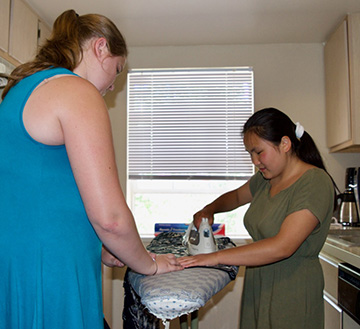 Parents need to keep in mind that once is not enough. Sighted children observe adults' activities again and again. Blind children, too, need repetition as they observe and explore, using hearing and touch. Parents are extremely busy people, and in the short term, all of this teaching may seem to be burdensome extra work. In the long term, though, the results will prove well worth the effort.
I remember talking with my mother about how she taught me to tie my shoes. Teaching me the complicated steps of tying a knot and a bow took time and patience. My mother went over the steps with me again and again until I had it all down. Sometimes the lessons were frustrating for us both, but when I finally mastered the process of tying shoelaces it was mine for life.
Fortunately, I was taught to do a variety of chores around the house. I learned to clean the bathroom, wipe the kitchen counters, and run the vacuum cleaner. I started babysitting when I was sixteen, and I worked at a Lions camp for two summers while I was in high school. I benefited tremendously from these experiences. Many blind teens are not so fortunate.
Here at the CCB we find that many blind people had few, if any, opportunities to do chores at home when they were children. Furthermore, few of the blind teens who come to our programs have had the opportunity to babysit or hold after-school or summer jobs. Concerned about these observations, I decided to interview ten of our students who are under the age of twenty-five in order to gather more information.
When they entered the program at the CCB, seven of the ten students I interviewed were strong Braille readers, and six of the ten had good technology skills. All of the students in the group received monthly SSI payments. All of the students in the group indicated that at least one of their parents worked outside the home.
Although most of these students had skills when it came to Braille and technology, their experience with household chores was minimal. One student explained that he did chores as a young child, but he was not expected to help out later on, as his vision declined. Another student said she helped care for her younger siblings, but she did not have any household chores. Four of the ten students said they felt they could not measure up to their sighted siblings and peers when it came to making themselves useful. They said that no expectations were placed upon them, and they felt ashamed for not doing more to be helpful at home. They admitted that they did not know what to do or where to begin.
A notable exception in this group was a student who lost his vision at age seventeen. Before he became blind he was always expected to do chores at home. In addition, he held several jobs during high school, and he even ran a lawn-care business. Of the ten students I interviewed, he was the only one who had ever worked competitively—and he held his jobs while he still had sight.
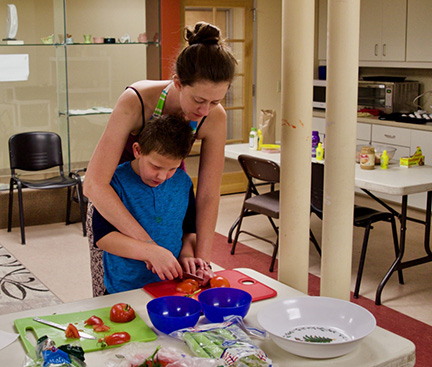 The good news is that training in blindness skills seems to make a significant difference in the way young people see themselves and their futures. Five of the students I interviewed are currently in college, and three are actively looking for employment.
Few of our students want to move back home with their families after they complete their training in blindness skills. They love the independence they have gained, and they are eager to step out on their own. As they master the skills of preparing meals and cleaning floors, they are learning far more. No longer are they the passive recipients of help. They begin to see themselves as people who can be proactive, who can make meaningful contributions as they move through their lives.
At first my mother didn't know how to teach me to tie my shoes. Yet she understood that I needed to keep up with my sighted peers in mastering the tasks of daily living. Step by step, hit or miss, she found ways to teach me. In the blind community we need to help parents find ways to teach age-appropriate skills to their blind children. We need to help them raise their expectations and bring up their children to become active, contributing members of society.