American Action Fund for Blind Children and Adults
Future Reflections Winter 2024 LEARNING AND TEACHING
Hands On? Hands Off!
by Carlton Anne Cook Walker
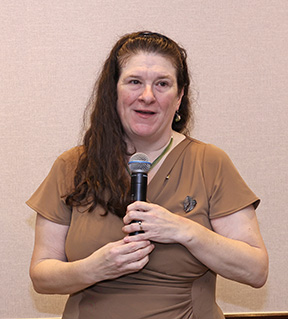 From the Editor: In her article "Helping Out," which appears elsewhere in this issue of Future Reflections, Julie Deden mentions the use of the "hand-over-hand" technique for teaching tasks to blind and low-vision children. Her reference to this technique launched the two of us into a lively discussion of "hand-over-hand" and "hand-under-hand" teaching methods. Our thoughtful exchange inspired me to reach out to Carlton Anne Cook Walker, who revisited an article she published in the Winter 2015 issue of Future Reflections and brought it up-to-date with her current thinking.
Carlton Walker brings several levels of expertise to her ideas on this important topic. She is an attorney, a teacher of blind and low-vision students, and the parent of a blind child (now a young adult). For many years she served as president of the National Organization of Parents of Blind Children (NOPBC), and she now serves as an educational advocate and consultant through her firm, Blindness Education and Advocacy Resources (BEAR). Here are her thoughts about the hand-over-hand and hand-under-hand teaching techniques.
When I trained to become a teacher of the visually impaired (TVI), I discovered that a great deal of teaching was done using hand-over-hand technique. Hand-over-hand is the technique in which a teacher or other adult places his or her hands on the hands of a child and moves the child's hands through the activity that is being taught.
I began to ask myself, "Why am I putting my hands on someone else's hands?" Maybe I'm a bit more sensitive than most people, but I really don't like people to touch my body without asking me first. Now that I've gotten to know so many blind adults, I have come to find out that uninvited touch is part of their daily experience. People put their hands on full-grown blind adults, people who are making their way in the world. I find it very strange and troubling.
Person-to-Person Contact
The Individuals with Disabilities Education Act (IDEA) clearly directs that students with disabilities be educated in the least restrictive setting that meets their needs. We all know there are outliers and true horror stories of under-inclusion (and, sometimes, over-inclusion). Nevertheless, for the most part, schools follow federal and state law in terms of educational placement.
However, the classroom placement of the student is only one part of the story—the part that is explicitly addressed under federal and state law and is monitored by state education auditors. Another chapter in the inclusion story is not written into law, and too often it is missing from practice in the schools. In many ways, students with IEPs (Individualized Education Plans) are treated very differently from students without IEPs. A major difference in the instruction of these two groups is the amount of physical contact, what I'll call person-to-person contact, that they receive from adults in their lives, both at school and at home. Part of being educated with children who are not disabled should include being educated like students who are not disabled.
Hand-over-hand is only one form of person-to-person contact. In the case of blind and low-vision children, person-to-person contact is used to show, to teach, to guide, or to protect. When a child has additional disabilities, person-to-person contact may be used in many other ways as well. A child with poor muscle tone may need back support in order to sit on the floor, neck support to prevent injury, or arm support to reach out for a toy. Students with poor muscle control may need person-to-person contact to help them keep their limbs from making unintended movements. Some students have positional limitations—they may not be comfortable or functional in certain positions. Person-to-person contact may be necessary to help such students achieve optimal positioning.
In all of these instances, person-to-person contact may help a student participate more fully in activities at school and at home. However, overuse of person-to-person contact can lead to problems.
Not surprisingly, parents tend to be more hands-on with all children than schools are. When an infant is born, we move the child's body around a great deal—for feeding, diapering, dressing, and of course, for cuddling. For a typically developing child reared in a typical environment, the amount of person-to-person contact lessens as the child increasingly engages with the environment. A parent may use person-to-person contact to initiate new activities, such as teaching the child to stir cake batter in a bowl. The typically developing child will demand more and more independence as he gains skills. In a typical family environment, children will be allowed to take responsibility for a new task as they become ready to do so.
Of course, when the atypical arises, the natural progression of learning may be disrupted. As noted above, some children do not have the physiological capability of performing certain tasks independently. Other children may need to grasp the concept of the task differently due to a physical, intellectual, or sensory disability, or due to a combination of these factors. A child who is blind or has low vision may need to learn the steps to a task through touch and/or verbal instruction. A child with additional disabilities may need special accommodations to perform the task. She may need more time to learn the task and its components, or she may only be able to perform a portion of the entire task.
Attendance at school helps push most typically developing children toward greater independence in the tasks of learning and living. By learning alongside peers from experienced educators, all schoolchildren benefit from increasingly age-appropriate expectations and interactions. Yet some schools do not hold the same expectations for students with disabilities. When this occurs, the school may actually encourage a parent to continue with person-to-person contact, even when such contact is no longer needed—and even when such contact harms the child's development. Thus, the entire life of the child with a disability, at school and at home, becomes unduly restricted.
Measures of Success
The time factor is one reason why teachers and parents tend to overuse person-to-person contact. "We're running late!" is a refrain in our daily lives. When a deadline is bearing down, most parents will simply tie the shoes or button the shirt rather than allowing the child to work through the task on his own. Frankly, it is easier and faster for us adults to do the task instead of waiting for the child to get it done. Yet it is crucial for the child to have the opportunity to grow in his capabilities and responsibilities as he gets older. Extra time is not always available, but attention must be paid to making time whenever possible.
Another reason we tend to engage in person-to-person contact is to achieve what we think of as "success." At home, a parent may help the child hold a spoon to reduce the mess that will result from the child's first attempts at feeding herself. At school, a teacher's aide may cut, paint, and even draw a picture to ensure that the child's artwork is pretty. While this help is well-intentioned and understandable (Who wants a messy floor? Shouldn't a student's project look nice?), it does not help the student develop skills or grow in self-confidence.
For all children, success looks different at different times. Imperfection is a natural and necessary step on the journey of learning and self-discovery. Failures help us understand how to achieve success later on. A child who is not allowed to fall will never learn to walk. As parents and teachers, our job is to support a child or student, but not to prevent failure or guarantee success.
The Downsides of a Hands-On Approach
When an adult provides too much support, the student may not learn to complete the task in question. Children may not reach their full potential to become independent.
Another problem resulting from too much physical contact with a child is the child's loss of self-determination. When someone moves the child's body without warning and without engaging the child in the purpose of the movement, the child has two options. The first, and most reasonable, is resistance. Indeed, I would resist if someone grabbed me, with or without warning, and tried to move a part of my body. I am an independent human being. I expect others to respect my body and my right to control it.
The other option for a child who is moved by another person is the passive acceptance known as learned helplessness. When children respond in this way, they show that they do not believe they have the choice to refuse or to engage in the activity. This passivity may make it easier for adults to complete a task, but it is potentially dangerous for the child. In the short term, the task is completed, but the child has learned nothing. He is simply a passive participant in the activity. In the long term, such passivity may render the child susceptible to physical and emotional abuse, and even sexual assault. The child feels powerless to object at the moment of the abuse or to report the abuse later in a safe environment.
The Purpose of the Contact
How can a parent or teacher determine whether too much support is being provided to a child? A first step is to question why the support is being given. While this sounds complicated, it really isn't. In fact, it's a process each of us uses daily in a variety of settings. For example, when I leave my house each morning, I must determine whether I need the support of a coat or jacket. I assess the current weather situation and perhaps check the weather forecast. I will wear a coat if it is cold, a jacket if it will be cool. I do not need the support of a winter coat on a hot day. Indeed, such support would actually have negative consequences.
Determining the proper level of person-to-person support for a child or student is no different. Here are some questions to consider:
- Is this contact tailored to the student's area of need?
- Does this contact even minimally meet the student's area of need?
- Can we increase the student's level of independence by reducing the level of person-to-person contact?
- What is the purpose of the task? To be completed quickly? To be completed with minimal mess? To be attempted or mastered by the student?
Once we have determined the why of person-to-person contact for a particular student, we are better able to determine the what, when, where, and how. Person-to-person contact can be active or passive. Typically, passive support is less likely to have the negative effects discussed above. An example of passive person-to-person contact is the positional support of sitting on the floor behind a student with low muscle tone. The adult's support serves as a "chair," enabling the student to maintain the posture needed to engage in activities. Certainly, providing passive support when it is not needed could hinder the student's progress somewhat. However, when the support is relatively passive, the student has the choice to accept it or not.
In the "human chair" example, a student who cannot sit up easily without support will lean on the adult. If the student develops more trunk and neck strength, he will be better able to sit up without assistance. The "human chair" can continually assess the student's need for support by getting into position and increasing or decreasing the level of contact, based upon the student's ability to sit up and engage in the desired task. The amount of support may vary, depending on the task, the time of day, or other factors.
Active Support
Active support takes many forms. A common form of active person-to-person contact used with blind children in the school setting is the hand-over-hand technique mentioned earlier. An adult's hand is placed on top of the child's hand, and the adult moves the child's hand in an action. For example, an adult might place a toothbrush in the child's hand. The adult then covers the child's hand with his own and brushes the child's teeth as if the child's hand were not even there. The child's hand is being manipulated by the adult's hand to perform the action.
As noted above, active support is commonplace with typically developing infants and toddlers. It is used less often as the child grows. At school, it is rare to find active support, such as hand-over-hand, used for teaching activities. Instances of active support are usually very short and infrequent. For example, a teacher might show a kindergartener how to clap by moving the child's hands together and apart a few times, but the teacher is not likely to do so every day with every child.
In stark contrast, active support is used a great deal in special education settings. Not only is it used with greater frequency, but its use is of longer duration. Each instance of active support may last for several minutes, and instances may be repeated over many days, weeks, months, and years. Perhaps due to its popularity in the schools, hand-over-hand technique is used at home more often for children with disabilities than it is for their nondisabled peers.
We should question this discrepancy. Why is the hand-over-hand technique used so very much with children with disabilities? Are we overusing it? Are we using it for noneducational purposes, such as speed? If hand-over-hand is a way to teach skills, why do children continue to need this support for years on end? At what point can we expect the child to learn the skill without hand-over-hand assistance?
Children Live What They Learn
In my interactions with students, I encountered these negative impacts of hand-over-hand instruction regularly. These students could not easily engage with age-appropriate instruction because they either worried about being moved around by me (the teacher) or did not attend unless I started moving them around.
This was so pervasive that I added an activity to my initial assessments and first few classes with my students: I set some tactile materials on the desk, I sat beside the student, I placed my hands flat on the desk, and I asked the student to "show" me what is there. Many times, my students would pick up my hands and move them on the desk. One time in particular, my student grabbed me by the wrists and slapped my hands all over the desk without reference to the tactile items presented.
This child's behavior spoke volumes to me. This student had low vision and additional disabilities—and she had been manhandled for years. She did not understand that she could gain information through touch; she just thought "teaching" meant slapping the student's hands around the desk. I shared this information with her classroom teacher and the classroom paraprofessionals. As a team, we immediately ceased hand-over-hand instruction and invited the student to become an active participant in her instruction. It took a few weeks, but this student was ready to learn. We explicitly explained that we would not be moving her around and that we wanted her to work with us on activities. Once she became confident that we meant what we said, she began to blossom. She gained skills and made progress toward her IEP goals and toward independence. Her interactions with her peers also improved; she was neither a rag doll nor a bully.
A New Approach
As an educator, I have come to the conclusion that hand-over-hand assistance is too restrictive to constitute an effective learning practice. When the active support of hand-over-hand is used, the child/student is reduced to a passive participant in the learning process. The hand-over-hand technique does not allow the child to understand the motor movements necessary to perform the task.
We learn best from activity occurring under our fingers. Our fingertips and palms are far more sensitive to tactual information than are the backs of our hands. Hand-over-hand instruction takes the child's focus away from what is happening on their palms and fingers and directs it to the adult's actions on top of the hand. Hand-over-hand technique also requires the adult's hand to make the movement for the child. The child's hand is controlled by the adult, not by the child himself. When this technique is used, the child cannot focus on developing the skill being taught and needs an immense amount of time to learn a given task.
Furthermore, hand-over-hand creates an environment that pits the child and adult against one another for control. When an adult places her hand on the hand of a child, the child cannot readily resist the activity. The child either must actively resist or passively accept the activity in question. Typically, strong resistance is met with disapproval by the adult, who uses more strength in the hand-over-hand motion. The child who resists is scolded, manhandled, and punished. The child who does not resist has taken another step on the road to learned helplessness.
Alternatives to Hand-over-Hand Instruction
In order to teach our children more effectively, another option is needed. For students who need additional support in gaining information about a task and learning new skills, a great option is the hand-under-hand technique. Hand-under-hand is becoming more prevalent in the school setting, and its popularity is growing, particularly in the education of blind and deafblind students. Hand-under-hand involves the adult's hand performing the activity with the child's hand on top, feeling the movement of the adult's hand. The adult performs the activity naturally, although maybe a bit more slowly, and verbally describes what is going on. For example, when learning to use scissors via hand-under-hand instruction, the child’s hand touches the adult's hand as the thumb and fingers go into the scissors handle. Then the child's hand perches on top of the adult's hand as the adult opens and closes the scissors. Throughout the process, the adult verbalizes what is happening. In time, additional information is added, such as the positioning of paper being cut and tactile examination of the "before" and "after" paper.
Hand-under-hand technique allows the child to feel the movements necessary for the task and to mimic the movement himself. A child who is resistant can easily pull away from the task. The child has choice and can use it. The adult can respond to the child's feelings, just as she would with a typical child who refuses to put on a pair of gloves or a hat.
In some cases, the child is willing to participate in the activity but has difficulty controlling muscle movements or is easily distracted. Minimal restriction may be helpful, such as looping a finger or thumb over the student's hand or providing a "hand wall" to keep the student's hand from moving too far from the area of activity.
Hand-under-hand technique lends itself easily to reducing the amount of support given. When I use this technique to encourage tactile exploration, I simply pull my hand farther back and allow the student's hand to touch more and more of the surface being examined. When I use this technique with a child who is learning to grasp a crayon or use a Brailler, I gradually reduce the presence of my hand on the tool and increase the amount of work for which my student is responsible.
Does it work? Yes! The results take a little longer to show up, but they are real and long-lasting. Students who receive hand-under-hand assistance become active participants in their learning lives. They reach out more, and they are less passive or not passive at all. It may take them longer to finish an art project, and that art project may not look as perfect as one done with hand-over-hand assistance. However, the student has performed the task. In time, the amount of hand-under-hand assistance can be reduced. The assistance can become more passive, and the student will be able to transfer skills to new areas of his/her life.
Hand-under-hand is not the only type of passive assistance that adults can provide. The adult can give supported assistance, such as supporting a student's elbow to allow for greater independent movement. Side-by-side modeling of an activity is great for gross motor skills such as learning the "Hokey Pokey." Step-by-step tactual prompts or cues, step-by-step verbal directions, and step-by-step verbal cues or questions such as "What's next?" all allow the child to learn while maintaining autonomy. Over time, the adult provides tactual or verbal assistance only when the student requests them. Such an environment allows the child true success, the sense of being capable and empowered.
Respecting the Individual
Let your child know what's going on. Instead of taking his hand, announce, "It's cold outside. We need mittens, and I am going to put your mittens on. Right hand first!" Instead of just feeling someone take his hand and put a mitten on it, your child knows what is coming and why. As your child becomes more able to put his mittens on, you might say, "May I help you put your mittens on? Which hand is first?" In this manner, you are gradually, but decisively, empowering your child to gain skills. At the same time, you are ensuring your child that you are there to provide any requested assistance—you are the safety net as your child practices walking the tightrope of independence.
Another important element in empowering your child is giving her a voice and respecting that voice. Children who do not have the right to disengage from an activity will probably not be fully engaged with the activity—they don't have a stake in the outcome. Moreover, granting your child the right not to participate, at least at first, helps to stave off learned helplessness and foster increased self-worth.
How can you make this happen? All learning starts at home. Choose an activity for which you would like to start implementing a more hands-off approach. It is usually best to choose one activity at a time, so as to allow the child to concentrate effort and focus on that activity. In addition, choosing an activity in which the child is highly motivated can ease the process for all concerned. For example, for teaching the use of an eating utensil, choose a food the child enjoys and can be successful with more easily. Eating applesauce with a spoon probably should precede eating broccoli with a fork.
An important part of including your child is verbalizing what is going on. Tell him what you are doing and why. Exhibit excitement for her learning without creating fear of failure. "I really enjoy feeding you this applesauce. But you know what? I shouldn't have all the fun. Let's practice using a spoon together!"
Another vital aspect of this process is patience. Make sure that you have the time and are in the right headspace to engage fully in the activity. Don't worry about spilled applesauce or other "failures" in this process. Every attempt is a step on the road to success. As hockey great Wayne Gretzky notes, "You miss 100 percent of the shots you don't take."
Staff members at your child's school might or might not be excited to engage in this new method. Changing habits and attitudes can be difficult, but it will be worth the effort. Share this information with your child's school. Tell the teachers and aides how important it is to you to have your child be more in control of her world. Emphasize the need for your child to gain actual skills, not for adults to complete tasks on her behalf. If IEP team members are resistant, keep track of your progress at home. Bring in concrete information about how your child has grown in skills when provided the opportunity to learn them without hand-over-hand.
Call an IEP meeting. Ask for the IEP to state (typically in the accommodations and modifications area): "Due to Sarah's need for assistance to perform classroom tasks with a growing level of task independence, no staff members working with her should support/utilize hand-over-hand technique," or, "Due to Brandon's need for assistance to perform classroom tasks with a growing level of task independence, all staff members working with him should use hand-under-hand technique or a lower form of support." If needed, explicitly reject hand-over-hand instruction: "In order to help Ashley develop skills, hand-over-hand instruction may not be used at any time."
Guiding Principles
Slow down! Lifelong learning is a marathon, not a sprint. A student may need additional processing time or additional time for practice. Avoid rushing to get an activity done. If you are in a real time crunch, just do it yourself. In these cases, explain to your child why you are doing the task yourself, "Wow! I lost track of time, and we're running late, so I'll put your shoes on this time. When we get home, maybe we can practice taking off and putting on shoes!"
Be flexible! Pick your battles. Think first—practice before doing.
Determine the real purpose of the activity.
- Focus instruction on the areas in which you want to see growth.
- Pick one area to concentrate on at first.
- Clearly communicate the purpose of the activity to the student.
- If portions of the activity are being put aside to focus on one area, explain this to the student.
Determine how much assistance is truly needed for the activity.
- Begin by using the minimal level of support you believe is necessary.
- Engage in constant assessment of the student's need for support.
- Drop back to less restrictive support whenever possible, but be willing to ramp the support back up if needed.
Understand that support needs may vary.
- Needs may be different from day to day, during different days of the week, and at different times of the day.
- They may also vary from task to task, and even within a task, particularly at the beginning of the task or when the student has reached a saturation level for the activity.
Preview the activity with the student verbally.
- Remember to engage with a running commentary.
- Preview any items with textures the student may dislike (such as shaving cream, a sandbox or water table, a sponge used in sponge painting) before utilizing that item.
Honor the student's individuality.
- Allow the student to say no.
- Of course, there may be consequences, but everyone else has the right to say no.
Accept imperfection.
- As the parent of a student with special needs, I can assure you that I would much rather have a piece of artwork that reflects my daughter than one that reflects her teacher.
- All students need the opportunity to make mistakes.
- By learning what didn't work, they are in fact learning a great deal.
All students need to feel valued and valuable.
- Let them have ownership in the task.
- Don't rob them of accomplishment.
Share the Knowledge!
- Parents are a child's first teachers. You are an expert on your child.
- Prepare a guidebook documenting what you have learned about your child. Share it with school staff and other family members. They can use it to engage with the student.
- Teach school staff to be successful.
Include information about approach, positioning of student, positioning of materials, verbalization, and anything else you have found helpful.