American Action Fund for Blind Children and Adults
Future Reflections Winter 2024 LEARNING AND TEACHING
Why the NFB is Bringing STEM to You
by Ashleigh Moon
Reprinted from Braille Monitor, Volume 67, Number 1, January 2024
From the Editor: Bringing science, technology, engineering, and mathematics programs to blind students opens up many opportunities that we have been told are beyond us for far too long. In addition to the programs the NFB has hosted in Baltimore, the Federation is now moving STEM opportunities to our affiliates. Ashleigh Moon is a STEM-access consultant for blind students, school districts, and organizations that work with blind youth. She provides direct instruction to students in the areas of math, science, and assistive technology. Ashleigh has organized STEM programs for blind youth, and she is the current coordinator for the National Federation of the Blind's STEM2U Program. She chairs the National Federation of the Blind of Arizona's Education Committee, and she serves as president of the Arizona Organization of Parents of Blind Children. Ashleigh provides support to families by serving as a volunteer IEP advocate, and she has organized IEP seminars for parents and professionals.
I have helped coordinate some of the National Federation of the Blind's science, technology, engineering, and mathematics (STEM) programs for blind youth across the country. People often assume that I believe all program participants should work in one of the STEM fields. This notion couldn't be farther from the truth!
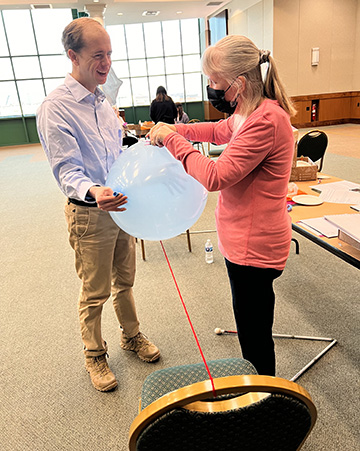 I have strong feelings about immersing our blind youth in all that STEM programs have to offer. It is also true that I have chosen a career that motivates me to advocate for the participation of blind youth in any and every STEM opportunity their classmates and peers receive. However, I do not feel that every blind youth should become a scientist, mathematician, information technology specialist, or engineer.
You may wonder why I feel so strongly about blind youth participating in STEM, if it's not for them to choose this career path. Furthermore, why should you advocate as strongly for equal participation as I do?
The answer to this question, though multi-faceted, is quite simple: blind students should do STEM because the other kids are doing it.
Of course, not all non-blind kids will grow up to work in a STEM field. This may seem like an oversimplification of the matter, but it really is the point. Sighted youth are provided with hundreds of chances to participate in STEM activities, in and beyond the classroom, from preschool all the way through receiving a high school diploma. Not all of these young people will become scientists or engineers, but by having opportunities to participate in STEM, they know that these careers are attainable.
Research demonstrates that participation in STEM activities improves critical thinking skills, teamwork spatial skills, language development, and more. For this reason a growing number of STEM-focused camps, curricula, and even schools are popping up all over the nation. More and more educators and parents recognize that participating in STEM learning opportunities helps youth improve their academic skills in all subjects. Sighted students who participate in STEM increase their academic success and build their career potential in endless fields. Blind youth deserve the same opportunity to reach their full potential.
Although I make this point seem cut and dried, many of us know that things are not so simple. The access obstacles facing blind youth in and out of the classroom present countless challenges to full and equal participation in STEM learning. Students often do not have the tactile graphics or technology they need. Often they have teachers who are not knowledgeable about alternative techniques or who are unprepared to teach what they perceive as predominantly visual subjects to a blind student. Too often the blind student is relegated to sitting on the sidelines, taking notes in the lab group. Meanwhile, the sighted students interact directly with the experiments and activities. Why can't a blind student use the open-flamed Bunsen burner or learn to measure out the chemicals for a lab experiment? The expectations that teachers have of blind vs. non-blind students are not equal. Sighted students have hundreds of opportunities to engage in STEM, but blind students are lucky if they have half as many. Even the opportunities blind students do have are often severely unequal.
The National Federation of the Blind knows that blindness is not a barrier to full participation in STEM in and out of the classroom. We are raising expectations by creating our own opportunities and educational resources to help blind youth overcome these barriers. Starting in 2004 with the NFB Rocket On! program, the NFB has been creating STEM programs for blind youth, proving that equal access is possible. From NFB Youth Slam to NFB EQ, these programs have shown blind youth, their families, and their teachers that STEM careers are not out of reach. You can learn more about these programs and other past NFB STEM programs at nfb.org/programs-services/national-center-blind-youth-science/past-nfb-stem-programs.
The NFB has also led efforts in creating educational resources that show how STEM can be accessible to blind people. This year the NFB released two informational toolkits to assist parents and teachers with bringing STEM access and opportunities to blind youth. These toolkits are NFB EQ for Teachers (nfb.org/programs-services/education/national-center-blind-youth-science/nfb-eq/nfb-eq-teachers) and NFB EQ for Parents (nfb.org/programs-services/education/national-center-blind-youth-science/nfb-eq/nfb-eq-parents). These toolkits are free online resources that focus on how to bring STEM access to blind students wherever they are.
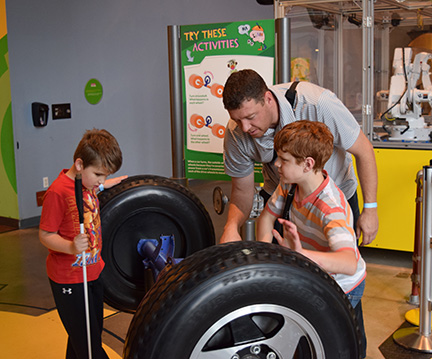 One of the currently running programs, NFB STEM2U, is uniquely designed to bring these amazing STEM learning opportunities directly to blind youth across the country. NFB affiliates in more than ten states will host STEM2U programs in the spring and summer of 2024. The theme of the current program is the James Web Space Telescope. Students will have opportunities to launch homemade rockets, learn how telescopes "see" space, and even build their own model of NASA's James Web Telescope. Bringing these activities directly to local affiliates eliminates travel and time barriers for students and families while giving them opportunities to participate in a fully accessible STEM experience. Many of these students have limited opportunities like these, where their blindness has no impact on their ability to engage, participate, and learn real science. Will they all decide to go work for NASA, Google, or the CDC after the program? The answer is likely no. The important thing is that students will build on their problem-solving skills, social skills, and knowledge of how science can be accessible to them.
As the voice of the nation's blind, the NFB knows that blindness is not (and should not be) a barrier to prevent blind youth from actively participating in science, technology, engineering, or mathematics. This is why the NFB is breaking access and education barriers for blind youth across the country. This is why the NFB is bringing STEM to You!
You can find out more and register blind youth for a local program by visiting nfb.org/stem2u.