American Action Fund for Blind Children and Adults
Future Reflections Winter 2024 THE PATH TO EMPLOYMENT
We Have Work to Do: Reflections on Changing the Blind Employment Paradigm
by Mary Fernandez
Reprinted from Braille Monitor, Volume 65, Number 11, December 2023
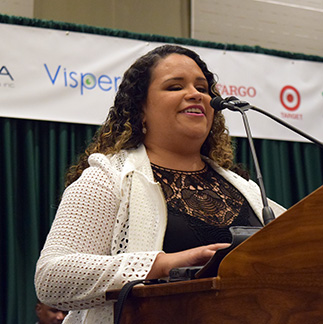 From the Editor: Mary Fernandez has been active with the National Federation of the Blind since 2006, when she helped launch a rocket with the Rocket On! program for blind high school students. Today she is the lead consultant on disability inclusion for Cisco Systems, a major producer of software and cybersecurity systems. This article is based on the address she delivered at the 2023 NFB National Convention in Houston.
Good afternoon, Federation family! It is an absolute honor and humbling experience to stand in front of you today.
When I was a little girl, my mom used to tell me, "You have to eat your books!" This was her way of telling me that literacy and education would be the keys to my future.
Yesterday's agenda featured three brilliant women: Susan Mazrui, Karla Gilbride, and Eve Hill. All of them are my personal heroes, undeniable queens, and all of them proudly mentioned that they were stubborn children. So, to all of you I want to say: "Hi! It's me! I'm the stubborn one!"
Mother Knows Best
As a stubborn child my attitude was, "No, I will not read!" Fortunately my mother is a literal force of nature. One day after I threw another tantrum, my mom shut me in my bedroom with a Braille book, Judy Blume's Freckle Juice. I would not go down without a fight! I screamed, I cried, I may even have thrown myself on the floor. There was nothing but silence from the outside.
Finally, in an act of seven-year-old desperation, I very slowly and tentatively ran my fingers over the book title. Freckle Juice? What is this Freckle Juice you speak of, oh Ms. Blume?
Then I did the unthinkable—painstakingly and ever so slowly I opened the book to the first page. And then...
I realized that there was a bunch of info on that first page about copyright. What the heck! It's hard for a seven-year-old to understand the importance of an author's intellectual property!
Finally I read the words: "Line up, boys and girls," Miss Kelly said. "Time to go home now."
I was hooked. I was hooked on books, I was hooked on literacy, and most importantly, I was hooked on Braille.
This stubborn child learned, and continues to learn, that my mother is always right. Thank you, Mommy!
My mother could not have been more right in that moment. She knew that education would unlock my ability to think critically and hone my ability to synthesize in the midst of complexity. My educational career taught me that stories move me, that curiosity drives me, and that connection feeds me.
My mom knew the importance of Braille literacy for her blind child. "If one can read," she would say, "one can do anything."
Reading Braille made it possible for me to earn a well-rounded education. For me, education was also the first puzzle piece to what, in a disabled person's life, can become the greatest and hardest undertaking: finding and keeping a job.
Three Big Questions
To say that education leads one directly to a job, and most importantly, to a fulfilling career, would be an oversimplification. However, I argue that the skills necessary for the job market start at home, that they are supposed to be reinforced in school, and that they are supposed to be cultivated and nurtured as we become adults and are able to make substantive decisions about our careers. But when you introduce blindness into the equation, the oppressive forces of ableism often break the links in that process.
Today I want to answer three questions. Why is the unemployment gap for blind people still so significant? What can I do as an individual to be more successful in the job search? What can employers do to move the needle in a meaningful way?
Let's look at the statistics. According to the US Bureau of Labor Statistics, in 2022 the unemployment rate for disabled people was almost 9 percent, vs 3.4 percent and dropping for nondisabled people. This means that disabled people are unemployed at almost three times the rate of nondisabled people. The statistics go on and on and can be broken into so many numbers, but at the end of the day the data tell us that disabled people are disproportionately under-employed or unemployed. This is particularly true if someone is disabled and has other marginalized identities, such as being a person of color.
It is one thing to hear these numbers; it's another to live them. I attended Emory University and graduated with a 3.8 GPA in 2012. I will never forget how, for the last semester of my senior year, I submitted an average of five job applications a day. I'll never forget the sinking feeling that came with every email saying what amounted to, "Thanks, but no thanks."
I will also never forget how, after five years of work experience as a paralegal at Brown, Goldstein and Levy and starting a transition program in New Jersey for blind and low-vision high school youth, I went back on the job market. While I sought a more stable position, I wanted to have an interim part-time job. I applied to be an English tutor for sixth graders. I completed the online application process, I passed with flying colors, and I got the job.
Then I mentioned that I am blind and wanted to test the collaborative software and have access to an electronic version of the instructional materials. There was a long pause on the phone, and I was told I'd get a call back. Ten minutes later I was told there was no longer a position available.
Most of us in this room have been there. We struggle with ourselves over whether to disclose our disability before or after we get an offer. We know that both choices offer no assurance of employment at the end of the long process.
Now, more than at any other time in history, we have unparalleled access to technology. We have laws that are supposed to protect us, and we have commitments to diversity, equity, and inclusion from companies that say, "We really do want you here." Yet many of the digital tools we need to do our jobs still are not accessible. Employment discrimination cases can take years to be resolved. The companies with bold DEI (diversity, equity, and inclusion) commitments published on their careers pages seem to miss the fact that accessibility and accommodation are integral parts of true equity and inclusion. As a result, most of us are still waiting for the opportunity even to try.
The Heart of the Problem
At the heart of this problem is oppression. Four aspects of oppression add up to marginalization. They are ideological, institutional, interpersonal, and internalized. These four types of oppression come together to form a narrative that affects every aspect of our lives.
Though there isn't time to dive into all these issues today, one important aspect of oppression I want to discuss is internalized oppression or ableism. This is the most uncomfortable form of oppression to dismantle. It requires us to acknowledge the presence of all those little voices that add up to say, "You are not enough. If you keep asking for accommodations, you are not as good an employee as everyone else." This voice can even manifest as, "If you ask for help, you are not a good enough blind person." All of these voices feed on the previous dimensions and are the ultimate form of oppression. They make us, in some form, doubt our worth. They sound different for every single person and every group.
One of the most effective ways to counter internalized oppression is through community and collective action. Action is the counter-narrative that we provide for each other, a narrative of strength, a narrative of resilience, a narrative that we do have control of our own future! It is the training, advocacy, and refusal to settle for second-class citizenship that are core to our organization.
In the face of oppression, what can we do as individuals to break down those barriers? How do we carry on when the systems that are supposed to support us continue to fail us?
The good news is that the NFB has always been a group made up of former stubborn children. It has been dismantling oppression for more than eighty years, and every one of us in this room has benefitted from that. When there was no useful orientation and mobility training, we invented it. Then we refined it, and now we teach each other how to travel confidently. If they will not teach our children Braille in school, we will teach them ourselves while simultaneously fighting to protect the rights of those children. The NFB has the largest scholarship program for the blind in the world. The list goes on and on.
Finding Community
The community I have found here in the Federation has been one of the most integral parts of my success. You see, when I arrived in the United States from Colombia, I was almost eight years old. When I was two my mother, at the age of twenty-six, took the risk to emigrate to this country. She knew no one, she did not know English, and she didn't know where she would go. But she got on a plane and landed at John F. Kennedy International Airport in New York City.
After she had worked here for about a year, my mother got a call. I had been diagnosed with glaucoma, and it would simply be a matter of time until I went blind. My mother used the pain of not being with her daughter during this pivotal moment and turned it into fuel to keep her laser-focused on her mission—to bring me and my brother to the United States. She knew then that it would be my only chance at a fulfilling life.
So I came here, an awkward and stubborn child. I had no social skills. I had never attended school, and I don't think I really understood what being blind meant. When my O&M instructor put a short, stubby stick in my hand and told me I had to use it going forward, I promptly dropped it on the floor.
Though the uphill battle to get me to read was fairly quickly won, the battle to have me use my cane proved much harder. I had deeply internalized beliefs about blindness and disabilities, even though I didn't know how to name them. Blindness was a weakness; a cane was a thing that old people used. Though by the time I was in high school I used my cane every day, I did not feel comfortable in my skin. I felt like an outcast, as if no matter what I did, I was either invisible to others or the most conspicuous person in the room.
It wasn't until I was fourteen that my feelings about myself began to shift. I started participating in the youth transition program in New Jersey called Leadership, Education, Advocacy, and Determination (LEAD). Through that program I met one of my first mentors ever, Sherlock Washington. Toward the end of the school year, I met another mentor, someone who would support me for the rest of his life, Joe Ruffalo.
Joe gave me my first lesson in advocacy. We were at the NFB National Convention, and I had heard about the Rocket On! program and how these cool teenagers would get to launch a NASA rocket. I wanted to go! Joe said, "There's Mr. Riccobono. Ask him if you can participate." So I did, and the rest is history.
Finding community equates to finding a place to belong. We know that blind people are not a monolithic group, but at the same time we have a shared lived experience that we all understand. We also understand the false narratives around blindness. With the NFB I found my little tribe. It has grown throughout the years, and it has carried me through the most challenging parts of my life.
So all of us on this employment journey, listen: It's hard! It's brutal! It's awful! But it is even harder when we do it all alone. It is harder when we have no one to turn to in those moments that only other disabled people will understand. I encourage you all to find and stay in community. Not everyone in this room is your cup of tea; that's okay. But maybe some of us are, and trust me when I say it's worth it.
Participating in the Federation sparked my passion and gift for advocacy. As a little girl, I was always looking for injustices to correct. When I understood the reasons why I was made to feel like an outcast, the fact that not all children got Braille instruction, that babies were taken away from blind parents, I thought, this is it, this is what I have to fight for, and fight for every day. The NFB also sharpened my leadership skills. From delivering my first speech in front of two hundred people at the NFB of New Jersey convention at age fourteen to leading affiliate student divisions, those leadership skills quickly transferred to my life outside the NFB. I became involved in after-school programs and ran for school club leadership. I learned that true leadership does not spring from positional power, but rather from the actions we can take to influence change. And I learned that we can do it from wherever we sit.
Shaping Future Leaders
As I have gotten older, I've identified the set of values that I carry with me everywhere, values that were instilled by my mother, nurtured by the Federation, and implemented by me. I value integrity, honesty, hard work, collaboration, and authenticity. I try to conduct myself with courage, including the courage to speak truth to power.
I say all that to bring several things to the forefront. First, instilling confidence, reliability, and resilience starts at home. It starts with letting our children take risks. It starts with letting them know that yes, they are wonderful, not just because they are blind, but because they have a specific set of gifts and skills to explore. All of these factors contribute to shaping future employees and leaders.
Second, in the face of oppression we, as a collective, are the best at developing each other's gifts and talents. We provide a space where we support each other while we constantly challenge each other to grow. And when the world won't provide, we fill in the opportunity gap to ensure that our youth have a full and well-rounded set of life experiences.
Are we perfect? No. Just because we are disabled does not mean we are free from ableist beliefs. Even as we push each other, we must continually find ways to uplift each other, not to fall into the trap of oppressing each other. We know that there isn't one right way to do blindness, and we must provide space for that. We know that blindness is often accompanied by other disabilities, and we must find ways to be inclusive to those of us with multiple disabilities.
As I think about employment and the collective blindness movement, I keep coming back to the evolution we've experienced since we began. Today we are having conversations around how all of our identities, taken together, form an intersection that is inseparable from how we experience the world. When I started in the NFB I embraced the idea that blindness was a characteristic like my hair color. But as I've grown in my work and dived into my intersecting identities, I actually think that my disability is far more than that. My disability is part of my identity. You see, if I had this gorgeous curly hair but I had 20/20 vision, the way I experienced the world would have been very different. For instance, my hair or my eye color would not have affected the accessibility of my educational materials in graduate school. However, my disability did. So do my skin color and my gender identity. I no longer believe that asking for equal access for disabled people is enough. Rather, in my work, I advocate for equitable access. That is, to provide the tools and resources that individuals need to be successful.
Equality means providing stairs for everyone to use. Equity means providing stairs, elevators, escalators, and ramps in equally convenient places so that all can choose their path upward. It is being intentional about bringing in as many people as possible. Because of the complexity of inequities that we experience at different moments in our lives, there really isn't a one size fits all solution.
In his speech "The Nature of Independence," Dr. Kenneth Jernigan said, "Unless you make advances over what we have done, you will, in a very real sense, fail to keep faith with those who have gone before you and those who will follow. In this context, I would expect and hope that some of you will become better travelers (and, perhaps, better philosophers and teachers) than I, and if you do, I will take joy in it." So I challenge us all to stay on this path of seeking not just equality but equity. If freedom is the right to choose, then equity is the path to that freedom.
Some Words for Employers
Employers, I want to spend a little bit of time talking to you. Here are three best practices: First, design with us and not for us. Often employers ask, "What are the right jobs for disabled people, and what programs do disabled people need?" Then, programs are launched with names that include the words "differently abled" and "special" and "uniquely gifted." These programs are seldom designed with disabled people, but rather for disabled people. I invite you, today, to design with us. Here is the good news: you all are already in the room where it happens. Each blind person here is an expert in their experience, and collectively we have invaluable wisdom about what we need. Go where the disabled people are, do not just wait for them to appear. Engage with us, understanding that what we share has value and that it will benefit you financially. Then proceed accordingly.
Yes, it is going to be messy and difficult, and it is okay that businesses haven't always gotten it right. But when we work with each other, we can create talent-based strategies that truly open up opportunities for economic freedom.
Second, let's stop performative hiring. What do I mean by this? Last year I went to a disability-related conference attended by most of the Fortune One Hundred. A career/talent expo was part of this conference, and periodically companies would announce who was leading in hiring the most disabled people. Out of curiosity I went to the company with the most hires. I talked to them about my experience and asked, "So, what types of opportunities do you have for someone with twelve years of work experience?" They said, "Well, we are really just hiring interns and entry level."
I'm a curious soul. I took it upon myself to walk around and see who was hiring experienced disabled professionals. The answer was no one.
Friends, it is not enough to hire people at entry level. Is it important? Yes, but it is simply not enough. First, when you do recruit and hire disabled talent for entry level positions, what strategies are you using to develop their leadership potential? Do you have processes in place to ensure you are removing accessibility barriers?
Also, there are disabled people with talent that is far beyond entry level. What are you doing to recruit them? Are you truly leveraging AI resumé screening systems to include diverse talent or simply to exclude disabled employees? We know that we only dismantle systems of oppression when we change the demographics of the group in decision-making positions. This means that we fundamentally shift what we think of as an executive leader, for instance, in preference to what skills, talents, and experiences people bring to the table. I submit that executive leaders are blind, are deaf, are autistic, dyslexic, etc. It is not our job to be "good enough" to break your glass ceiling; it is your job to take your own roof off.
If you do those two things—design with us, and critically assess and revamp your recruitment and hiring pipelines—then we start slowly to reach for that higher fruit. That stretch will get you to just brush the tips of the branches of belonging.
Third, belonging is a sense that each of us is fundamentally valued and that our uniqueness is not only sought for but treasured. There is one week every year where I feel a real sense of belonging outside my circle of friends and family. That is at the NFB National Convention. I know that if I walk into a restaurant, I'll be offered Braille, large print, or regular print menus; I know that there are talking signs for meetings; I know that no one will grab the end of my cane to guide me around. This knowledge gives me an energy I don't feel at any other time to be my truest and best self. When we remove barriers systemically and intentionally, we allow every person to be their most productive self. When we design for the margins, we include everyone in the middle.
I want to wrap up with an ask for everyone in this room. My ask is that you always pay it forward. When you get that internship, pay it forward by mentoring another, perhaps younger student. When you sit in that room where no other blind person has sat, pay it forward and open up that door further. When your company outperforms predicted revenue, pay it forward and open up the door to economic freedom for disabled talent.
In my case, education has been the touchstone of my success, my mother the unwavering support, and the NFB the community that has held me and on whose shoulders I stand. To every person in this room and all disabled people who do not have community yet, you have my commitment that I will continue to pay it forward. And I hope each of you in this room will join me in paying it forward, too.
I'll leave you with this question: what will you do to pay it forward?
In that spirit, I want to pay it forward today: for the stubborn child who refused to accept society's narrative about her blindness, for every young person in this room who is just finding their community, and for every parent who fights every day to give their child a future without limits. In honor of the woman who raised me to be courageous, fearless, authentic, and a strong advocate, I'd like to pledge $3,300 to the NFB in honor of Clara Roman, my mother. I trust that no other organization will put this to better use in educating our youth and pushing the boundaries of what we've been told is possible.
Thank you!