American Action Fund for Blind Children and Adults
Future Reflections Winter 2024 THE PATH TO EMPLOYMENT
Discovering My Passion: How My Life Experience Led Me to Become a School Social Worker
by Jhaliyah Anderson
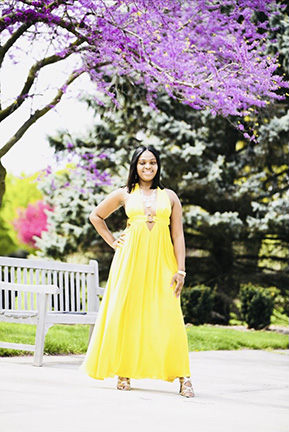 From the Editor: I met Jhaliyah Anderson in 2015 when, as an entering college freshman, she won an NFB of Illinois Scholarship. At a point in life when many students feel uncertain about their future plans, Jhaliyah knew exactly what she wanted to do. She wanted to become a school social worker. She wanted to help students who felt like outsiders, who struggled to fit into the school environment as she had struggled herself. Jhaliyah never wavered in her determination, and this year she started a job as a social worker in the Chicago public school system. Here is her story.
I lost my vision at the age of three. Many of the people around me thought my blindness would define my life, but I never believed it would stop me from doing anything I wanted to do. I guess I was a stubborn kid right from the beginning!
Through fourth grade I attended a resource room for blind students in a public school near my home. I became a fluent Braille reader and learned to use a long white cane. For part of the day I went to classes with the sighted students in my school. Since I was only mainstreamed for a few classes each day, I felt like an outsider. To make matters worse, often I didn't get my class materials in an accessible format, so it was hard for me to participate fully.
In fifth grade I transferred to the Illinois School for the Visually Impaired (ISVI), a residential school nearly four hours from my home. Suddenly I found myself in an environment that was completely tailored to my needs as a blind student. Everything on campus was accessible! For the first time in my life I had all the Braille books I needed for my classes!
During my years at ISVI I took part in a variety of extracurricular activities. I was on the debate team, I played goalball, I was a cheerleader, and I went out for track and field. We were never coddled. We were expected to take on challenges, and I thrived in that atmosphere.
As time went on, though, I realized that ISVI had its down sides. Academically I was one of the strongest students on campus. Instead of challenging me, the teachers left me to work on my own while they focused on my classmates who were struggling. Often they asked me to help the other students, and I did a lot of peer support. I wanted to advance academically, and I realized that my opportunities at ISVI were seriously limited. I asked to take some of my classes at the local public school, but the administration at ISVI said no.
Meanwhile, I heard from my friends back home about all the things they were learning and doing at school. I felt I was living in a protective bubble. I was isolated from the world where the vast majority of people lived, worked, and played.
When I was in eighth grade, I told my family that I wanted to leave ISVI and return to public school back home. As I look back on it, I realize it was a bold decision. Without the support that was available to me at ISVI, I struggled to fit in.
Making a transition is hard work! I had spent my middle school years among blind peers, in an environment where no one doubted my capacity. Now, back in public high school, I was an outsider. Every day I had to prove myself to my teachers and classmates. I constantly felt scrutinized and judged, and I grew anxious and depressed. I missed a lot of school due to the stress.
Hard though it was, I wanted to stay the active, involved person I was back at ISVI. I pushed myself to talk to my classmates, working at making friends. I went out for track, cheering, and speech. The track coach was amazing! I was included in everything. But on the cheerleading squad I was not allowed to train for competitions. I did all the cheering maneuvers at our games and never messed up, but that made no difference. Nothing I said, nothing I did in my performance could change the coach's mind, and I felt isolated and discouraged.
My classes were a struggle, too, because I didn't always get the books and other materials I needed in accessible formats. One teacher wouldn't even give me tests with the rest of the class. She actually told me to put my name on a classmate's paper! When I told my mother what had happened, she went into action. A huge meeting was called, and even the superintendent got involved. After that the teacher shaped up, and I was tested along with everyone else.
In chemistry class I was assigned a classroom aide to help me in the lab. The chemistry teacher would stop by and talk to the aide about my work, never speaking to me directly. It was more than annoying! One day I said, "I can talk to you about my assignments. Please talk to me, not to my aide!"
Later, when I was meeting with my TVI (teacher of the visually impaired), the chemistry teacher burst into the room. "You were disrespectful to me!" she screamed. "In front of the whole class! I won't have you speak to me that way!" She was really out of control. That was another time my mom had to get involved. There was another big meeting, and after that the chemistry teacher spoke to me directly instead of talking to my aide.
My experiences in high school led directly to my career choice. I made up my mind that I wanted to become a school social worker. I wanted to help students who were struggling academically and/or socially, students whose needs weren't being met by the system that was in place.
After I graduated from high school I majored in social work at the University of Illinois/Springfield. I graduated in 2019 and took a job as a counselor in a program called Super Seven. It involved recreation and counseling with Black and brown girls in inner-city neighborhoods. Later, early in 2020, I was hired as a teacher's aide—but the COVID-19 pandemic ended that job before it began.
For a while I worked in sales from home. That job confirmed what I knew already—selling products was not my thing! Finally I completed the lengthy process of being approved to work for the Illinois Department of Human Services. Mostly I interviewed people to determine their eligibility for Medicaid, SNAP, and other assistance programs. It was a lot better than sales, but I still wanted to become a social worker and work in a school setting.
After I had been with the state for a year, I finally was able to enroll in the Master's in Social Work (MSW) program at the University of Illinois/Chicago.
Not too surprisingly, some of my instructors assumed that I wanted to work in an agency that serves blind people. I had to point out more than once that blindness is just one piece of who I am. I have lots of skills and interests, and I can serve the community in many ways.
When I interviewed for a job with the Chicago Public Schools (CPS), I was apprehensive about the roadblocks I might encounter. Maybe the manager would say it would be too dangerous for me to work in the schools. Maybe I'd be told to apply for a job at the Chicago Lighthouse.
But to my delight the hiring manager really saw me for who I am. We talked about my commitment to work with students who are struggling in the school environment. I think the manager really understood that this was my passion. I was hired on the spot!
When I started my job, a few of my coworkers were pretty skeptical. They tried to steer me away from some of the students, kids they thought I wouldn't be able to handle. I tried to have open communication with them and to answer all of their questions. When they observed how I interacted with the students, they calmed down, and now I feel they're fully on board.
Right now I'm more than halfway into my first year on the job, and I'm very excited to be here. I'm really happy with what I'm doing; I feel it's my life's purpose. I realize I've gained a lot from my life experience, and it helps me connect with kids who are struggling. Whatever issues they face, I try to help them find ways to cope and get through the day.
I haven't worked with any blind students, but I've met some kids with learning disabilities who are struggling to fit in socially. When they talk about feeling isolated and excluded, I think I know just what they mean. I'm their advocate. We work together to map out strategies so they can handle some of the tough situations they face.
I'd like to stay in school social work for at least ten years. Eventually I want to work in underserved neighborhoods, maybe helping to start a community center. There's also a great need for people to work in juvenile justice, and I might decide to go in that direction. The longer I work in the field, the more I'll learn. The more I learn, the more I'll be able to contribute through the years.