American Action Fund for Blind Children and Adults
Future Reflections Special Issue on Cooking GETTING STARTED
The Apple of My Pie: My Culinary Journey
by Cricket X. Bidleman
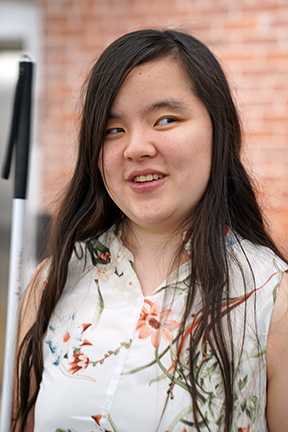 During my sophomore year in college, I decided to teach a class on baking. It would be a class with only a few students, but I thought it would be a great opportunity for me. At that time I wanted to enter a doctoral program and eventually teach at the college level. The problem was that I had never done much baking myself, much less taught baking to others. Sometimes turning dreams into reality starts with more of a dream than one realizes.
My journey into cooking was circuitous at best. I loved to read cookbooks growing up, but my parents never allowed me to cook. They actually prevented me from cooking, learning to do laundry, and taking public transportation, despite endless recommendations from my teachers of blind students. My parents believed I should make enough money someday that I could hire others to do those things for me. Considering the widespread unemployment rate among blind people today, this notion was highly unrealistic.
Food was the catalyst for my severe issues around body image. For my mother the ideal body was one that many would consider unhealthy. Since I couldn't see what the people around me looked like, I didn't have a strong concept of what it meant to have a healthy body. There were times in my childhood when I was fairly overweight, but there also were times when I was forced to lose weight at an unhealthy rate. Honestly, I'm still not sure what a healthy body should look like. I never have a scale in my apartment because I know it would bring back some old anxiety.
Although these issues were deeply troubling to me, I couldn't discuss them comfortably with my parents. I think there were aspects of raising a blind daughter that they simply couldn't understand.
That being said, I truly loved food, and I still do. Food brings people together—everyone has to eat, after all. The regional differences between similar types of food are intriguing—falafel in one city differs from falafel in another city within the same country. The more my parents drove me away from cooking and food, the more deeply I was drawn to cooking intellectually. However, my lack of exposure to cooking made my connection with food purely cerebral.
In my senior year of high school, I knew that I had to attend a training center where I could learn independence skills—alternative techniques that would allow me to be successful as a blind person. I was going to college soon, and then I'd be an independent adult. I didn't know which college I would go to, but I knew for sure that I'd have to do my own laundry. I didn't need to have other people seeing those weird peanut-butter socks my grandma sent me! Seriously—those socks had logos for some obscure peanut-butter company whose name I don't remember anymore!
I was very comfortable with my identity as a blind person. Nonetheless, pursuing training at BLIND, Inc., a training center based in Minneapolis, was one of the hardest decisions I've made. I was sure that my desire for independence would fracture my already-tenuous relationship with my parents, and I was right. We're now estranged, but training at BLIND, Inc. built the foundation for self-confidence and independence as I entered adulthood. In other words, if I could go back and make a different choice, I would not. During the summer of 2017 I had the opportunity to learn to live independently, to grow as a person, and to work with some wonderful mentors.
During my summer at BLIND, Inc., I discovered how much I love cooking. I also discovered how much I (like many others) despise doing laundry, and how much I needed to improve my travel and public transportation skills. Being around so many successful blind people filled me with the determination to succeed and to be like them. I aspired to pass forward the love my blind mentors showed me.
My Federation mentors are still an integral part of my life. Until I started seeing a therapist during college, I leaned on them far more than I should have. They were always there for me, helping me build self-confidence, responding to my endless texts and calls, and extending the empathy that I didn't experience growing up. I really think my emotional growth started when I met them.
My mentors prepared me for self-advocacy in college. Dealing with the Office of Accessible Education and the Department of Vocational Rehabilitation is complicated, to say the least. Getting the technology I needed for college was quite the battle. Once I was in college, getting the accommodations I needed from my instructors was also difficult.
In December of my freshman year I faced my first-quarter exams. Final exams were scheduled to be three hours long. I was allowed double time as an accommodation, which meant I'd be writing essays for six hours. I ended up taking the exams at different times so that I wouldn't be writing late into the night.
My dormmates and I all had one exam in common—we were in a literature/philosophy program together. I asked them what I could do for them while they took the exam I was taking at a different time. Was there something that I could make to help ease the post-exam stress? Someone suggested that I make hot apple cider.
I had no idea how to make apple cider! I realized I could buy some, but my campus wasn't close to any stores. Besides, it didn't seem fair to take a shortcut while my friends were furiously writing essays for three whole hours.
I looked up a recipe for apple cider, and ended up boiling apples for three hours in a pot of water with a bunch of spices. That first batch wasn’t great. I should have used less lemon juice and fresh spices instead of powders. But I managed to make it, and that was an accomplishment. My friends were very hungry after the exam, so they thought it was great. I've made hot apple cider many times since, and each time it gets better.
It was during the following year that I decided to teach baking. With infinite cleverness, I called my workshop “Apples to Apples.” As I’m sure you can guess, we made apple desserts. When it was time for us to bake apple pie, I honestly had no idea what to do. I looked up recipes, gathered ingredients, and figured it out. The pie was great, and I've been an avid baker ever since.
Since then, I've done lots of baking, and I've explored the alternative techniques that blind people use in order to succeed. I bake regularly for friends and for the staff at the National Federation of the Blind, which is where I work. I'm even growing a sourdough starter, which I named after one of my colleagues as a joke. The name stuck, so the joke's on me.
Many people, both blind and non-blind, think that cooking is very visual. How can you tell when a steak is done? How do you know if cream is whipped to stiff peaks? How do you tell when sourdough starter has doubled in size?
You can tell when meat is done by the texture—cooked meat feels tougher, firmer, and of course hotter. (Or you could use a talking thermometer.) When cream has reached stiff peaks it feels different, and the mixer attachments make a different sound. If you mark your container of sourdough starter with a rubber band or a piece of tape, you can check how far the starter has risen. Often the alternative techniques I use are not as complicated as you might think, but they do take practice.
My message to parents in general, and especially to parents of blind children, is that kids should start learning to cook early. A passion for food is not bad, despite some of the bizarre and sometimes unhealthy perceptions that exist. Blind children need some extra passion to help them get beyond those moments when they’re told that they can't do something; for us, those moments are far too many. Blind kids can and should dream big. And they can, and should, turn dreams into reality.