American Action Fund for Blind Children and Adults
Future Reflections Special Issue on Cooking GETTING STARTED
Kitchen Memories
by Rebecca DeGeorge
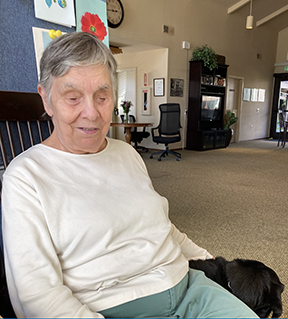 From the Editor: Rebecca DeGeorge grew up in Chicago during the 1960s and attended the University of Illinois at Champaign-Urbana. She lived in Indiana for seventeen years, freelancing for the local newspaper. In 1985 she moved to California, where she taught Braille at the San Francisco Lighthouse and later worked for Guide Dogs for the Blind.
The kitchen in the house where I grew up was my mother’s domain. It wasn’t a fancy kitchen. It had no dishwasher or counter. It just had a sink with a drainboard on each side, a gas stove, and the Formica kitchen table where Mom put her cutting board. On that table she peeled, chopped, or sliced fragrant vegetables or mixed the ingredients for meatloaf in a bowl. We were a meat and potatoes, spaghetti and meatballs kind of family. Whatever my mother cooked tasted delicious—except, in my opinion, liver and onions.
Since I’ve always been totally blind, Mom told me that celery and lettuce are green, carrots are yellow, and meat is brown when it’s done. What mattered to me was the taste and the pleasure of coming home from school to the mouth-watering smell of whatever was simmering, baking, or frying.
One day when I was five or six years old, Mom asked, “Want to help me make a chocolate cake?” I was thrilled about chocolate cake and about being asked to help.
“You can grease the pans,” Mom said, “but you need to wash your hands first. You always wash your hands before you cook.”
Mom put a small dollop of vegetable shortening on each of the two round layer cake pans. She showed me how to spread the shortening all the way to the sides.
“It’s got to be even,” she explained, “or the bottom of the cake will stick, and we don’t want that.”
Mom showed me the box that contained the small envelope with cake mix and read the directions out loud. I could smell chocolate! Yum! After showing me the nested measuring cups, Mom measured out the necessary ingredients. She cracked an egg into a bowl and let me scramble it slightly, guiding my hand so I learned to keep the tines of the fork flat.
“Now we’ll stir it up,” Mom said. With her hand over mine as I held the wooden spoon, that’s what we did.
“This is fun!” I said. I felt grownup, proud to be allowed to help.
In some ways, Mom was a perfectionist. Things had to “come out right.” I think she felt too worried to let me get up close and personal with the stove. During my grade school and high school years, I often heard the clink of measuring spoons and the rattle of measuring cups, but I was the kind of kid who’d rather read than cook, and Mom didn’t insist. Even as an adult, cooking is something I do because I need to, not because I can’t resist the lure of the kitchen.
At age eighteen, before going away to college, I spent a few months at an agency that used to be called the Illinois Visually Handicapped Institute. In one class a very patient woman taught us to iron, sew on buttons, and cook. I finally learned to measure, slice, chop, and use the top of the stove as well as the oven. I learned to label cans and jars with Braille and to keep tools organized, always putting a knife in its place with the blade pointing to the back of the drawer, the sharp edge to the right. The instructor stressed safety and orderliness when cooking—no dangling long sleeves, no ties getting near the burners, no paper towels or other objects lying on the stove top. We practiced standing in front of the center of the oven door and getting pans in and out while the oven was cold. Then we did it when the oven was set at the correct temperature. We learned about putting tactile markings on the oven dial at important, frequently used temperatures. We did the same with burner dials, knowing which dial related to which burner. We learned to use Braille cooking timers. I loved finding Braille cookbooks!
One afternoon when my parents were out, I decided to make peanut butter cookies. I spread newspaper on the table, got out the bowls, and lined up the ingredients. Then I put my Braille copy of the recipe on the fridge with a magnet so it wouldn’t get spilled on. I measured, stirred, mixed, and rolled, placing the cookies carefully equidistant from each other on the cookie sheet. Then I slid the cookie sheet into the oven.
Long before, Mom had shown me where the point of the oven dial would be when the temperature was set at 350 degrees. Why she told me this I can’t remember. Maybe I didn't set the dial as precisely as it needed to be set. Perhaps timing the baking with my watch, since we didn't have a tactile timer, wasn’t precise enough.
After several minutes, just about the time when I was ready to take the cookies out of the oven, I began to smell smoke. Then, as I opened the oven door with a potholder on each hand, I heard the key turn in the front door lock.
“What are you doing!” My father’s quick, loud steps and loud, angry voice almost made me drop the cookie sheet.
Coming home to a house full of smoke would be a jolt for anyone. Still, my parents’ reaction left me feeling deflated, disappointed, and embarrassed. The cookies didn’t taste very burnt, but I felt I could never experiment in Mom’s kitchen again.
When I went away to college and eventually got my own apartment, a home teacher of the blind encouraged me to pick up the wooden spoon and spatula once more. That encouragement, along with reading cookbooks written for blind people, got me going.
Years later, the first meal I cooked for my husband was spaghetti and meatballs. “Please stay out of the kitchen until the table is set and everything is ready,” I insisted, feeling nervous and self-conscious. Fortunately, the meal turned out well, even though, by the time it was ready, I felt exhausted!
When each of my sighted daughters turned eight years old, I began to teach them to cook. We started with cookies, since that's something kids love! We “graduated” to more complicated baking and preparing main dish meals such as chili. I was always the main cook until they grew up and left home, but over time, each girl began preparing meals, which made us all proud. They taught me things as well. For example, I learned that foods like macaroni and cheese and corn do not make appetizing plate mates.
The biggest change I've experienced in cooking is the invention of the microwave oven. Marking it with Braille or tactile icons and teaching your child to use that appliance safely may be the best way to begin the cooking adventure. Neither you nor your child needs to become a clone of Julia Child. The goal is to teach your child to prepare tasty, simple meals safely. Whether you bake cookies or bread with your child or prepare main dishes together, there's no rush, no pressure.
National Braille Press sells a number of books related to cooking in Braille and other alternative formats. Check out www.nbp.org. The National Library Service for the Blind and Print Disabled (NLS) offers hundreds of Braille and recorded cookbooks. Under a new NLS program, patrons can request up to five Braille titles per month to keep indefinitely, so you can easily build a wide-reaching cookbook collection. And, of course, you can invent your own recipes as you go.
Remember, practice, not perfection is the goal. If you burn the bottom of your peanut butter cookies the way I did, it just shows that we learn by doing, not by trying to be perfect. Have fun!