American Action Fund for Blind Children and Adults
Future Reflections Special Issue on Cooking MEETING THE CHALLENGE
Making Espresso and Related Drinks Nonvisually
by Justin Salisbury
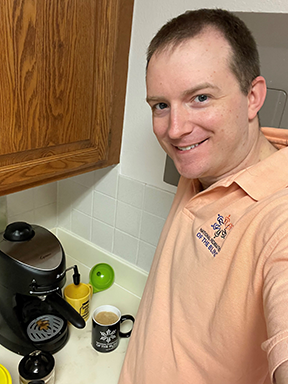 From the Editor: Currently Justin Salisbury is a graduate student and graduate teaching assistant in the Department of Rehabilitation Psychology and Special Education at the University of Wisconsin/Madison. He has taught cane travel, Braille, home management, and NFB philosophy classes at residential and nonresidential training centers for the blind. He works to bring the knowledge of the National Federation of the Blind into research, policy, and university training spaces.
Some devices that we might seek out are built especially for the blind. At other times we can adapt a mainstream product and make it nonvisually accessible, adopting principles of universal design. In such cases there are multiple ways of receiving, interacting with, and responding to information that comes from the device. These devices are often sold in places such as the NFB Independence Market, which are geared to blind consumers. However, such products can be used perfectly well by our sighted friends and family members. If these products were sold in mainstream markets and their inaccessible counterparts simply did not exist, we would not even think about them as blindness-specific products.
In my opinion, we tend to overlook products that naturally work for us from the beginning. They are just a normal part of life, and they don't require our further thought.
Strong Skills for Wise Consumers
I learned many wonderful lessons during my training at the Louisiana Center for the Blind (LCB). Just over ten years ago I was a student for nine months in the residential adjustment to blindness training program for blind adults. I took all of the classes that were included in the comprehensive training program. No matter how advanced someone is in a particular area, taking all of the classes together creates a symbiotic effect. The learning in one class complements the learning in another, and the knowledge from all of the classes becomes integrated across disciplines. The most important things we learn in training are not the physical techniques but the emotional lessons. Some people call it social and emotional learning.
Nevertheless, alternative techniques may not be obvious to all blind people. We can benefit from sharing these techniques with each other in a forum such as Future Reflections.
As one of the requirements in the home management class at the LCB, I had to learn to cut up a whole chicken. The instructor, who was sighted, told us that when she was first married, she and her husband were very young and did not have much money. They needed to stretch every dollar in order to live as well as possible. Many blind people can relate to this situation, as we are disproportionately economically disadvantaged. It's a good idea for us to acquire skills that can help us avoid spending money unnecessarily. Buying a whole chicken and cutting it up yourself is more economical than buying chicken legs, thighs, or breasts that have already been separated.
I admit that I have never cut up a chicken since the day I had to do it in training. However, that lesson taught me some new ways to think about food preparation. The same principle applied in the industrial arts class, where we learned simple home maintenance techniques, such as how to unclog a drain or fix a toilet. By mastering these skills, we wouldn't have to call a plumber for every little problem. Basic skills can save us money, and they give us choices and control in our lives. I have definitely used the home maintenance skills I learned, and I've been proud to teach them to others.
The Espresso Challenge
In the course of my lifetime, drinking espresso has become widely popular in our society. Today you can order espresso at coffee shops such as Dunkin', Starbucks Coffee, and Caribou Coffee much more easily than you could do it twenty years ago. I have lived on two continents and in eleven US states, and I find that coffee shops are springing up in places where they did not exist before.
America runs on coffee, and coffee is big business. Espresso has become a big part of that business, and espresso drinks are expensive. I know a lot of blind people with limited means who somehow manage to allocate the funds to purchase latte, macchiato, cappuccino, cortado, or some other espresso-based drink on a regular basis. I don't fault them for making that choice, but I would like to introduce another option. I would like to share a way for us, as blind people, to make our own espresso. Making espresso for ourselves can save us money and time, and it can give us more freedom of choice.
When I look for a new product that will work for me, I reach out to other blind people and find out what's working for them. This is one of the beautiful benefits of belonging to the National Federation of the Blind. I asked my blind acquaintances to share with me any wisdom they had about making espresso nonvisually. This might sound like an odd request, but allow me to explain why making espresso wasn't working out for me.
Many espresso machines for home use, especially the manual ones, require the user to watch for a light that will signal when the espresso shot is ready. In some cases the user has to look into the cup or miniature carafe and determine visually whether enough espresso has been brewed. In other instances the user has to watch a little gauge, something like some speedometers on cars, for an indication that it's time to turn off the machine. These approaches were not satisfactory for me as a blind person.
Even if I personally have enough vision to use one of these machines, I did not want to depend on my unreliable sight. I wanted to come up with a way to use an espresso machine without having to see it. When I reached out to my fellow blind people, I kept hearing that nobody made their own espresso. A fair number of people even lectured me about how it's not necessary for us to make our own espresso because we can just go to Starbucks and buy it. This notion ran counter to my reason for asking in the first place.
Some folks told me that espresso is only relevant in some obscure cultures. They claimed that it is not part of mainstream America. We're all entitled to our own ideas, but I operate under the assumption that most American adults have heard of a latte.
Finally I shared my dilemma with some coffee-shop employees. I explained various ways that an espresso machine might be nonvisually accessible. Commercial espresso machines are certainly different from the ones people use in their homes, but I figured that coffee-shop employees might understand the issues. Some told me they had heard of or seen an espresso machine that chimed to tell the user when to turn it off. That sounded great! I spent a lot of time looking for such a machine, but to this day I have never found one.
At last I decided to call the customer service lines of some of the big espresso machine manufacturers. I learned that there are manual espresso machines and automatic espresso machines. The automatic machines cost more, but they would allow the user to put the milk, the espresso beans, and the water into the machine; turn it on; and let the machine do everything else. This was certainly a step ahead of where I was, but those automatic machines were expensive. Besides, I wanted to climb to the top of this mountain of figuring out how to make my own espresso.
One conversation with a couple of NFB leaders really broke the door open for me. Grace Pires served as the national representative at a state convention about a year ago, and her husband Rob came with her. Grace is a rehabilitation counselor, and her husband Rob is a rehabilitation teacher. I knew that they both came from Rhode Island, a place where espresso is pretty normalized. I asked them if they knew anything about how a blind person could make espresso. By this time I had asked hundreds of people, and I was almost ready to give up. My conversation with Grace and Rob changed the dynamic of my search.
Grace and Rob had a system. They had a machine that was older than I was, and they still used it every day. They were able to talk me through the process, and they gave me a clear idea of what to look for in a machine.
The Espresso Solution
Now I will describe the machine that I have today and explain how I use it. This machine can be purchased for less than one hundred dollars. If you use it to make one latte every day, it pays for itself in one month!
I have a Capresso 4-Cup Espresso and Cappuccino Machine, model number 303.01. It has one button, which is an on/off toggle switch, a rocker switch. It uses a little carafe that can hold four espresso shots. It has a little basket for espresso beans, a handle that resembles a giant spoon that holds the basket, and a steamer arm-bar. You add the water through a hole in the top. I bought a big bag of espresso beans for five dollars at an Ocean State Job Lot, which is a discount store that, ironically, originated in Rhode Island! This bag of espresso beans lasted me through my entire fall semester.
To get started, I make sure the valve for the steamer arm-bar is completely closed. I twist a knob clockwise, righty tidy, and that valve holds in the pressure of the machine. Later I will use the valve to release the pressure.
Next I take the carafe and measure the amount of water that will match the amount of espresso I want. According to the instructions in the manual, I should fill the carafe all the way and stop the brewing process when I get as much espresso as I want. However, I don't like that technique. I prefer to measure the water while it's cold rather than measuring the espresso while it's hot. This is a blindness technique. I measure the water in the carafe. Usually I fill the carafe halfway, thus making about two espresso shots. I open the cover over the hole in the back of the top face. Then I pour the water from the carafe through a funnel into this little reservoir, and I screw the cap back on over the reservoir's opening. There's a lot of pressure in this cap, but a typical adult has the necessary hand strength to remove it. It's nothing compared to opening a pickle jar!
Then I scoop out the espresso with a spoon and load it into the basket. Next I use a little tool that comes with the machine. It has a little plunger on the end, which I press down into the basket so the espresso is packed very tightly. There are raised markings inside the basket that show me how high to fill it, based on whether I want one, two, three, or four shots of espresso. I did not need to adapt these markings because they were already there for everyone's benefit.
After that I put the basket into the spoon-like holder, and I line it up underneath in front of the espresso machine. I have to put it in with the handle pointing to the left and then twist it to the right to lock it in place. The bar will point outward, directly at me. There's also a lever across the upper front face. When positioned in the middle, the lever allows the machine to brew espresso; when it's positioned to the left, it directs the steam elsewhere in the machine and toward the steamer bar. Moving this lever will later be the first step in ending the espresso brewing process.
I next add the milk that I want in my drink to the carafe. I position the carafe in its place underneath the brewing basket. Adding the milk this way is my personal choice. I like to allow my espresso to brew straight into the milk. Personally, I do not have any need for my drink to be frothed. I know how to do it, but it just doesn't matter to me. Also, I don't want my espresso sitting in the air. The chemical nature of the espresso changes as it reacts to the air exposure. If I brew straight into the milk, it mixes on impact, and the chemical composition of the espresso does not go through the changes that involve sitting in the open. It happens pretty quickly, so being able to brew straight into the milk heads off this chemical reaction. I think it tastes better this way. Try this out if you like, or don't, as you choose.
Anyway, I finally have a device that's ready for brewing. I keep the steam vent arm-bar swung all the way to the right so it sticks out, away from the rest of the espresso machine. When storing the device, a person might choose to put the arm-bar back in, but I leave it swung out all the time. The espresso machine lives on my counter. Underneath that steamer vent and valve, I keep an extra coffee mug to receive all that steam. I plug in the machine and switch it on with the little rocker switch. Then I hear the machine start to heat up. Water in the reservoir will be boiling, and it will be under a lot of pressure. Espresso works based on pressure.
Eventually, I will hear the espresso starting to brew into the carafe. That's a beautiful sound as I stand there, looking forward to my caffeine! As it continues to brew and approaches the point where there is no more water left to brew with, the sound of the machine starts to change. The hiss of steam becomes louder. When the sound changes, I know I'm done. Quickly I push the lever on the front face over to the left, directing the remaining moisture and air to the steamer valve, and press the rocker switch to turn the machine off.
Then, to start depressurizing the device, I reach over to the steam valve knob and start to turn it slowly in a counterclockwise, lefty loosey, direction. The steam starts to come out of the steamer valve and begins depressurizing the machine. I allow it to begin depressurizing. Then, I pick up the carafe and pour into a coffee mug. I enjoy my drink, and later I go back and continue depressurizing the espresso machine. If I need to turn the steamer valve knob any further to the left, or counterclockwise, I continue to do that. Once it is depressurized all the way and the sound disappears, I know I can twist the bar that holds the basket of espresso grounds. Also, I can twist to release the cap in the back of the device. I do not remove the basket or the cap until the steamer valve is completely depressurized. This is very important.
If you want to steam or froth the milk, just put the milk into a mug and put that mug under the steamer valve arm-bar. If you want the milk to be frothed, make sure the tip of the steamer is submerged in the milk. A good nonvisual way to do this is to start with the mug of milk sitting on the counter before beginning the heating process. Then lift it upward while the steam is coming out of the valve. You'll hear and feel the difference when the milk starts frothing. I've heard that the exposed metal of the steamer valve arm-bar gets very hot as all the steam moves through it, but I've never touched it to find out. I have no plan to do so.
The process that I have described here does not have a single visual component. I suppose a sighted person could run through it all visually, but there's nothing about it that is inherently visual. We can do every step of this process as blind people. The device doesn't require any modification. It just involves a few small nonvisual tweaks in the process.
By using this device, I don't have to go out to buy espresso. I can make it in my pajamas, and I save a whole bunch of money! Blindness does not stop me from making my own espresso, and it doesn't have to stop anyone else. I do not propose that I am the first blind person to figure out these techniques or to find this device, but it is important to me to take the time to write about it, to help make this process available to more people. I think it might also be a good idea for those of us who provide instruction to blind people in adjustment-to-blindness training programs to consider including the process of making espresso as part of that instruction. It will help a lot of blind people save money, and it will give us more freedom of choice in our lives.