American Action Fund for Blind Children and Adults
Future Reflections Special Issue on Cooking MEETING THE CHALLENGE
Step Up to the Stove: Mixing Together Independence, Confidence, and Safety
by Elizabeth Rouse
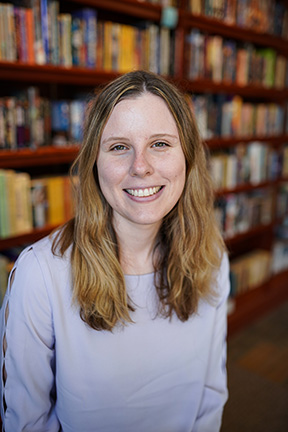 From the Editor: Elizabeth Rouse graduated from Central College in Iowa in 2020 with degrees in English and theatre. While at Central she worked with other blind students in Iowa to re-establish the Iowa Association of Blind Students. Currently she serves on the board of the NFB’s Performing Arts Division and the National Association of Blind Lawyers, as well as two national committees. Recently she began a Master of Fine Arts (MFA) in creative writing through an online university, allowing her to share her stories with the world.
If you had told me when I was ten that I'd grow up not only to learn how to cook independently, but also to love my time in the kitchen, I likely would have given you some sort of dazed and confused expression and rolled my pre-teen eyes. Back then, the only time I spent in the kitchen was when I sat down at the dinner table with my family. Occasionally, I baked with my mom, with the ulterior motive of licking the spatula before I escaped any real responsibility, such as doing dishes. However, in early middle school Chad, my teacher of the visually impaired (TVI), set in motion a journey that would culminate in my preparing a four-dish meal for forty people.
Chad was adamant that cooking was an essential part of independence. Over my protests he managed to convince my parents to incorporate cooking into my Individualized Education Plan (IEP) when I entered middle school. We started small, focusing on things Chad knew I liked to eat, such as smoothies and scrambled eggs. In my memory the main highlight of our time cooking together was finding a mouse in the sink of our school's resource kitchen! My fifth- and sixth-grade science teacher was the only person truly excited by this discovery!
Although Chad was successful in getting me to brave the kitchen during his biweekly visits, I dug in my heels at home. I refused to practice skills that likely would have served me greatly during my undergraduate years. Because my parents are both sighted, I don't think they felt comfortable pushing me to practice nonvisual techniques that they did not use themselves. I remember that watching me load and unload the oven and practice knife skills unnerved my mom to no end. Because she had never seen a blind person operate independently and safely in a kitchen, she didn't know what a little nudging could empower me to do. My foods teacher in high school did her best, too, but I was much more comfortable washing dishes and letting my groupmates handle the actual cooking tasks.
I left for college with the abstract idea that blind people could cook, but without the conviction that cooking was something I myself could do. Luckily, I chose an academic institution that required students to spend all four years living on campus. As a result, I never had to manage my own apartment and cook for myself.
During my freshman year I met and became close friends with two other blind students on campus, Katy and Marissa. Before the year was over, both of these young women left Central to undergo training in nonvisual skills at the Louisiana Center for the Blind (LCB). They graduated from the program nine months later as completely new and improved versions of themselves. Through their respective experiences, they showed me how attending the LCB could transform a person's entire life.
The transformation of Katy and Marissa planted a seed that grew in me throughout my college years. Whenever we spent time together, they challenged me to think differently about my blindness in all facets of my life, including my time in the kitchen. We prepared meals together from start to finish—deciding what to cook, making a grocery list, visiting the store, prepping the meal itself, and (of course) cleaning up after we'd eaten. Their independence and self-sufficiency were addictive. By the time I graduated from Central, I knew I wanted everything they'd gained at the LCB.
My time in training looked a bit different from the experience of those who went before me. I attended the LCB in the midst of the COVID-19 pandemic. However, the quality of my training was still top-notch. I started my days in the woodshop before I headed up to the West Kitchen to round out my morning. Conrad and Cameron, my home management instructors, slowly introduced me to the skills I'd need to complete the program. They began by teaching me to navigate the kitchen safely and create organizational systems to ensure that I grabbed my own materials instead of someone else's.
Later we moved on to harder challenges. I distinctly remember Conrad making me redo a cookie recipe two months into my program because I'd refused to waste time locating a mixer, opting to stir by hand instead. He encouraged me to think systematically when I searched for the mixer. The search involved opening and shutting twenty-three drawers before I could get on with my work. (Yes, I slammed some of those drawers, and yes, I still think the first batch of cookies tasted better!)
While I grew in so many ways during my time at LCB, I think I had some of my greatest epiphanies in the West Kitchen. Conrad encouraged me to learn from my failures instead of allowing them to define me. He showed me that cooking for myself and others could be fun, even when I set off the fire alarm in my apartment. Above all, he served as my friend and mentor. He was someone I could turn to when I felt overwhelmed by the rapid self-growth I was experiencing. I knew that if I messed up or needed to cry, he'd be there with a terrible joke or an amazing recipe he thought I'd enjoy. His guidance, at least in part, pulled me back into the kitchen with a desire to try something new, in spite of the possibility that I wouldn't succeed on my first attempt.
Sadly for me, Conrad left LCB to pursue his MBA in the middle of my training program. While his departure was hard on me, it gave me the opportunity to work with Cameron, another wonderful instructor, who pushed me to achieve even greater and grander things. Cameron is the instructor who assigned me to complete my small- and large-meal challenges at the center. Each of these endeavors required me to prepare a protein, a grain, a vegetable, a dessert, and a beverage entirely from scratch.
I completed my small-meal and large-meal tasks in June of 2021. Part of the challenge was operating on a budget. My organization-driven mind flourished. I wrote out invitations with my slate and stylus, compiled grocery lists, and even chose playlists well in advance of D-Day. Preparing each of these meals proved to be both fun and educational. The reality of constructing my large meal will always be one of my fondest training memories.
Though I dove into the organizational tasks head-first, prepping a meal for forty people is bound to come with some unexpected twists and turns. To begin with, I had to move from the familiar West Kitchen to the East Kitchen, and I had to learn where all the dishes I needed were stored. Then I severely overestimated how much pasta sauce I needed to make. I visited my cane travel instructor's office to complain about sharing space unexpectedly with some students who were new to the center and didn't know enough to stay out of my way. Needless to say, I got ample practice in deep breathing, practicing patience with myself and others, and re-emphasizing the need for flexibility in one's preset plans.
Throughout my prep days, my close friends at the center lifted me up. They provided me with words of encouragement, sat with me while I cut up pound after pound of green beans, and offered to help with whatever clean-up tasks my meal accrued.
On the actual day of my meal, my mom, my aunt, and my mom's best friend, who happens to be my former Foods teacher, arrived in Louisiana to celebrate my accomplishment with me. I think watching me turn my plans into reality helped solidify their belief, as it did my own, that I really did belong in the kitchen. The friends who offered to help with clean-up came through, and I'll forever be grateful for their help. Without it, I might still be there cleaning, almost three years later.
I don't cook as much as I did while I was in training, but I rest easy in the knowledge that I can cook just about anything, confidently and safely. It's likely that I watch more cooking and recipe videos on TikTok than anyone I know. I don't hesitate to bust out my wide array of saved videos when the opportunity presents itself for me to cook for my friends and family. Without Chad starting me on this path and all the guidance and mentorship I received at LCB, I would have let my fear keep me out of the kitchen.
Ten-year-old me can roll her eyes all she wants. I'm glad I was finally brave enough to put on an apron and step up to the stove. I hope my story helps parents and educators see that blind students can accomplish far more than one might expect. Do what you have to do to get us started, even if it's something as simple as letting us lick the spoon!