American Action Fund for Blind Children and Adults
Future Reflections Special Issue on Cooking MEETING THE CHALLENGE
“Oven Open!”
by Lauren Altman
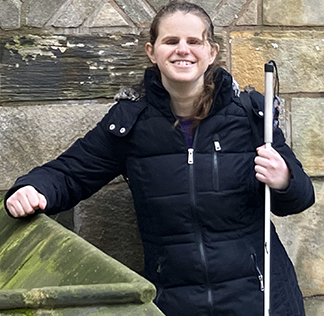 From the Editor: Lauren Altman currently serves as president of the National Association of Blind Students (NABS). She is studying psychology and special education at Ramapo College of New Jersey. She has a passion for education equity, especially for blind students.
“Oven open.”
“Walking with a plate of food.”
“Alexa, set a yummy yummy brownie timer for twenty minutes.”
These are some of the most common phrases I said during my time in the West Kitchen at the Louisiana Center for the Blind (LCB). During my nine months of training at LCB, I made dishes ranging from rice to three-tiered wedding cakes. I learned to conquer my fear of deep frying, charcoal grilling, and using spices other than oregano. I became more comfortable exploring new environments with my hands and challenging myself to take on new projects.
Although I am a far cry from a culinary expert, I grew up learning to cook. My family doesn't make homemade meals very often. Like many others, my parents always worked long hours, so we ate a lot of pasta and hot dogs—both of which are comfort foods. We did most of our serious cooking on holidays and for other special occasions. Whether I was helping my bobbie (my grandmother) cook one of the many dishes that she made for the new year or asking my dad to teach me to make challah French toast yet again, the best thing my family did for me was support me in my eagerness to learn.
Adults often flinch at the idea of a blind child (or adult) using knives or open flames independently, and they'll simply opt not to let them try. The truth is, of course, that those things can be dangerous. For a person (blind or sighted) who doesn't know how to use them, sharp knives and open flames certainly can be unsafe. But when a blind person is given the opportunity to learn to use kitchen equipment, vision doesn't play nearly as big a role as one might think. It exhausts me to see a parent or blindness professional dissuade a child from learning to cook because of the misconceptions they carry. Natural curiosity needs to be fostered safely, and safety and curiosity are not mutually exclusive.
Because I went into training with an understanding of basic kitchen skills, I was able to focus on branching out and trying new types of recipes. One of my favorite projects that I completed during my time at LCB was my small group meal. The task is to make a meal for eight to ten people that includes a drink, a protein, a vegetable, bread, a dessert, and homemade invitations. Inspired by some of the creative meal designs previous students reminisced about, I decided to base my meal around the theme of the board game Clue.
I Brailled out invitations that read as though I was inviting people to a fancy dinner party. Everyone was given a character to play, complete with invented biographical information. For the meal itself we had vegetarian beef Wellington, roasted asparagus, strawberry kiwi water, and turtle brownies. The mood music was a mixture of classical symphonies and horror-movie scores. I had a ton of fun with my meal, and I've since recreated the murder mystery game three times for a club on my college campus.
I loved adding my personality to the projects I took on. Cameron, my ever-patient and fabulous instructor (also known as Professor Peacock), was very supportive of my endeavors. Contrary to what most people might assume, Cameron gave me a lot of space when I was cooking. He would check in every now and then and be right there if I needed help, but I had the freedom to problem solve and trust my own abilities. As in all the other areas of Structured Discovery learning during training, this freedom was very impactful in my ability to apply the information I already knew to new projects.
Sure, I stuck a plastic pan in a hot oven one time, and sure, I spent the next class period researching how to get melted plastic off a wire oven rack! But I promise you, that mistake wasn't caused by my blindness; it was caused by my attempt to make three dishes at once without considering small details such as the composition of the baking sheet I was using.
I would never call any of the classes at LCB particularly easy. However, because I was exposed to cooking at a young age and I had confidence in my abilities in the kitchen, cooking quickly was the class that came easiest to me. Now that I'm no longer in training, I find myself cooking less overall, but I appreciate the comfort of knowing that is by choice. Half of the joy in having cooking skills is having them as a tool in my toolbox, a tool I can pull out whenever I want it. I have the autonomy to decide when I'm going to start on a roux for homemade mac and cheese, when to pull out a box of Wacky Mac, and when to make use of my meal plan.