American Action Fund for Blind Children and Adults
Future Reflections Special Issue on Cooking PASSING IT FORWARD
Cooking for an Army
by Melba Taylor and Jim Papania
 From the Editor: In 1936 the US Congress passed the Randolph-Sheppard Act, which established the Business Enterprise Program for the Blind (BEP). To this day BEP provides blind people with the opportunity to own and operate vending and dining facilities on federal property. Over the years the Randolph-Sheppard program has been expanded, and today facilities in most states are included as well.
Some Randolph-Sheppard workers operate shops and vending machines. Others run snack bars, cafeterias, and restaurants at facilities such as courthouses, prisons, and military installations. In this article two Randolph-Sheppard entrepreneurs describe the work they do and the challenges they meet every day.
Melba Taylor began eighteen months of Randolph-Sheppard training in 1997. “The training was very thorough and extensive,” she says. “It covered every aspect of running a business—bookkeeping, hiring and managing employees, following health and safety regulations, and learning every aspect of food preparation.” Her first job under Randolph-Sheppard involved operating a café that served breakfast and lunch to employees at the US Census Bureau.
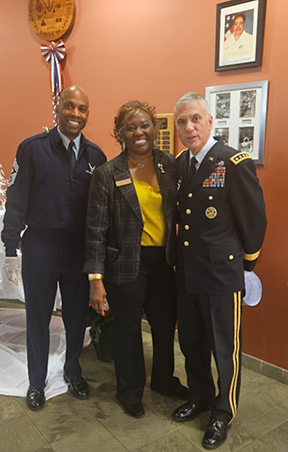
“Today I'm a government contractor, managing a dining facility for the US military,” Melba explains. “I oversee the preparation of twelve hundred meals a day, every day of the year. I'm quite literally feeding an army.”
Jim Papania is Director of Food and Nutrition Services at the Workforce and Technology Center in Baltimore. The center is under the Maryland Department of Education, Division of Rehabilitation Services. “It's a school for students with physical and emotional disabilities,” he explains.
Melba and Jim each had positive early experiences in the business world. Melba has retinitis pigmentosa (RP), an eye condition that causes progressive vision loss. Her grandmother and her mother had the same condition. Melba learned to cook from her grandmother, who taught her to use techniques that didn't rely on her limited sight. Melba's mother ran a greenhouse, raising flowers and plants for a nearby florist. She encouraged Melba to learn bookkeeping and other management skills.
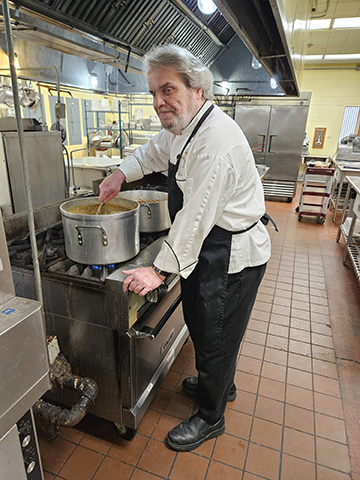 “My involvement with food preparation goes back to when I was in college,” Jim recalls. “I was majoring in psychology, but I got a job as assistant manager at a chain restaurant called Hardee's. After I graduated I kept on working at Hardee's, even when I got married and started a family.”
Eventually Jim teamed up with a couple of partners and opened a Dairy Queen. He also bought a pizza shop and a full-service dining restaurant, which he passed along to his son.
Jim attended culinary school in the late 1990s, and he got involved with the Business Enterprise Program around the year 2000. In addition to his job at the Workforce and Technology Center, he teaches culinary arts to blind students.
“Some special kitchen tools for the blind are quite helpful,” Jim points out. “Today we can use talking thermometers and talking scales, and most of those tools are very affordable.”
For the most part, however, Jim teaches his students to use mainstream equipment. “My students learn to use all of the equipment available in a commercial kitchen, including the slicer,” he explains. “A blind person can use any piece of equipment in the kitchen, regardless of how much or how little vision they have. The important thing is that they respect the equipment. Actually, culinary schools teach their sighted students to use knives entirely by touch.”
Jim contends that no aspect of cooking inherently requires sight. “You can use touch to tell when eggs or hamburgers are done—you can judge by the firmness. And when you wipe down a countertop, your hands will tell you whether it's clean.”
Timing is also a great help to blind cooks, Jim explains. The cook will know how long it takes to cook a chicken breast or a soufflé at a particular temperature. “If you use a timer,” Jim says, “and if you're careful about the temperature, you won't have a problem.”
Melba oversees forty-seven employees, so most of her job is managerial. “It's all about hiring good people,” she says. “I have a wonderful team, and I have tremendous trust in them.”
Melba spends most of her time placing orders, following supply chains, and attending meeting after meeting. Not too surprisingly, the military has rules and requirements that affect every aspect of the work. “There are even rules about how you clean the floors and run the dishwashing machines,” Melba says. “Step by step we have to follow recipes that the military has approved.”
As far as accommodations are concerned, she uses ZoomText, a screen enlargement program. She turns to human readers when she has to deal with handwritten documents or complex charts and tables.
As supervisor Melba has to know every aspect of the job, from ordering food to cleaning floors. If someone has to miss work on short notice, Melba is prepared to fill in wherever she's needed. “My employees all know that I'm blind,” Melba says, “but many of our customers do not. I know every square foot of our kitchen. Because it is so orderly, I easily find everything I need.”
When the dining hall gets crowded, Melba stands near the front of the line to interact with the customers. It's a chance for her to get to know them and to hear their compliments and complaints. “I'm always glad to hear ideas about how we can make our service better,” she says, “and it's very rewarding when people tell me we're doing a good job. That makes all the work worthwhile.”
Cooking is not entirely free from hazards. “I’ve been cooking professionally for fifty years,” Jim says, “and it's true, I've been burned a few times. It happens to all commercial cooks at one time or another, whether they're blind or sighted. If you have a burn scar, we call it ‘the Mark of the Dragon.’”
Like Melba, Jim emphasizes the importance of organization in a commercial kitchen. “Always put your utensils in the same place. Keep your knives in a knife block or a rack on the wall. It's frustrating dealing with a lot of my employees. They don't always respect my sense of order. Their attitude is, ‘Find a drawer, shove it in.’ That doesn't work for anybody! In commercial cooking, speed is of the essence. You don't want to waste ten minutes hunting for a spatula!”
Jim handles about seventy-five percent of the cooking for the students and staff at the Workforce and Technology Center. As manager he sets the tone for the establishment. “It's not often that anyone questions my ability due to my low vision,” he says. “When someone comes into my kitchen, they see me as capable; I'm the guy in charge. The same was true when I worked at Hardee's and when I made pizza.”
Jim strongly encourages blind people to get involved with the Business Enterprise Program. “They train you, and they believe in your abilities. A lot of us have picked up fears and negative attitudes from the sighted people in our lives. We've heard so many messages about all the things we can't do that we begin to believe we're helpless. I want to show my students that we're fully capable of working in food service at every level. In the Business Enterprise Program we get the chance to step up to the challenge.”