American Action Fund for Blind Children and Adults
Future Reflections Special Issue on Cooking PASSING IT FORWARD
Of Jams and Pickles
by Serena Olsen
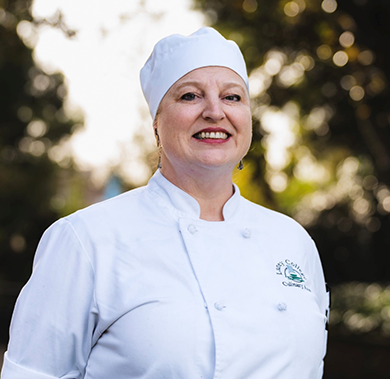 From the Editor: Serena Olsen loves the artisan bread baking class she's taking, and she is actively looking for work as a culinary professional. She aims to improve her sourdough skills and up her cupcake game. She stays busy with volunteer work in her community, focusing on food and natural resources. She believes that most of the world's problems can be solved through more love, feeding people, and planting trees. Currently Serena serves on the board of the San Francisco Chapter of the NFB of California. You can learn more about Serena and her work by following her blog at https://itstartswithquiche.com.
“You should work with blind people,” so many people have told me along the path of my career development. Indeed, they continue to press this idea upon me to this day. And so I did. Working with blind people was the path of least resistance, and I could justify its relevance to my graduate work in International Policy and Nonprofit Management. However, my younger, aspirational self wasn't interested in teaching anything to blind people. I was learning to be a confident blind person myself so I could step out into the world and make my own choices. Teaching other blind people is just the path that well-intentioned, nondisabled people expect blind people to follow, quite possibly for their own comfort. The message seems to be: you belong over there; then I won't have to deal with you over here.
Dreams Deferred
After I left graduate school I did become a blindness professional for many years. The career choice was an easy fit for me, drawing upon my own growth into the competent blind person I am today, thanks to the National Federation of the Blind.
I was the first person in my family to go to college. I was a struggling low-vision student at Santa Barbara City College when the internet started to take off. A chance encounter with the California Department of Rehabilitation got equipment into my apartment and brought me a connection to the Worldwide Web. I searched for scholarships, as any starving student would do, and I found the NFB. Thanks to the savvy recruiting practices of our state student division, I went to my first convention, Atlanta 2004. My life would never be the same.
I wanted to live the expatriate dream, doing community-based work as a development professional. I was a linguist interested in language policy. I was passionate about the plight of child soldiers, the trade in small arms and light weapons, poverty, women's empowerment, and the rights of children. But people kept telling me, “You'd be really great at working with blind people.”
Indeed, it was other competent and successful blind people working in nonprofit agencies serving the blind who were willing to hire me and give me a chance. Still, I had a nagging, a tugging sense that I'd drifted in my ambitions. The tension is real, for who is better equipped to serve the blind than competent, successful blind people? Yet, the necessity for us to continue pushing into nondisabled spaces, where we belong yet where we are often marginalized, is a powerful gravitational force.
The Kyrgyz Challenge
Around 2012, things aligned for me to pursue a dream I'd had since I was a teenager: to serve in the United States Peace Corps. In the spring of 2014 I departed for service in the Kyrgyz Republic, deep in the heart of Central Asia. Thanks to the soft bigotry of low expectations and hard-to-prove discrimination in the placement process, I'd reverse engineered my assignment, networking my way to some folks in Bishkek who were building a Federation-based training center. I was still working with blind people, but this time it was in a context I was sure would be a pivot toward my goals in international development.
Finally I was living my expatriate dream, only to find that this life wasn't the fit I'd thought it would be. Years of career dreams and goals seemed to vaporize, and I was sitting with the great chasm of an unknown future before me. It was a pickle, a jam indeed, to find myself middle-aged, sitting with the career goal I'd been working toward for years, yet never feeling so adrift.
And I went into the kitchen.
I didn't grow up with an obvious culinary background. I could barely cook for myself as a newly liberated young adult. It wasn't for lack of blindness skills. I was just culinarily inexperienced. Then a dear girlfriend from my early Santa Barbara days planted the magic seeds. She showed me not only how good food can be and how to make it. Beyond that, she taught me about the vital role that food plays as social glue. By the time I moved to the Bay Area to launch my career in 2010, I was solidly on the foodie path. I dove into wine tastings and got to know other people who loved the food experience. I had my first taste of steak tartare and foie gras. I loved to eat, and I loved to cook.
Then, when I got to Kyrgyzstan, I spent most of my first year living with host families. They did all the cooking, despite my best efforts to insert myself into family food preparation or even to cook for myself. Between language and cultural variables, the ongoing construction in the tiny, crowded house where I lived, and various other logistical issues, feeding myself felt like an uphill battle. In fact, for a short time, I barely ate at all and lost a dangerous amount of weight.
For a number of reasons, the Peace Corps determined that I should move out of my host family's house into my own apartment on the south side of town. My apartment was right across the street from the best bazaar in all of Bishkek. This independence was exactly what I needed in order to flourish in my Peace Corps experience.
The trolley into my neighborhood dropped me on one side of the bazaar, and I traveled a winding path among the stalls. I gathered needed groceries from the friendly vendors I was getting to know. I sharpened my language skills bantering over pleasantries, inquiring about that day's offerings, navigating transactions, and inquiring about offerings in other areas of the bazaar. I bought milk by the liter in a plastic bag for making a fermented drink called kefir. I condensed milk in my rice cooker to make the instant NesCafé I drank every day a little more palatable. Produce was plentiful year-round in Bishkek, providing plenty of opportunity for me to shop around. Nevertheless, I went back to the same stall again and again because the folks there were playful and fun to talk to.
I always went to the same grain guy for buckwheat because he was kind and inquisitive. Buckwheat tasted like cardboard, though it was cheap and full of protein and iron. I shopped around a lot for peanuts and raisins for snacking. They were on the expensive side, but I learned to buy from the more expensive sellers; the cheaper options often came with surprise little clods of dirt that weren't pleasant to chomp on. Finally, if I had a hand free to carry them very carefully, eggs nestled delicately in a plastic bag from a little free-standing structure near the place where I exited to cross the street to my apartment.
With regular consultation and support from my language tutor, I had the best kefir culture blooming in my apartment, despite cold temperatures. I made jams and flavorful Kyrgyz condiments, and I learned the ins and outs of traditional Kyrgyz food preparation techniques. I bought salt, vegetable oil, and precious lemons to indulge myself in a bath scrub, and I used the lemon peel to make limoncello, a vodka-based liqueur. I made jars and jars of refrigerator pickles. I made the traditional kosher style pickle with the abundant summer cucumbers, and created salads of shredded cabbage, carrot, and onion—vegetables that were affordable, healthy and usually abundant.
New Directions
Every time I was avoiding responsibility or simply decompressing, I was in my cramped, very sparsely appointed kitchen, playing with food. I brainstormed what my next steps were going to be, usually running them by the pigeon that hung out on the ledge outside my fourth-floor kitchen window; I affectionately referred to him as my neighbor. I was in a jam; I was in a pickle; and out came more jams and pickles, of a delightful and edible sort. Life gave me some lemons, and I made limoncello. I was middle-aged and single, and I felt I had no career. It was a bleak feeling, yet at the same time I felt the vast expanse of open possibilities that lay before me. I had a clean slate upon which I could emboss any future of my choosing.
Then Sterling, a fellow volunteer, came into my kitchen on a layover to another province with a few other fellow volunteers, and he started cooking and cleaning. I was smitten. When he left me with a plastic water bottle full of the rum he'd acquired at the bazaar for our burrito party the night before, I promptly poured it over raisins.
To find myself again, I planned to attend a yoga retreat of unknown duration in India after my Peace Corps service. Instead I brought this boy from Missouri back to California with me. We married, bought a home, and adopted two very anxious and adorable cats. We share in all the cooking and cleaning, experiment with food projects of all kinds, and enjoy lots of tasting adventures.
I went back to working with blind people. This time I got to do all the fun stuff—managing social and recreational programs, building community. Not surprisingly, I put food at the center of my work.
Hot, Fast, and Noisy
In the upheaval that was 2020, my slate was again wiped clean. I began to rebuild from a little blog project I'd launched at the beginning of 2019, “It Starts with Quiche.” I began to take a deep dive on this long journey I've had with food and how it connects to happiness. I jumped at an opportunity to take culinary arts classes at a local community college. I was already committed to pivoting into culinary endeavors, though I wasn't entirely certain what that would look like. I still had lingering uncertainties about how and where I'd be able to insert myself, not only into nondisabled spaces, but into spaces full of hot things and sharp things and low expectations about the appropriateness of blind people being in the kitchen.
Laney College Culinary Arts has given me a test lab to figure out what working in a commercial kitchen really will be like. As one might expect, it's hot, fast, and noisy. I started on the savory side, the program that focuses on restaurant kitchen work and management. In my second semester, I took a baking class on the pastry side as an elective, and I fell in love. On the savory side, knife skills are fundamental, and despite lots of practice, I still struggle there. It's not necessarily a blindness thing, but making precise, restaurant-quality knife cuts and doing it quickly is a legitimate challenge. Try cutting carrot matchsticks that are exactly two inches long and 1/16 inch square, or slicing an inch of carrot into sixteen even slices. Or just consider cutting round things into squares with minimal trim. You've got to do a lot of that, too, and swiftly! In addition to the knife work, another challenge I struggled with in my savory classes is that a lot of the work is on the stovetop. I'm working right under a commercial oven hood that is whirring away, effectively cutting in on my sense of hearing, which I use a lot in my home kitchen to follow the progress of my cooking. I completed my savory classes successfully and got A’s. I definitely learned a lot about the culinary profession, though finding a position I can truly enjoy and excel at in a commercial kitchen will be tricky.
In the baking lab, on the other hand, there is much less knife work and much less noise. Baking feels less complicated in some ways, and it allows me to focus on the tasks at hand. While complicated in its own right, making baked goods is somehow more straightforward than whipping up a serving or two of a complicated fine dining plate.
Meanwhile the planets have aligned for me to lean hard into my job search and return to full-time work. While I stay enrolled part-time in Laney College baking classes for professional development, I'm deep in all the trappings of an employment search. I'm writing cover letters, preparing resumés, filling out applications, networking, and doing research. This time I'm taking the leap into a relatively unknown space, the world of a culinary professional. Fortunately, I've been well trained in Structured Discovery. I'm gathering lots of information. I'm problem solving my way through new territory, getting lost and found, and trusting my skills and my network. Bring on more jams and pickles!
I still hear about how great I'd be at working with blind people. I hear it from instructors at Laney and from my job coach. There's a double-edged sword here; there's no one better equipped to teach a blind person than a competent, successful blind person. Yet we belong in mainstream spaces, too. Working with blind people does not have to be our place. It is a noble profession, to which I owe much of my success and to which I have given and continue to give back. There is also much to be gained, for myself and for my blind peers, by stepping outside of this box. There will be much to surmount in this endeavor. Thanks to the problem-solving and self-advocacy skills I've acquired and honed over the years with help from the Federation, I am taking the challenge on gladly. I have a tremendous community of support, and I look forward to reporting from a hot oven somewhere with an armful of pastries and artisan breads.