American Action Fund for Blind Children and Adults
Future Reflections Special Issue on Cooking PASSING IT FORWARD
MasterChef and Beyond
by Christine Ha
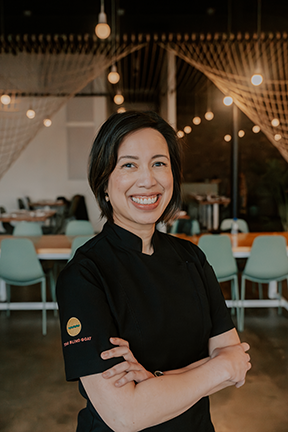 From the Editor: In 2012 Christine Ha vaulted to fame when she won the MasterChef competition, hosted by Gordon Ramsay on the Fox TV network. Her triumph reverberated throughout the blind community, as she was the first blind chef ever to earn such acclaim. Over the past fourteen years Christine went on to publish a successful cookbook and to open two Asian restaurants. I am deeply appreciative that she made time in her busy schedule to contribute this article to Future Reflections.
I was born in Los Angeles, California. My parents were Vietnamese refugees who escaped Vietnam the day before the Fall of Saigon. Soon after I was born, they moved to Houston for my dad's work. I grew up in Houston, and I have lived most of my life in Texas.
I grew up eating a lot of delicious home-cooked Vietnamese food. Sadly, my mom died when I was fourteen, and I never learned to cook from her. Finally I started teaching myself to cook when I was a student at the University of Texas in Austin.
After my freshman year in college, I moved out of the dorms and found myself in an apartment with a little kitchen. I figured I had to learn to cook in order to eat, since I no longer could rely upon the dorm cafeteria. I bought a couple of Asian cookbooks and tried to replicate the flavors I recalled from when I was growing up. As a cook I am completely self-taught, and it took a lot of trial and error.
In 1999, when I was twenty years old, I began to experience blurred vision and a variety of other symptoms. The doctors thought I had multiple sclerosis (MS), but eventually I was diagnosed with a condition called neuromyelitis optica (NMO). NMO attacks the optic nerves and nerves in the spinal cord, so it can cause vision loss, numbness, tingling, and even paralysis. For a time I was paralyzed from the neck down. Fortunately medications, physical therapy, and occupational therapy helped control most of my symptoms, but I had to accept that my vision loss was permanent.
I received training in blindness skills from the Texas Vocational Rehabilitation program and Lighthouse for the Blind in Houston, and that was very helpful. Even with training, however, it took some time for me to rebuild my confidence in the kitchen. After I lost my sight, I had to learn everything again, from knife skills to how to work with fire. I took small steps—one day I finally was able to make a cold sandwich; a week later, I could somewhat scramble eggs. I got better at doing things the more I tried. Each accomplishment gave me confidence to try the next challenge in the kitchen. I learned to depend on my remaining four senses, and of course I added a few adaptive tools. I put raised bump-dot stickers on my stove and my oven and added Braille to label my spices.
I've always been a very organized person, and that helped make the transition relatively easy for me. My kitchen is extremely organized, so I know where everything is without relying on sight.
I was studying creative writing in graduate school at the University of Houston when I had the opportunity to audition for MasterChef. As a writer, I try to experience as many things in life as possible in order to fuel my creativity. I thought going on the show would be an interesting experience to draw upon. Maybe it would inspire me to write an entertaining short story or a humorous personal essay. My friends and my husband encouraged me to go for it. They said that the nation needs to see how a blind person still can cook independently.
The MasterChef producers wanted to make the competition fair for me. They provided adaptive kitchen tools and put raised bump-dot stickers on the stove. They got me talking thermometers and scales.
The producers also provided me with a sighted assistant. However, they drew up strict rules to make sure my assistant didn't offer me any unfair advantages. Lawyers from the network were on set, listening in on our mics to observe how we communicated. I was not allowed to ask my assistant to taste or touch my food. I only could ask objective questions such as, “What is the color of the meat in my pan?” If she replied red, brown, or black, I could deduce that it was raw, cooked, or burnt. If I asked her to run to the pantry and grab me a stand mixer, I had to step back from my cook station and not touch anything, even if it was on fire. My assistant was considered an extension of me, so if she was in the pantry grabbing a mixer, then it was as though I were in the pantry and away from my station.
A majority of the viewers were rooting for me and wanted me to win. I received an overwhelming amount of support. Of course, there will always be naysayers. Some people trolled me online and claimed I was faking my vision impairment. Some insisted that I had an advantage because I had a sighted guide.
The MasterChef championship brought me a cash prize of $250,000 and the chance to publish a cookbook. Recipes from My Home Kitchen: Asian and American Comfort Food from the Winner of MasterChef Season 3, was published in 2013 by Rodale, and the book was a New York Times bestseller.
I've been given a lot of great opportunities, and I'm very grateful for all of them. In 2019, I opened my first restaurant. Because it's a modern Vietnamese restaurant, I wanted to put a Vietnamese twist on the name. I was born in the Year of the Goat in the Vietnamese zodiac, and I'm known as the blind cook online. Thus the name The Blind Goat was born. In 2020 the James Beard Foundation selected The Blind Goat as a semifinalist for Best New Restaurant in America.
Over the years I have worked with various blindness organizations. My activities include teaching blind and low-vision students to cook and advocating for the blind at the United Nations. I've attended fundraisers and galas for all sorts of nonprofits in the blind and low-vision community.
For those with vision impairment who want to learn to cook I have several suggestions.
1) Celebrate the small victories. Begin with baby steps, and one day you'll think back and realize you've made progress. Perhaps you acquired a skill today that you didn't have yesterday, or a week ago, or a year ago.
2) Embrace your mistakes. That's how you learn. Failure is not always something to be viewed negatively. It's what you learn from it and how it propels you to move forward that's key.
To learn more about Christine Ha, visit her webpage at www.theblindcook.com. Her social media handle is @theblindcook.