American Action Fund for Blind Children and Adults
Future Reflections Special Issue on Cooking PASSING IT FORWARD
All Things Culinary
by Regina Mitchell
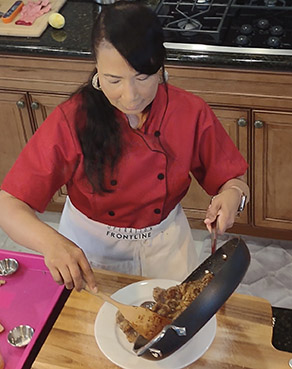 From the Editor: Regina Mitchell studied for two years at the Seattle Culinary Academy. Later, under an eighteen-month fellowship, she trained with master chefs in Edinburgh, London, Paris, Barcelona, and Rome. Back in the US, she provided restaurant-style service in the homes of elite clients.
After she lost most of her sight due to the onset of lupus, Regina enrolled at the University of Nevada/Las Vegas. She received a National Federation of the Blind Scholarship in 2017. During the COVID-19 pandemic she began to teach cooking classes to blind people over Zoom. In many venues she continues to share her passion for cooking with blind people of all ages.
I was in the midst of a flourishing career, cooking for celebrities and high-end CEOs, when I lost most of my vision due to an autoimmune disease called lupus. Although I had lost my sight, I never lost my passion for all things culinary. I realized that many blind people are fearful about cooking because they have never been given the opportunity to get hands-on experience in the kitchen.
During the COVID-19 pandemic I began to teach cooking classes to blind adults and children over Zoom. With Zoom geography is no limit; the platform allows me to work with people anywhere in the country. My students come to class with the ingredients and the equipment they need, and we go through our recipe step by step.
After my vision loss I went for training in blindness skills at BlindConnect, a blindness rehabilitation program in Las Vegas. Today I'm the chef instructor for two BlindConnect programs.
Hands-on Training
At BlindConnect I teach as part of a ninety-hour program for adults who are dealing with recent vision loss. Before graduation the students have to cook a meal for six to eight people. Each member of the class chooses to prepare a particular dish, such as a salad or an entree. Once the meal is prepared, the students gather to eat and participate in a class on etiquette.
I come in toward the end of the students' training and help them hone their blindness skills in the kitchen. One of the coaches commented to me, “I can teach them the mom stuff, but you can take them to a higher level.” Actually, though, sometimes I teach them basic techniques, such as the best nonvisual way to wipe down a counter.
If we have a class of six students, I work with three on one day and with the remaining three on another day. By splitting up the class, I can spend more one-on-one time with each student.
I find that students need help in several areas. Knife placement is one area I emphasize. A lot of students are inclined to drop their knives into the sink. They're very surprised when I tell them that's not the way to do it! I teach them to tuck the knife under the cutting board or to wash it and put it away. Also I teach the students to put a paper towel under the cutting board to keep it from sliding around.
We also work on the use of small appliances such as handheld mixers, choppers, and can-openers. After all, you can't always buy a can with a pull top! A lot of less common gadgets also can help in the kitchen. For instance, I like to use a garlic press.
As a professional chef I often find myself having to wind back, to realize that techniques I take for granted are not everyday knowledge. In addition, I was a sighted person when I learned to cook, and I'm always discovering things that a blind person might not know. I can't take anything for granted.
Not every information gap is related to blindness, of course. I find that many of my students didn't know much about cooking, even when they were fully sighted. We live in a fast-food society. To a lot of people, cooking means popping food into a microwave. Our food is pre-packaged or delivered to our doors.
One of the simple techniques I teach is how to spread butter or garlic butter onto a slice of bread. Some people start on one edge and spread toward the center. Actually, the most effective technique is to put the pat of butter at the center of the slice and spread it toward the edges. The same holds true of pizza sauce when you're making pizza.
My own visual acuity is waning, and as time goes by, I find myself becoming more and more tactile in the kitchen. I was fully sighted when I bought my house, and I love the look of black marble. Now, though, my black marble countertops are a nemesis! I can't find anything visually! If I look with my hands, though, the color of the surface doesn't matter a bit. Most of my students are going through the process of losing vision and adapting to that reality.
I know that some of my students are not very likely to use the skills I teach them. When they go home their spouses or their parents will cook for them again. But if they need cooking skills, they'll have them. If they wish to do so, they'll be able to cook something delightful for themselves and for others. I find that when people choose to cook something, they're passionate about that choice. I encourage students to choose a dish they really like. Maybe they want to learn how to make a vinaigrette dressing for a salad. Maybe they want the fun of baking cookies. Even if a person is using pre-made cookie dough, they still need to learn to grease the cookie sheet and use their hands to measure how far apart to arrange the balls of dough.
When we plan our meal at BlindConnect, people's choices range from basic dishes to dishes that are very complex. One of my students made an African peanut stew. Someone else made a Filipino chicken adobo. I encourage them to try whatever they choose.
Cooking for a Living
Through BlindConnect I also train BEN operators. BEN stands for Business Enterprise of Nevada, which is a program authorized under the Randolph-Sheppard Act. The act allows licensed blind and low-vision entrepreneurs to operate a business in the state, particularly in food service. I do the training that is required under the state program. It's a real honor! Over the past two years I have trained several operators so that they can become eligible to own their own establishments. I'm very happy that I can help prepare them for success!
I teach students in the BEN program to use the kitchen on a professional level. It's quite different from working with a home cook. I can draw upon all my professional experience and show them the skills they truly need. Cooking skills aren't optional in this business! The students need blindness skills, of course, but they also need to master health codes and kitchen safety.
Students in the program need to answer a number of questions. What dishes will you have on the menu? What will your food costs be, and how much do you want to charge? I work with the students for fifteen hours, and then they go through another sixty hours of training to become eligible for state licensing.
The sixty hours of training is called community-based assessment. We call it a pop-up café. The students create their own menus, and they itemize and estimate their costs. They're given a budget, and they go shopping. They do the pop-up café at BlindConnect, and they actually cook for the students there. The students can pay for the meal, which is a way for the entrepreneur in training to learn about accepting money and giving back change. They can calculate whether they have a profit—they don't always have one.
I do an assessment of their time in the kitchen. I look at their leadership skills, their punctuality, cleanliness, and organization. They work three days a week, six or seven hours a day. They also spend time on menu development, shopping, and orientation and mobility. When they cook I keep them on task. I monitor their organization and make sure they follow the protocol and safety measures.
At the end of the session we go over everything the students have learned. We itemize their food costs and all their other expenses. Finally I send my assessment to vocational rehabilitation, and the students move on to the next level of training. It's a very intense program!
Independence Market
Another project I'm working on involves the Independence Market at the NFB headquarters. Some people don't cook because they don't have the tools they need. We're putting together kits people can buy when they want to get started in the kitchen. We're creating kits around specific themes: a beginner's kit, a baker's kit, and a culinary kit. Each kit will contain five devices.
NFB also is working to find accessible countertop devices. We're working with various appliance brands to encourage greater accessibility. We hear a lot of complaints from blind people who have found that one appliance or another is not accessible. We want people to tell us about appliances and gadgets that actually work well for them. We can take that information to companies and say, “This works! We need more products that include these elements.”
Two years ago I demonstrated accessible equipment at the NFB National Convention. The room held about sixty people, and it was bulging at the seams! Last year they gave me a room double that size, and it was packed! Today many kitchen devices have inaccessible touch screens. Clearly blind consumers are very interested in finding kitchen equipment they can use.
Of course, accessibility is only one aspect of any cooking equipment. We also want to be sure that the equipment is a quality item that does what we want it to do, whether it's making toast, warming up pizza, or steaming rice.
Starting Young
Last summer I held some Zoom classes sponsored by the NOPBC (National Organization of Parents of Blind Children). I found that the children were a lot more daring in the kitchen than some of the adults I've taught! They were very open to taking part in a cooking class. The kids cooked along with me—peeling potatoes, making meatballs and sauces, boiling pasta, melting chocolate. They chose what they wanted to cook, and the most elaborate item they asked to make was a chocolate lava cake. It was so much fun to see their excitement! During our sessions the parents only came in at certain moments, such as taking food out of the oven.
These blind kids are the new generation. They won't face the obstacles that blind cooks have dealt with in the past. They want to eat yummy food, and they want to cook it themselves. I'm extremely proud of them!
These NOPBC parents understand that their children have real potential. They're on board with the program when it comes to teaching their kids to cook. They want their blind children to advance in cooking, just as they want them to advance in their use of technology and their ability to travel independently. They're learning along with their kids—it becomes a family project.
My next goal is to host an online cooking class for adults. I'll cook and people can observe me. I want to open the class to everyone, blind and sighted alike. As long as I verbalize clearly everything I'm doing, classes don't have to be separate. Everybody can learn together.
I also teach one-on-one cooking classes. I've taught blind couples and couples where one spouse is blind and the other is sighted. I'm working with a premarital couple next week, and I've done several young women's cooking classes. I love teaching, and I love having people cook along with me!
You can learn more about Regina Mitchell and her work at yourfriendinthekitchen.com.
An earlier article in Future Reflections can be found at https://nfb.org/images/nfb/publications/fr/fr42/1/fr420103.htm.