American Action Fund for Blind Children and Adults
Future Reflections Summer 2024 TEACHING AND LEARNING
Katie Can Read!
by Kathy Pratt
 From the Editor: I met Kathy Pratt and her family at the NFB National Convention in Houston in 2023. When Kathy told me how she and her husband fought to get Braille instruction and other opportunities for their daughter, I realized they had an important story to share with the readers of Future Reflections. It's a story of persistence, resourcefulness, and parents' unshakable belief in their child's potential to lead a full and active life. Here it is:
Our daughter Katie is considering entering a program to study landscape management, or maybe she'd like to learn floral design. She's also thinking about becoming a sommelier, an expert in wines and wine culture. She plays the guitar and the cello. She hopes to undergo blindness skills training at the Louisiana Center for the Blind (LCB) in Ruston, Louisiana, before she starts training for her chosen career, whatever that may be.
My husband and I are full of hope when we look toward Katie's future, but it hasn't been an easy journey. We have faced daunting challenges all along the way, but always we have believed in Katie and her capacity to learn.
Katie was a premature baby, born at just twenty-five weeks gestation. In the neonatal intensive care unit (NICU) she was seen by an ophthalmologist and a retina specialist, but neither of them had experience treating a child with retinopathy of prematurity (ROP). The retina specialist treated Katie as though she had diabetic retinopathy, a very different condition with different treatment protocols. While she was in the hospital, we were told that Katie would have good central vision, though her peripheral vision would be compromised. The staff assured us that Katie would be able to read standard print, drive a car, and live as a fully sighted person.
Once Katie came home from the hospital, we took her to an eye specialist who sent her for immediate surgery. After the operation we had the good fortune to connect with the pediatric ophthalmologist who wrote the standards of treatment for ROP. She ended up following Katie's case for many years.
Katie had twelve eye surgeries during her first year of life. After several of these surgeries she had to be kept lying face down in order for her eyes to heal. In the end she retained some sight in one eye, but we were warned that it might not last. She would be able to read very large print, but she could definitely benefit from Braille instruction.
Vision loss wasn't the only challenge Katie faced. She had serious speech delays. She also was unable to handle solid food, the result of spending so much of her first year lying on her stomach. She ate everything the rest of the family ate, but first we put her portion in the blender.
When she was three years old Katie entered a special-education preschool program through our local school district. We thought she would spend two years there and head to kindergarten. However, after her second year, the preschool team insisted that Katie wasn't ready to move on. In the end Katie was in preschool for four years.
From the beginning my husband and I asked that Katie be given Braille instruction. We sensed that her TVI (teacher of the visually impaired) was very reluctant; she kept telling us that Braille would be too difficult for Katie to learn. I vividly remember one day when Katie's TVI met with us at my husband's office. She arrived with two enormous Braille volumes in her arms. As she thumped the books down on my husband's desk she demanded, "Is this really what you want to burden your daughter with?" We assured her that yes, we did want our daughter to learn Braille, and we didn't consider it a burden.
Katie's TVI told us that she would start Braille instruction by teaching Katie to recognize ten Braille letters. When it came time for us to evaluate Katie's progress, however, we learned that the TVI had chosen to begin by teaching her the Braille letters b and k. After months of lessons, Katie still couldn't tell b and k apart.
 To anyone who knows Braille, confusion between these two letters is not surprising. B and k each consist of two dots arranged vertically. The dots in the letter b (Braille dots 1 and 2) are closer together than the dots that form the letter k (dots 1 and 3). Most teachers working with a beginner focus on letters that are more easily distinguished. The TVI’s decision to start with b and k was a recipe for failure. Yet she pointed to Katie’s struggle as proof that she couldn't learn Braille. If we insisted on Braille instruction, she told us she would try to teach Katie two Braille letters per year.
During Katie's fourth year in preschool, we connected with a wonderful consultant named Donna McNear. Donna is a TVI, and orientation and mobility specialist based in Minnesota. She has extensive expertise working with blind children who have additional disabilities. Donna helped us move Katie into kindergarten and begin Braille instruction.
In kindergarten Katie had a new TVI who helped her build her Braille skills. While she made progress with her Braille reading, print was Katie’s preferred reading medium. By the second half of kindergarten, she was taking her spelling tests in both print and Braille. Typically, she earned grades of ninety to one hundred on her print tests, and eighty to ninety on the Braille version.
Katie continued to receive Braille instruction, but she did not enjoy reading Braille as much as she liked writing it. Large print was her preferred reading medium. With letters enlarged to a font of thirty-six, eventually she was able to read sixty-five words per minute.
When a child is between the ages of nine and twelve, the eyes undergo a second period of growth. This growth can cause retinal detachment when the retinas have suffered previous damage. When Katie was eleven, her fragile retina detached. Four surgeries within a month failed to reattach it, and Katie became totally blind.
That same year, Donna McNear arranged for us to take Katie to Minnesota to a therapy center for children with special needs. We finally got sound suggestions on helping Katie learn to eat solid food. Today she eats most solid foods without any difficulty.
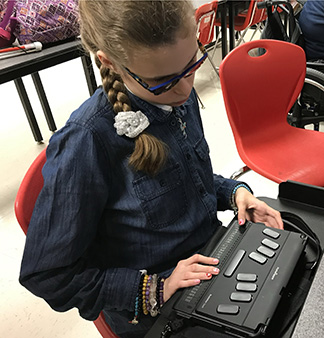
After she lost her remaining sight, Katie got fully on board with Braille. For the first time in her life, she really wanted to learn to read by touch! We renewed our efforts to get more Braille instruction into her IEP (Individualized Education Plan). Each year we worked with great diligence to build an educational team that could meet Katie's learning needs. It was a challenge sometimes to get accurate information into her IEP'S and three-year evaluations, to focus on what she could do and not to emphasize the things she couldn't do yet.
Fortunately, we've had a couple of wonderful TVIs over the years, and some of Katie's classroom teachers have been terrific. She's also had some great speech therapists, occupational therapists, and physical therapists, as well as school administrators who went above and beyond to make sure she got the education she deserved. It really has taken the proverbial village to educate our daughter!
Katie doesn't learn quickly, but once she masters new information or a new skill, she retains it. Recently she passed the Texas history requirement for high school students. She had a great teacher who was careful to explain the material in ways Katie could understand. She remembered everything she learned in his class, and she passed the exam.
Katie's skills are very scattered. She has some areas of strength and some areas where she continues to struggle. We keep plugging away, and she keeps learning. One of our doctors commented, "It doesn't matter when she learns that two plus three equals five. What matters is that she learns two plus three equals five."
Katie graduated from high school with a certificate of completion, and she is now in a postsecondary program at Texas School for the Blind and Visually Impaired (TSBVI) to build her daily living and other skills. She and I share an apartment in Austin so she can be close to the school campus and attend as a day student. This coming year she'll live in the dorm.
Today Katie has many friends at TSBVI, and spending time with them has helped improve her language skills. When she and her friends are together, Katie is the one who tries to get people to laugh. She pays attention to the things people like, and that gives her topics to talk about.
Katie has been accepted into WACO (Work and College Opportunities) and HOPS (Horticultural Options in Plant Sciences), two postsecondary programs for students with special needs sponsored by Texas A&M University. These programs, which Katie can attend sequentially, will allow her to explore jobs in landscape management, floral design, and other fields that appeal to her. Like other people her age, Katie is eager to explore the possibilities that await her.
We're profoundly grateful for all of the help and encouragement we've received through the years from teachers, therapists, friends, conference organizers, and our support system in the NFB. Most of all, we're proud of Katie herself. Though she has encountered enormous hurdles, Katie has shown us again and again that she is determined and resilient. When she makes up her mind to do something, nothing will stop her.