American Action Fund for Blind Children and Adults
Future Reflections Summer 2024 CAREERS
You Could Be a Unicorn! Consider Becoming a Teacher of Blind and Low-vision Students or an Orientation and Mobility Instructor
by Janna Kowalik
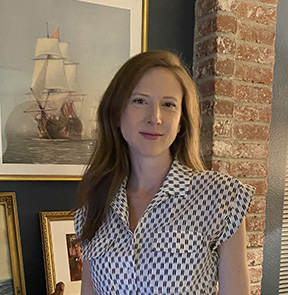 From the Editor: I hear the story from families all over the country: "My child needs Braille instruction!" "My child needs to learn access technology!" "We don't have anyone to teach my child to use the long white cane." The need is dire, especially in rural areas. In this article, Janna Kowalik writes about the joys and benefits of working in the field of blindness education. Janna is a teacher of the visually impaired (TVI) and orientation and mobility instructor based in Sacramento, California. And—full disclosure!—she's also my daughter.
The world of special education is filled with acronyms. If you are reading this publication, you already may know the significance of the letters TVI (teacher of the visually impaired) and O&M (orientation and mobility). However, you may not realize the high need for professionals in these fields. The scarcity of certified TVIs and O&M instructors has a negative impact on students across the country. I have worked as a TVI and O&M instructor for the past twelve years, and I love my career. So why are professionals in these fields so scarce?
I believe that lack of awareness is a key piece of the puzzle. In this article I hope to raise awareness of the job duties performed by TVIs and O&M instructors and to share the many benefits of working in these fields. Perhaps these words will reach someone who is choosing their first career, someone considering a career change, or someone who knows somebody who would make an amazing teacher but isn't sure where to start.
A teacher of students with visual impairments (known in some training programs as a teacher of blind students, or TBS) is a certified teacher who has received either a bachelor’s or master’s degree in teaching with an endorsement in visual impairments and blindness. TVIs are trained to teach the Expanded Core Curriculum (ECC). Blind and low-vision students need instruction in concepts and skills that will allow them to compensate for the decreased access to information that results from their visual impairment.
These concepts and skills fall into nine areas under the Expanded Core Curriculum: assistive technology, career education, compensatory skills (including Braille), independent living skills, orientation and mobility, recreation and leisure, self-determination, sensory efficiency, and social interaction skills. Within each of these areas, TVIs address the aspects of the ECC that relate to a student's visual impairment. For example, a TVI teaching social interaction skills might teach a student to hold their head up and turn toward the person speaking to them. Assistive technology within the ECC includes the use of screen magnification, screen-reading software, and refreshable Braille displays. A TVI teaching sensory efficiency skills might work on the use of tactile discrimination to complete daily tasks or on using visual scanning to locate a desired item in an array.
Orientation and mobility refers to safe and efficient travel skills such as indoor and outdoor wayfinding, mental mapping, and the use of the long white cane. It can only be taught by a certified orientation and mobility specialist.
TVIs and O&M specialists are often itinerant, traveling from school to school within a school district or throughout multiple districts. Some even travel by plane or helicopter to reach students who live in remote areas! Others work in resource rooms or at residential schools.
Many districts in my area have unfilled TVI and O&M positions. In fact, some of these positions have remained open for a year or more. I live in an urban area, where the likelihood of filling a TVI or O&M position is relatively high. In rural areas there may not be a qualified TVI or O&M instructor within one hundred miles of a given school district.
The nation currently faces a teacher shortage in all areas of pre-K-12 education. Districts are struggling to find and retain teachers in every discipline. However, the scarcity of TVIs and O&M instructors is nothing new. When I entered my graduate program in 2010, I was assured that my employment post-graduation was all but guaranteed, especially if I were willing to move to a less urban location. In fact, my graduate-school tuition was fully covered by a grant aimed at bringing more professionals into the field. I have heard employers refer to TVIs and O&M instructors as "unicorns" because we are so scarce we might as well be mythical creatures!
The need for qualified TVIs and O&M instructors has been dire for decades. As long as positions remain unfilled, students will not have access to vital areas of the expanded core curriculum, instruction to which they are entitled under IDEA (the Individuals with Disabilities Education Act).
There are many benefits to working as a TVI or O&M instructor. For starters, many universities offer significant grant-funded tuition assistance for those enrolled in certification programs. Such assistance makes studying to become a TVI or O&M instructor more affordable than the pursuit of other disciplines. In addition, opportunities exist to work and be paid as a TVI intern while completing a certification program. Some districts unable to fill positions with certified TVIs are willing to employ students who are enrolled in a certification program. Due to the high number of open positions, certified TVIs and O&M instructors have the benefit of a less stressful job hunt. Someone entering the field will likely never have to compete against a pool of fifty other applicants for a job!
Then there are the many benefits of the job itself. Most TVI and O&M positions are itinerant, meaning that instructors travel from school to school and often town to town throughout the day. For this reason we enjoy a great deal more flexibility than typical classroom teachers experience. While we must take into account the availability of our students, making every effort to avoid pulling them from academic classes, we are granted the freedom to set our own schedules. For example, if I live close to a certain school, I may be able to start or end my day there to ease my commute. Itinerant TVIs and O&M instructors usually work one-on-one with students, which allows us to get to know our students on a level that is not always possible in a classroom setting. Also we only have to worry about the behavior of one student at a time, so classroom management is not usually an issue.
If you believe variety is the spice of life, you'll love working as an itinerant TVI or O&M instructor. You will have the chance to work with students of all ages, backgrounds, and abilities. I can assure you, boredom is never an issue in these fields! Depending on your students' needs, you will find yourself working on anything from Braille and activities of daily living to self-advocacy skills. You might teach all of the above to one student over the course of a school year. You might be at a kindergarten in the morning, encouraging Braille-letter recognition; and at a high school in the afternoon, helping a student prepare a scholarship application. You might spend time in a special education classroom, helping a student learn to press a switch to choose between two recreational activities. From there you might drop by a middle school to make sure one of your students has access to a large print copy of To Kill a Mockingbird. The variety of tasks within our field ensures that we are always growing as professionals, always adding to the skills in our toolkits.
The final job benefit I will discuss is the one I feel is the most important. As teachers of students with visual impairments or orientation and mobility instructors, we play a critical role in our students' futures. Throughout my years as a TVI/O&M instructor, my colleagues and I have helped students learn Braille and assistive technology, and we have helped them learn to navigate their school campuses without sighted assistance. We've shown students how to access community resources and how to understand the accommodations provided in their IEPs. We've even taught students to send text messages using VoiceOver so they can communicate with their friends like any other teen. If we hadn't been there, that instruction might have been provided piecemeal by overworked teachers in other disciplines—or those skills might never have been taught at all. Blind and low-vision students will always benefit from the contributions of their classroom teachers, other service providers, and supportive family members. However, as TVIs and O&M instructors, our roles are crucial. It is our job to prepare blind and low-vision students to be as independent and capable as possible. A good TVI or O&M instructor can make all the difference between student failure or success.
If you are interested in becoming a TVI or O&M instructor, please look up accredited programs in your area. To get more information about the job, join one of the many Facebook groups for TVIs and O&Ms. And if you are not interested in these careers yourself, please send this article along to anyone you know who might be.
If you are already a TVI or O&M instructor, ask about participating in career days at the high schools in your district. Help teens considering future careers become aware of these job opportunities. Ask about providing an in-service training for students in education courses at your local college. Post about the shortage on social media. Any degree of awareness might make a difference in getting future students access to qualified TVIs and orientation and mobility instructors.