American Action Fund for Blind Children and Adults
Future Reflections Summer 2024 NEW DIRECTIONS
The Use of Body-tactile Signals for Children with Visual Impairments and Additional Disabilities
by Flavia Daniela dos Santos Moreira
From the Editor: Flavia dos Santos Moreira is a professor at the Benjamin Constant Institute in Rio de Janeiro, Brazil. Part of Brazil’s Ministry of Education, the Institute is charged with promoting educational opportunities for the blind and visually impaired. Professor dos Santos Moreira is conducting extensive research on the use of tactile methods of communication with children who have visual impairments and additional disabilities such as cerebral palsy. This work may also have value for children who are deafblind or those who have cerebral/cortical visual impairment.
I would like to share with you some of the work I carry out in individualized alternative communication services. I work at the Benjamin Constant Institute, a secular institution founded in 1854 by Brazil's Emperor Pedro II and located in Rio de Janeiro. It is an institution specializing in the needs of people with visual impairments, including early education, basic education, vocational training, and ophthalmological care. In addition, the Institute offers professional training in the field of visual impairment through extension courses and broad postgraduate courses.
Is it possible to indicate the beginning and end of an activity to children with multiple disabilities and visual impairments through tactile signals?
The presence of visual impairment can make it difficult for infants and young children to interact with parents and others who are accustomed to communicating by visual means. When additional disabilities are present, the challenges can be even greater.
The child's ability to represent objects or situations that are outside the visual field or the current context is called semiotic function (Piaget, 1982). Within Piagetian theory, representation involves the ability to evoke, through a sign or symbolic image, an absent object or an action that has not yet been performed. During the sensorimotor period of development that occurs in the first two years of life, the child is in the process of adapting to and integrating into the surrounding environment. At this stage, children cannot yet think about things outside their tactile and visual perceptual fields. Their interaction occurs through direct action with the elements present (Piaget, 1982). In the preoperative period, which occurs between two and seven years of age, children are still largely limited to their sensory environment. It is important to provide experiences that allow children to expand their understanding in order for them to relate words to objects and actions.
In the pre-symbolic phase, children with visual impairments and additional disabilities face unique difficulties in forming concepts regarding elements far from their immediate context. Chen and Dote-Kwan (1995) explain that these children belong to a widely diverse group with visual impairment as a common characteristic. According to these authors, additional disabilities may include intellectual disability, physical disability and reduced mobility, autism spectrum disorder, and fragile health conditions. These children may have syndromes that present complex communication needs, leading to difficulties generalizing skills from one environment to another (Chen; Dote-Kwan, 1995).
It can be a huge challenge for these children to access information related to arbitrary concepts, such as verbal explanations about the beginning and end of their routine activities. Many of these children communicate through informal and idiosyncratic nonverbal modalities, including subtle body movements or natural gestures. Therefore, it is necessary that the people who live with them possess great awareness and sensitivity in order to respond to the child's manifestations of needs, feelings, and interests. It is essential that the child receives a response; if there is no response, the surrounding environment will be perceived as unpredictable and full of ambiguities (Granlund, 1983).
In the absence of vision, touch can be used in communication and learning (Peltokorpi et al., 2023). For example, touch can be used in modeling actions, and children can see with the hands to perceive the details of a given object.
When there is ambiguity and disorganization, things may seem to appear and disappear without any clear and consistent explanation. When this happens children may become withdrawn and passive (Granlund, 1983). Due to additional disabilities, the child's access to information is fragmented, reducing the child's motivation to explore, initiate interactions, or participate actively in everyday situations. Consequently, adults' expectations for the child may become low. The child becomes increasingly dependent on other people and trapped in a cycle of passive and meaningless activities (Chen; Dote-Kwan, 1995).
With this concern in mind, the individualized communication services we provide here at the Benjamin Constant Institute are organized into three phases: beginning, middle, and end. This work is part of a longitudinal research study coordinated by me. It is authorized by the Ethics and Research Committee and approved by the Benjamin Constant Institute through Approved Opinion No. 5,905,847.
The following body-tactile signals were created:
A: Body-tactile signals referring to emotions: angry, sad/pain, and that's okay.
Figure 1 — Body-tactile signals for emotions.
Source: Prepared by the author.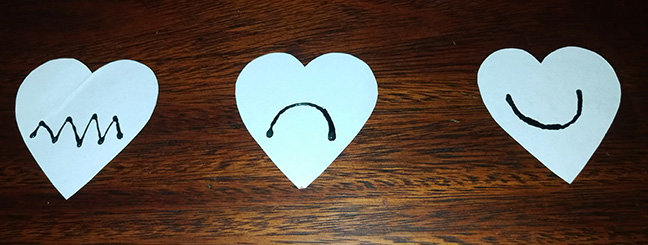
At the beginning of the lesson, these signs are made on the child's left hand or arm to find out how they are feeling. There follows a waiting period for the child to express his or her response. The response could be a raised index finger, a vocalization, or a facial expression.
b) Body-tactile signals to represent the start and finish of an activity.
Figure 2 — Body-tactile signals to represent to start and finish.
Source: Prepared by the author.
During these alternative communication sessions, the participation of families was essential in the child's various environments. After all, communication is the connection between two or more people, occurring throughout the child's life.
Granlund (1983) emphasizes that every activity has communicative potential. Children's communicative development requires that their actions receive a response. The child's expressive and receptive communication will become deliberate as he or she receives frequent responses from others. For body-tactile signals to work effectively, it is important to consider the child's cognitive abilities, muscular control, state of attention, motivation, likes, and dislikes. Likewise, it is important to observe how the child reacts to environmental stimuli; depending on the child's pathology, excess stimuli may cause difficulties in processing information. I hope that this report can inspire new practices to be carried out with children with multiple disabilities and visual impairment.
References
Chen, D. and Dote-Kwan, J. (1995) Starting Points: Instructional Practices for Young Children Whose Multiple Disabilities Include Visual Impairment. Los Angeles, CA: Blind Children's Center.
Granlund, M. (1983) "The Importance of Communication." in Anden, G. and J. Brodin. My Body—My Words: Communication for the Mentally Handicapped. National Association for Retarded Children, Young People and Adults, Stockholm (Sweden). Swedish Inst. for the Handicapped, Bromma, pp. 8-10.
Peltokorpi, S. et al. (2023) "Bodily-Tactile Early Intervention for a Mother and Her Child with Visual Impairment and Additional Disabilities: a Case Study." Disability and Rehabilitation: An International, Multidisciplinary Journal. Vol. 45, No. 12, pp. 2057-2072. Available at https://doi.org/10.1080/09638288.2022.2082563 Accessed on June 24, 2024.
Piaget, J. and Inhelder, B. (2000) The Psychology of the Child. NY, Basic Books. https://www.alohabdonline.com/wp-content/uploads/2020/05/The-Psychology-Of-The-Child.pdf