American Action Fund for Blind Children and Adults
Future Reflections Summer 2024 CREATIVE ENDEAVORS
The Disorienting Journey of the Eye: An Artist in the Country of the Blind
by Stephen Proski
 From the Editor: In 2021 Stephen Proski was the recipient of a National Federation of the Blind Scholarship. He continues to pursue his passion for the fine arts and for opening this field to people who are blind or have low vision. This year he will study in Poland on a Fulbright Fellowship.
I've been a traveler in the country of the blind for most of my life. Getting lost, taking detours, becoming stranded, breaking down, and perhaps having a panic attack or two along the way—all these experiences are inevitable parts of the process. The journey itself is the destination, after all. There is no Lonely Planet or Rick Steves’ Travel Guide for navigating this place. Its borders are unseen and undefinable, and whatever makeshift maps I could muster up proved to be ineffective and unreliable.
I refer to myself as a traveler instead of a naturalized citizen because I've spent unaccountable portions of my life assimilating to the culture and customs of a world geared to the sighted. And I did this not for myself, but for the benefit of others.
For a long time, I didn't want to accept my blindness. It became something uncontrollable that others used to define who I was. It determined the expectations they had of me, and those expectations were pretty low. I've put myself into countless uncomfortable and stress-inducing situations trying to accommodate and please other people, when in fact they should have tried to accommodate me. Only within the past two years have I come to realize that I wasn't offered the same opportunities or experiences in school as my classmates. Due to my blindness, the education system wasn't invested in my future in the way it invested in the prospects of others. I was viewed as a burden and treated as such, despite my persistent work ethic and my desire to succeed. People seemed to feel threatened by and skeptical about my blindness. Ironically, the attitudes I perceived left me feeling somewhat skeptical as well. In reaction, I tried to convince myself that I wasn't really blind.
The pressure for assimilation in a disability context is inherently ableist. It implies the need for a cure when cure is not possible or even necessary. It creates internal conflict rife with antagonism. Only recently have I begun to dismantle the atrocities of internalized ableism. The desire to cure me, rather than encouraging me to be an active, capable blind person, became a recurring motif that I didn't know how to manage.
When I was younger I developed an unhealthy obsession with eating carrots in the hope that eating them would improve my eyesight. Carrots contain beta carotene, which the body uses to make a form of Vitamin A that helps the eyes see in low light. A deficiency in Vitamin A actually can cause a form of blindness. I convinced myself that if I ate as many carrots as Bugs Bunny, my eyes would suddenly function properly, i.e., the way other people wanted them to function.
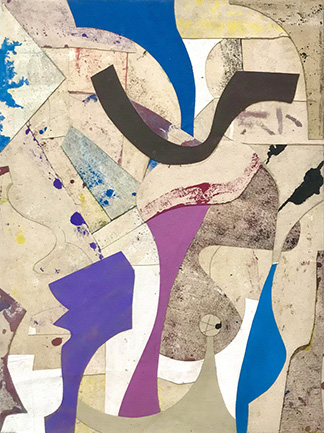
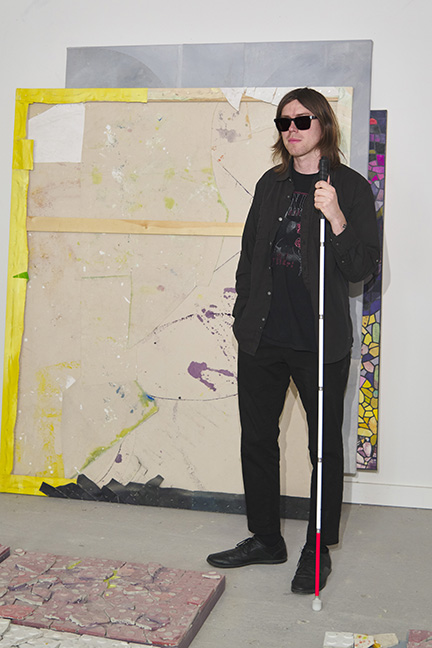 I'm a blind/disabled artist participating in the world of visual art, a world that prioritizes vision (and people with vision) over everything else, especially when it comes to painting. Making art is a choice, and choosing to pursue life as an artist is an even more difficult decision. It requires an incredible amount of commitment, sacrifice, and resilience. It's an extreme sport, and not everyone is cut out for it. The population of professionals in this niche part of the world is startlingly small, just a fraction of 1 percent. I can count on one hand the number of blind artists I know. In general the art world has a reluctance toward embracing the idea of a blind artist and all the complexities and nuances associated with blindness and artistic expression. There are as many ways to be blind as there are to be sighted. We live in a culture obsessed with vision and the subjectivity of the human visual process. Why aren't more blind artists being recognized for their work?
People with disabilities are skilled at adapting. We meet our needs through malleability and ingenuity. Disability as a state of human experience arises not from the failure of a body or the self's inability to adapt to the world, but from the world's failure to adapt to the varied needs of individuals. Backpacking in Spain, studying abroad in France, or uprooting the life I have built to start over in a new city, I have adapted to my surroundings by navigating the sometimes hostile built environment without the privilege of vision.
Prior to attending graduate school, I worked at a nonprofit art studio that supported adults with developmental disabilities. Working alongside other artists with disabilities showed me the epidemic of underrepresentation of disabled individuals in the art world, and it inspired me to reverse that trend. I am determined to amplify my own voice and continue working with other disabled artists to do the same.
I came to discover the National Federation of the Blind when I was applying for scholarships so I could afford to attend graduate school. Prior to that time I had had little access to blind culture or the fabled accounts of blind citizens. It was as though this section of the library had always been unlocatable. It was as though portals would change their location the closer I came to discovering them, leaving me forever lost in a labyrinth of misinformation.
When I attended my first NFB convention in 2021, I felt part of a community for the first time in my life, engaging in cross-cultural exchange unified by the common experience of blindness. At convention I shared my ideas about art and blindness with people who were actually willing to listen. I met people who shared my conviction that the varied experiences of blindness offer a unique lens of perception. Like me, they believed that the harnessing of impairment as a creative force is profoundly radical and decidedly political. Not only to exist, but to make art in the face of a world that wants you silenced or even eliminated, is the ultimate act of resistance.
I didn't know what the Fulbright program was until I read Ben Lerner's Leaving the Atocha Station, a novel based on the author's time as a Fulbright recipient in Spain. I had been completely unaware that most people with at least an undergraduate degree are eligible to apply for a Fulbright fellowship. The Fulbright program is an international exchange facilitated by the US Department of State with funding provided by the US government. Its overall goal is to improve intercultural relations and cultural diplomacy between the US and other countries through the exchange of persons, knowledge, and skills. Participants are selected through a rigorous application process that welcomes applications from students, scholars, teachers, scientists, professionals, and artists. Likewise, citizens of other countries may qualify to study in the United States.
Needless to say, I was hesitant to apply. As usual, thoughts of self-criticism, inferiority, and doubt immediately began to creep around in my skull. I was sure that Fulbright was specifically reserved for, well, people who aren't me. Just spend some time perusing the grantee directory and you'll get an idea of what I'm talking about! However, once I discovered there were other blind Fulbrighters, I persuaded myself that this opportunity wasn't so far out of reach. Even with my cane in hand, with the unwavering support of a few others, this was something to which I could aspire.
I'm happy to report that during the upcoming academic year I will be pursuing research and living abroad in Poland as that country's first-ever blind/disabled Fulbright grantee. My project will focus on cultural attitudes toward ableism through the lens of Polish postwar mosaics and architectural ceramics, specifically factories that once employed blind/disabled workers during the reconstruction of the country after World War II. I look forward to learning about the blind/disabled experience from the perspective of another country, and I welcome the opportunity to collaborate with others and connect with my Polish heritage. I know my ancestors lived in Poland, but, like my vision, any memory of this place seems to deteriorate over the course of time. There is a strong blind community in Poland, and I'm excited to represent my community and to establish cultural connections between blind/disabled people in the US and those in Poland. I hope to make Poland my home away from home, while still maintaining a permanent residence in the country of the blind, where things have become a little bit more navigable.