American Action Fund for Blind Children and Adults
Future Reflections Summer 2024 ADVOCACY AND ACCESSIBILITY
Fostering Inclusion: Blindness Doesn't Define Us
by Cricket Bidleman and Karen Smith
Reprinted from Braille Monitor, Volume 67, Number 5, May 2024
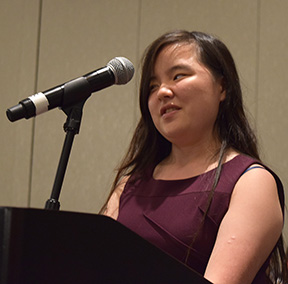 From the Editor: Playing games together can be an endless source of fun for friends and family. For us as blind people, however, issues around accessibility and inclusion can become complicated. No matter how much we want to join in the fun, we may feel apprehensive about inconveniencing others when a game is not fully accessible. In this article Cricket Bidleman expresses her delight over being fully and unquestioningly included by a group of friends.
I didn't have many games growing up, other than a Braille Monopoly® set, a couple decks of cards, and Uno®. I sometimes spent hours using my slate and stylus to make game cards; sometimes I had to staple packets of index cards together to include all the information that was on one print card. By this point, the "cards" were far too bulky to do anything with, and shuffling decks was a real pain. If I was tag-teaming with someone, I could kick some serious butt at Mario Cart. At one point, my brother taught me how to play various Pokémon games on his Game Boy and Nintendo DS. Most of the creatures made unique sounds. Although I'd like to think this was an intentional accessibility feature, probably it was added to make the games enticing for sighted players.
The first time I encountered a variety of games was in college, where my friends had impressive collections of card games, board games, and social deception games ... and most of them were inaccessible.
Fortunately, my friends didn't mind adapting the games to make them more usable for me. One friend even went so far as to make an all-online version of Avalon—a social deception game in which certain characters had access to information that other players couldn't see. Essentially, certain characters knew who was on their team. My friends didn't necessarily understand the scope of inaccessibility, nor what it's like to live in a world where inaccessibility is so rampant, but I was incredibly privileged to have friends who were willing to go the extra mile to include me in recreational activities.
I met my friends Ryan and Maivboon ("My-boon")—now essential members of my family—in my second quarter of freshman year. Ryan's enormous collection of games truly eclipses all others. If I recall correctly, they took up almost the entire back seat of a car in 2018. I had never heard of the vast majority of these games, but fortunately, Ryan and his friends were very willing to foster an inclusive gaming environment.
It was not very difficult to find alternative techniques for playing some of those games. You could use a random number generator for games that needed number sequences. You could use an Optical Character Recognition app to scan cards, or have someone else read or text information. You could team up with someone when boards had no tactile squares or when there were no tactile differences between differently colored pieces. You could put stickers on pieces that blind players are using, add labels to cards, etc.
I constantly have had to fight for accessibility. I felt that asking for accessibility around games was wrong and taboo. I was essentially asking people to do something extra to facilitate my participation. When they did so, voluntarily and gracefully, I was incredibly grateful.
Blindness was never a big deal on board game nights—I felt truly included and welcome. I didn't feel like I had to sit on the sidelines unless I wanted to. In fact, sometimes I would volunteer not to play a game because I didn't want to be an inconvenience, and someone would come up with an alternative technique that would let me participate without much trouble.
When Ryan brought his parents back to the dorm for some games one night during spring break, I really thought about sneaking off to my room so as not to be an inconvenience. I had learned to assume that people didn't know anything about accessibility and were automatically conditioned to be resistant to it. While Ryan was used to finding solutions by now, I assumed that his parents wouldn't want to do something extra so that I could participate. Ultimately I decided to stay with them, and it was the best decision, because we're now family.
It has been over six years since that night. Periodically I wondered what kind of impression my accessibility needs made on Ryan's parents. When I stayed with them during COVID-19 and after, I tried to be as unintrusive as possible in terms of accessibility. It wasn't until they asked me why I hadn't already labeled their appliances that I ended up doing so. That was one of the very few times when someone invited me to implement accessibility rather than me having to ask. I have tears in my eyes thinking about how loved and welcome I felt in that moment, and honestly, during all the time that I've spent with them. They didn't necessarily understand accessibility at first, but they were and are willing to learn and implement solutions. Nevertheless, I couldn't get rid of the feeling that blindness was an inconvenience to all of us, and that their introduction to accessibility on that board games night ruined what should have been some family fun.
I read this Facebook post from Ryan's mom Karen for the first time last weekend, although she wrote it six years ago, and I am sharing it with her permission. It is so incredibly refreshing to find out that my blindness and accessibility needs were not a burden for them. I want to end with what Ryan's mom wrote. Until the day when everyone recognizes the importance of universal design in fostering inclusion, I hope that more people will approach blind and disabled people with the open-mindedness and love that the Smiths have constantly shown me.
Karen Gaupo Smith is with Dan Richard Smith
March 24, 2018
Last night was a first for me. It was an amazing night. I have tears in my eyes as I write this. Dan and I caught a plane yesterday to spend the weekend with our youngest son, Ryan. He is on spring break during his senior year in college. He is working during the break, so he was not able to come home. We had a nice dinner together and then he invited us back to his dorm for game night. Ryan brought down a selection of board games and we would decide what to play as the evening progressed. And now the amazing part, one of the college students that joined us is blind. Her name is Cricket. That is all I know about her. That is because there was no focus on her blindness. The focus was on the fun we were having playing these games together (complicated games that were new to most of us, but a whole lot of fun). The players just naturally described the game boards, the visuals, things relevant to playing the game, and things that were just aesthetic about the gaming pieces. One of the players also directed her hands to the embossed areas on the pieces and on the game boards, even though it was not needed to understand the rules. There were times when secret information on the game cards needed to be provided to Cricket. When it was legit for one of the other players to also know the information, they texted the info to her phone so her app would read it to her earpiece. When the information could not be shared with another player, one of the players escorted Cricket to find someone else in the dorm who could read the card to her privately. All this was done with a simplicity and naturalness that flowed as a part of the game. Being a part of this evening and the amazing kids made me more proud than I can express. I am in awe of both Cricket's ability to quickly absorb and play something that I needed all my senses to comprehend and the other students' abilities to improvise how we played the games. I may never look at a game board the same way as I run my fingers across the embossed areas.