American Action Fund for Blind Children and Adults
Future Reflections Convention 2024 NOPBC CONFERENCE AND BOARD MEETING
Blaming It on Blindness
by Carlton Anne Cook Walker
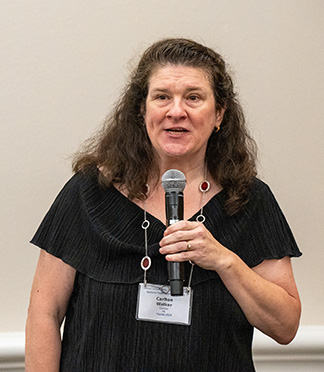 From the Editor: As an attorney, a certified educator of blind/low-vision students, and the parent of a blind child (now a young adult), Carlton Walker brings a unique perspective to educational theory and advocacy practices for blind/low-vision students. She is an educational advocate and consultant with Blindness Education and Advocacy Resources (BEAR). In this article, based on a workshop she presented at the 2024 NOPBC Conference, she addresses some of the obstacles facing blind students and their families and explores solutions to the ubiquitous problem of “blaming it all on blindness.”
Blindness/low vision is called a “low incidence” disability. Students who have IEPs (Individualized Education Programs) with “visual impairment, including blindness” as their primary disability represent a tiny fraction of all students with IEPs. Less than one-third of one percent of all students with IEPs—about three students in one thousand—list blindness/low vision as their primary disability. Given that students with IEPs represent only ten percent of all students in US schools, there are only three students with an IEP for blindness/low vision for every ten thousand students enrolled in school.
Throughout the public-school journey of my blind child, including early intervention services, my child was the only blind/low-vision student in the school district. In fact, there had not been another blind student in our school district in years. This is the reality faced by students with low-incidence disabilities.
Educators who have little experience with blind/low-vision students often argue that minimal services, instruction, accommodations, and assistive technology are needed for the blind child. At the same time, they tend to assume that blindness is the cause of any educational challenges or obstacles the child encounters. In other words, they may minimize the true educational needs of the child, but then assume that any delays or struggles are the result of the child’s blindness—a disability for which they don’t want to provide adequate instruction, accommodations, or technology.
Sometimes even talented educators fail to identify the incongruity of these assumptions. They simply do not understand the adverse impact of atypical vision within a vision-centric education curriculum. Their inexperience with nonvisual educational tools often leads them to try to “maximize vision” or exempt the student from vision-based tasks. Both of these solutions rob blind/low-vision students of genuine access to the curriculum.
Low Expectations
Most educators are typically sighted. Some cannot understand how anyone can function at a high level with atypical vision. In fact, they might never have met a blind adult. Given these realities, it’s not surprising that they have trouble imagining how a blind child can achieve at the same level as a sighted child can.
Sadly, even some teachers of blind/low-vision students fall into the trap of low expectations. When I was in the classroom teaching, I worked with many other professionals, including TVIs (Teachers of the Visually Impaired) with decades of teaching experience. Even some of these seasoned professionals had low expectations of their students.
Aversion to Adequate Accommodations
IEPs typically deal with both accommodations and modifications. Accommodations are changes in presentation or methods that make the content accessible. Examples include Braille in lieu of print, tactile graphics instead of printed graphs and photos, and accessible digital materials. Modifications are changes to the content itself. Examples of modifications include shortened assignments, exemption from class projects, and the use of a human guide instead of independent travel in and around the school.
Low expectations can lead to assumptions that a student has disabilities in addition to blindness. I remember one student who was transitioning from early intervention (EI) services to school. The TVI who handled his early intervention services told me, “This child is so hyperactive, and he’s also very low intellectually.”
This child had very high myopia, and he was at risk for retinal detachment. Unfortunately, the EI TVI did not catch this important diagnosis. Instead, she insisted that the child “just liked getting up close.” She also failed to identify his difficulties in low light environments, despite the fact that she was also an orientation and mobility specialist. She minimized the impact of his significant low vision and failed to recognize its likely progression. Furthermore, due to her misunderstanding of his visual impairment and her rejection of his nonvisual needs, she asserted that he had additional disabilities.
I performed an NRMA (National Reading Media Assessment) on this student; this assessment is required under federal law for every IEP in which a blind or low-vision student is not receiving Braille instruction. As I performed the assessment, I noticed that every ninety seconds the student began wiggling around in his chair and looking out the window. He was off task literally every ninety seconds. What was going on?
This child was giving himself a visual break! After each visual break, he went right back to the task at hand. He knew he needed visual breaks, and he figured out ways to get them without having to ask for them. Does that sound like low intelligence?
As I administered the NRMA to this preschool child, we got to the part that looks at shapes. It includes circles, triangles, and squares. I showed him each shape, and I asked him, “What do you call this?” I don’t really care what a student calls each shape, as long as the child says the same thing every time—you can call them Riccobono, Maurer, and Jernigan as far as I’m concerned! It’s all good, as long as each time it’s the same. This child looked at the shapes and said, “That’s a ball, that’s a box, and that’s a roof.”
This child had very young parents, and there were two more children right after him. His parents hadn’t gone very far in school. His grandparents were doing the best they could to help, but the family had very limited resources. That TVI called this child “low intellectually” because he didn’t know the terms circle, square, and triangle. But he knew ball and box and roof! Low? Are you kidding me?
We really have to dig a bit when we evaluate these children, not just guess at easy answers. We need to take our time and talk to the child, give the child the chance to be himself or herself.
Misunderstanding of Visual Abilities—and Reasonable Expectations
I had one student with no central vision. One day that student saw a bird fly by, and none of the rest of us noticed it. People said, “Look! He isn’t blind after all! He saw that bird!” But seeing a bird fly by is not the same as attending to instruction. The only vision this student had was peripheral vision. Peripheral vision is used to discern movement and irregular patterns. It kept us safe in the jungle with the lions. If we saw an irregular pattern, if we saw the leaves moving, there might be a lion there. That’s what peripheral vision is good for.
Peripheral vision is not good for reading. It’s not good for attending to instruction in the classroom. But when this student saw the bird, the staff assumed he must have good eyesight. Ironically, the only reason the child saw the bird was because he’s blind. Nobody else saw it, because nobody else was exclusively using their peripheral vision. This child couldn’t read print in a book, but he could find things on the floor. When it came to reading, he still needed to learn Braille.
Collecting Data Objectively
How do we sort out whether a child is taking a visual break or avoiding a task? How do we rule out ADHD? Maybe the child’s inattention could be caused by low blood sugar. Maybe the child ate something with red dye in it.
In evaluating a blind child, experience helps. I became better at maintaining objectivity in my data gathering as I gained experience and collaborated with others.
I often collaborated with the school psychologist. Some school psychologists are better than others, and you’ll find out which ones you like to work with. One psychologist gave me a very useful piece of information: a disability will never cause a child to over-perform. What does that mean?
Let’s talk about IQ tests. On IQ tests the mean is 100, with average on either side, between 85 and 115. That’s the range from low average to high average. Now let’s add another fifteen points on either side, 70 to 84 at the low end and 116 to 130 at the high end. The higher score is not in the gifted zone yet, and the lower one is in the range we call delayed. When an IQ score is below 70 we consider intellectual disability. If the score is above 130 the child will be considered gifted.
Intelligence Testing for Blind/Low-Vision Students
When typically sighted children undergo IQ testing, they are given nine subtests to arrive at an overall score. Unfortunately, most of those subtests are highly visual in nature. They cannot be given to children who are blind or have low vision. When they are tested, blind/low-vision students are given only two subtests out of the nine given to their sighted peers.
There are reasons why nine subtests are typically given. They provide a lot of information about a child’s abilities. We cannot obtain that range of information about a blind or low-vision child through testing.
One of my students scored 70 on the processing test and 99 on the test for verbal comprehension. What should the IQ score be? That score of 70 should not be averaged with the child’s score of 99! We have to understand that the 99 is probably close to the child’s true score.
Another blind student had scores of 99 and 141 on the subtests. On the verbal test this child is well into the gifted range. But this child had something going on that tanked the working memory score. In this case, the IQ test validated the parents’ concerns that the child had dyslexia. Additional testing, in collaboration with an experienced professional in blindness education, yielded proof that this student was intellectually gifted and dyslexic, as well as legally blind.
I don’t believe that IQ tests should be used for blind/low-vision children as a general rule. Blindness or low vision artificially, absolutely lower the score. The score is not truly based on the test. Instead, it’s a score based on how the test is designed.
No IQ tests ever have been normed and validated for blind/low-vision students. The population is simply too small. Does that mean there are no gifted blind people? Of course not! Just because we don’t have the right tests, we can’t keep a child out of a gifted program that might be appropriate!
Perils of Praising Ordinary Artificial Accomplishments
Probably most of us have had experience with children who are more intelligent than they’re given credit for at school. What about the other way around? What happens when a child gets excessive praise for things that are actually easy and age-appropriate?
Is the blind child being given good information about what other people are doing? Do they know they’re getting more praise than others receive? What do the other children think about someone who gets praise for doing something ordinary and basic? Sometimes a blind student gets to college and discovers that they’ve been sliding by their whole life, not doing the work that was expected of everyone else.
Sometimes modifications lead the blind child and the adults around them to overestimate the child’s performance. Think carefully about any modifications that are offered. Are they really necessary? Will they mask an area where more intervention is needed?
A modification we often find in IEPs for blind/low-vision students is a reduction in workload. This might mean:
- Listening when peers are expected to read
- Dictating when peers are expected to write
- Doing fewer problems per assignment
- Doing shorter or less challenging assignments
Why do we encounter blind children who are doing only half of the work assigned to their sighted classmates? Often low expectations are to blame, but there are other possible causes as well. If the material is inaccessible, a modification may be the only way the student can engage with it at all. However, it is the school’s job to make the materials accessible. All of the student’s materials should be accessible—every time, on time!
If materials are inaccessible, the school has failed. It is never appropriate for the school to “solve” the problem of its failure by employing a modification to the curriculum. This “solution” only exacerbates the problem. It robs the student of educational opportunity by denying the student full access to the educational content. The modification only serves to hide these problems, making it harder to identify and correct them.
IEPs are supposed to be designed to meet the unique educational needs of a child with a disability, for the purpose of providing that child with a free and appropriate public education (FAPE). However, IEP teams sometimes accept modifications that actually prevent the child from receiving FAPE. I call this “IEP-ING” the student out of FAPE. In these cases, the team gets so focused on the individualized aspect of the IEP that it individualizes the student out of access to educational opportunities that are available to nondisabled students. Examples include:
- Providing the student with a human guide in lieu of adequate and timely orientation and mobility instruction
- Providing an adult who serves as a scribe for the student when peers are expected to write their assignments
- Providing audiobooks when peers are expected to read for themselves
- Exempting students from computer activities (including computer-based assessments)
- Permitting shortened classes or school days to facilitate the student’s movement between classes or use of bus transportation
Perhaps the student does not yet have the skills needed to use nonvisual tools and techniques independently and efficiently. In that case the student likely will need some modifications. However, the key is to recognize that these modifications are a support that will be reduced as the student gains needed skills and builds confidence. In these cases, the IEP team must document that these modifications are to be withdrawn as the student develops independence skills and is provided with appropriate instruction and tools. Even in cases where some modifications will always be necessary, the IEP team must focus on providing the student with appropriate levels of instruction and access to tools and technology.
Students with disabilities only have the right to FAPE in grades K-12. Once the student graduates from high school or ages out of having an IEP (typically at twenty-one or twenty-two years old), the student no longer has the right to modifications or disability-related instruction. However, disabled individuals do have the right to reasonable accommodations in most educational, employment, and community settings after high school and for the rest of their lives.
Reasonable accommodations include accessibility, but they exclude modifications. IEP teams should focus on providing an appropriate level of disability-related instruction and access to tools and technology. Not only will such instruction allow the student to access educational opportunities in primary and secondary education. It also will prepare them for postsecondary life by helping them understand the accommodations they need.
Providing Opportunities
Let’s look at a child who has a mixed level of skills. Is it appropriate to push that child into regular ed as though the child didn’t have a deficit? Every child deserves a shot.
I think we all can agree that children with intellectual disabilities don’t need to be saddled with intensive levels of formal, intellectually challenging tasks. Those tasks are inappropriate for a child with intellectual disabilities, regardless of the child’s level of vision. However, we must also recognize that sighted children get a lot of learning opportunities, even if they have intellectual disabilities.
Sighted children with intellectual disabilities receive instruction in classrooms full of pictures. Often they have opportunities to engage with technology (particularly the iPad). They may have a wealth of real-life experiences such as measuring, cooking, gardening, and cleaning.
Is there anything about Braille that makes it more intellectually challenging than print? (Hint: the answer is NO!) Is there any sound educational reason to withhold access to 3D models and tactile graphics? Should teachers refuse to provide nonvisual opportunities for a blind/low-vision child to measure, cook, garden, or clean, when other children of the same ability are doing those things?
Blind/low-vision children deserve the same educational opportunities that are offered to their sighted peers. This holds true for children with additional disabilities, including those with autism or intellectual disabilities. Nonvisual skills, tools, and technology open the doors of opportunity for all blind/low-vision students. Additional disabilities should never result in the reduction or elimination of these opportunities!
Strategizing IEP Development
The IEP has to cover all areas of a student’s disability, not only their needs as a blind student. It’s important to include as many areas of disability as possible. We need to empower parents to be on board, and we need to empower the children, too. Of course, getting good data to support or refute the presence of one or more additional disabilities is not always an easy task.
Often I see blind children being diagnosed with autism. On the other hand, sometimes parents are told that their children cannot have autism because they’re blind. It would be false to say that all blind children are on the autism spectrum, and it would be just as false to say that no blind children are on the spectrum. Blind children are human, and they have lots of different qualities. There’s a whole spectrum of autism, just as there’s a whole spectrum of vision or lack thereof.
As a result of their atypical vision, blind/low-vision children may have fewer opportunities to experience the environment than their sighted peers have. This lack of experience or different type of experience may result in atypical behaviors in the blind child who is not autistic. Some of these behaviors are also encountered in children with true autism, blind or sighted.
We might see some autistic-like behaviors such as “stimming” in blind children who have had limited opportunity to experience their surroundings. Although they display some traits associated with autism, overall they are unlike a blind child who truly is autistic.
How can we make an accurate assessment? While it is not perfect, a good place to start is this chart, “Comparison of Development among Children Who Are Sighted and Typically Developing, Blind or Visually Impaired, and Blind or Visually Impaired with an Autism Spectrum Disorder.” It is found in Appendix 2A on pages 32-37 of Autism Spectrum Disorders and Visual Impairment (Gense & Gense), 2005, APH. The book is available on Bookshare. The preview on Google Books includes this chart: (https://www.google.com/books/edition/Autism_Spectrum_Disorders_and_Visual_Imp/
fpQIdJNkS7AC?hl=en&gbpv=&printsec=frontcover)
Then we come to interventions. If a child has some characteristics of autism, and we find interventions that are successful, does it matter what the diagnosis is? We need to focus on the student and the student’s needs, not on labels or checklists.
Visual Components of Assessments for Other Disabilities
Speech assessment tends to be pretty auditory. However, academic and learning assessments are often based on vision. How do we assess processing disabilities? Most tests for processing disabilities are largely based on vision, so they are not valid for our blind and low-vision children. When doing a physical therapy assessment the examiner will say, “Okay, now do this.” How do we conduct assessments that were never validated for blind and low-vision children?
In many cases, we simply can’t perform valid assessments. However, the existing assessment tools can provide some useful information about our students. IEP teams need to have the typical examiners collaborate with skilled teachers of blind students. These collaborations can yield better assessment plans and can determine the usefulness of the information that is gathered. Experienced individuals such as Casey Robertson can help the local teacher of the visually impaired and the person doing the assessment.
How can this information be useful? In some cases, the assessment is so vision-based that we can only use the results of the nonvisual portions to benchmark the student against himself/herself. In other words, the assessment can show individual progress. However, so much is missing that it cannot provide grade-level information.
What can we do to address tests that aren’t valid? Here’s a good question to ask: what does the test really tell us? Are we testing paragraph recognition? If we are, the test might not be valid for our low-vision children, depending on how much central vision they have. How about using tactile graphics? Are tactile graphics interchangeable with print graphics? Well, not really. First children have to be taught to read them. Sighted children see pictures everywhere—at the grocery store, on Sesame Street, in books, on signs. Our blind children never have anything close kin to that exposure! Even if they did, tactile graphics are very different from two-dimensional pictures, and children interact with them in different ways. We may have to do more informal assessments than the official occupational therapy assessment used with sighted children.
Behavioral Assessments
Another big concern with some of our blind/low-vision kids is behavior. Behavioral assessments can be incredibly unfair. All behavior is communication. Our children tend to be pushed harder on behavior than their sighted peers are.
I had a student with low vision who also had fetal alcohol syndrome. I first assessed him in his preschool setting. The preschool was held in a church, and the reading circle was huge. There were about thirty children in the reading circle. My student was sitting on one side of the circle, and the teacher was all the way at the other side. The teacher complained to me, “He can’t pay attention at all. He’s always getting in trouble. He’s always talking to everybody.” When I sat by this child, I could barely hear the teacher myself.
Was this child a behavior problem? He was engaging in off-task and disruptive behaviors, but there were certainly contributing factors. It’s very important for us to identify problems within the child’s environment.
The school’s behavior assessor may not have much experience with some of the behaviors they see in our blind children. For instance, the behavior scales ask what the child does when X, Y, or Z happens. The blind/low-vision child may not have that experience at all. We can’t assume that our children have had experiences that may seem ordinary to the examiner, such as picking out items at the grocery store or playing at the park. We can’t make any assumptions! There may not be any way to make a test valid, to compare our children with children who are sighted.
Instead of trying to shove our children into the assessment paradigm, we must assess their behavior objectively and document their environment. When we identify areas of concern, we can make plans to investigate. Once we have more information, we can determine what the appropriate intervention should be. Maybe the blind child needs intentional instruction in areas that sighted students typically learn incidentally. Maybe the child should have one or more nonvisual accommodations. Maybe a behavioral intervention is needed. Maybe it’s necessary to devise a combination of these strategies. The key is to gain data objectively and meet the student’s documented areas of need.
Conclusion
In an educational environment designed for typically sighted children, our blind/low-vision children face some vexing challenges. Since most of the assessments that are used with sighted students are not valid, we need to be patient and resourceful when we assess children who are blind. We must be careful not to tag our blind children with inaccurate labels that may stick throughout their educational experience. Through observation, reflection, and advice from experts on blind children, we can find ways to give our blind children the range of opportunities they need and deserve.