American Action Fund for Blind Children and Adults
Future Reflections Convention 2024 NOPBC CONFERENCE AND BOARD MEETING
Where Flavor Meets the Federation
by Nick Oliver
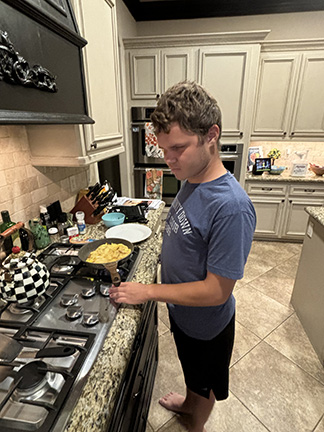 From the Editor: By long tradition, blind students address the NOPBC Conference and share a bit about their lives. This year the assembled parents and teachers heard from Nick Oliver, a rising high school senior from Texas. Nick’s mother, Sandra Oliver, has been active in the NOPBC for years, and Nick grew up in the Federation. In his talk he shared how Federation philosophy and know-how shaped his experience growing up, and in particular, his exposure to cooking.
Good morning. I’ve been asked to talk about my experiences cooking as a blind person. To give you some context, I am seventeen years old, and I’m about to begin my senior year in high school. Before I talk about my experiences, I first thought it would be helpful to give you some background and talk a little about my experience in the Federation.
I’ve been attending NFB events since before I can remember. My parents brought me to NFB events as a baby. They chose the NFB due to its positive philosophy on blindness. Blindness is merely a characteristic; with the right training and resources, blind people can do anything that sighted people can do.
With this philosophy in mind, I continued to attend the NFB Convention annually, as well as taking part in various state and local activities throughout the year. These events certainly served as a reminder to me and my sighted parents that I needed to be doing everything my sighted brothers did, including cooking in the kitchen.
Like many kids, I had my first experience in the kitchen baking cookies, particularly cookies for Santa at Christmastime. All my life I have never enjoyed getting my hands messy. But this attitude was about to change. I would be in for a crash course, as cracking the eggs would often result in my hands getting sticky. Over time, I learned to avoid getting my hands messy. I also came to understand that it was sometimes necessary to be willing to get my hands dirty and to try things I might otherwise be uncomfortable trying. For someone who values cleanliness and organization, cracking eggs is not going to be a pleasant task at first. But with time and practice, it can get easier.
Another major hurdle I had to overcome was learning to stir and mix the ingredients. For the sighted, mixing ingredients is a fairly painless process. Sighted people need only stir until they see that the dough is crystalized and formed. However, if you do not have sight at your disposal, you rely on other methods to identify when the ingredients are mixed well. For one thing, using the mixing spoon to feel the clumps of dough in the bowl is helpful in identifying when the dough is fully formed. In order to identify when the dough is ready, it can be very helpful to feel it with your fingers and ensure that the ingredients are fully mixed. Again, for someone who values clean hands, this is not the most pleasant task. However, it is essential to accept that getting your hands messy and feeling things that sighted people might otherwise look at are essential parts of the process for a blind chef. With practice and persistence, it will continue to get easier.
After the cookies have been mixed and loaded onto a pan or cookie sheet, we reach what I felt was the scariest part of the process: placing the cookies into the oven. When I first started baking cookies, at four or five years old, I was not the one responsible for this arduous task. This is completely acceptable, as most parents might have trouble letting their sighted kids use the oven at four years old. But soon enough I was older, and it was my turn to load the cookies into the oven. Uncertain and apprehensive, I put on my oven mitts, opened the oven door, and slid the tray inside. Although this task was definitely scary at first, with practice and repetition, it became a task that now requires little to no thought. With practice and yes, a few minor burns, I learned some major lessons, such as the necessity of always wearing two oven mitts when carrying the pan and the importance of letting the pan cool down before touching it again.
Although it was hard and maybe a little scary at first, learning to properly use the oven and being willing to practice are essential in learning the ins and outs of successful cooking.
So far, I mostly have talked about the art of baking cookies. I should add baking in general, because I also remember baking with my nana, who is an exceptional baker and would always have us grandkids in the kitchen, helping her with cookies, pies, and other treats. However, this would prove merely to be the start of my cooking career. Over the years, I have expanded my cooking skills by learning to make sandwiches, scrambled eggs for breakfast, and burritos. I practiced many of these skills by participating in various NFB training programs, including the Buddy Program at the Louisiana Center for the Blind (LCB) and the summer youth program at the Colorado Center for the Blind (CCB).
But with all of this training, there was one skill I had yet to gain: grilling. I could bake cookies and scramble eggs with ease, yet I was useless when it came to making a tasty burger for lunch. Keep in mind that my dad is excellent at grilling burgers. My two sighted older brothers were as inexperienced as I was in this regard until they went off to college. This is not a dig on my dad; he taught us many things, just not the art of grilling.
To remedy this situation, my NFB mentors, whom I gained by joining the NFB Mentoring Program in my state, decided it was time I learned this valuable skill. The first order of business was gathering all of the necessary ingredients. As I was at my mentor’s house, the kitchen was unfamiliar to me. I had to find the meat, the buns, the seasoning, and the other toppings. Once this was done, it was time for me to decide what kind of seasoning to put on the burger. To answer this question, I had to learn to open each jar of seasoning, sniff it, and decide which one I liked the most.
Next up came one of the toughest parts: flattening and forming the burger patties. To do this, I had to learn to squeeze each burger patty between my hands to flatten it and form the patty. Yes, it is a messy part of the process, and it requires you to get your hands greasy. Still, flattening the burger patties between your hands is an essential part of making a tasty burger.
Finally, it was time to cook the burgers. For the grilling, my mentors decided to use a George Foreman countertop grill. This type of grill is easy to use in the kitchen due to its compact size and portability. Also, due to the fact that all of the cooking is done inside the grill under a lid, it is very easy to clean. So, after turning the grill on and setting it to the desired temperature, another important question came up: How do you know when the grill is ready? These grills vary in their accessibility, and many will produce a light or a visual indicator to show that they are ready. While this is a very good indicator for sighted people, a blind person would need to use alternative techniques. A good rule of thumb is to wait five minutes or so, then open the grill. Without touching the surface, hold your hand out over the surface to feel the heat. This is a valuable technique that will allow any blind person to cook on any grill, regardless of how inaccessible the indicators are.
For me, placing the burgers in the grill was mostly painless. I simply placed the burgers on the spatula and tilted the spatula down and into the grill, letting the patty fall into place. The harder part was identifying when one side of the burger was finished and flipping the burger over. Because I could not touch the burger without burning my hands, I learned the necessity of running my spatula along the burger patty to feel if it was hard enough and fully cooked. This would determine whether or not it was time to flip the patty over.
When the time came, I opened the lid and got ready to flip the patty over. So far, our cooking adventure was smooth and painless, and nothing had gone wrong. But that was about to change! When you first use a George Foreman grill, it is necessary to add non-stick cooking spray to the surface and to the lid to ensure that the patty does not stick. When my mentors and I first set up the grill, we made the unfortunate mistake of forgetting to apply the spray. Normally, flipping the patty over would have been a very simple motion with the spatula. However, when I positioned my spatula under the burger to flip it over, I realized to my dismay that the burger was completely stuck. No matter how hard I pushed, the burger would not move. In the end, the patty broke apart in the grill, and one of my mentors had to use a fork to remove the pieces. However, after cleaning the grill and applying some spray, everything worked out perfectly. From then on, I was able to flip and remove the burger patties with no issues. So, overall, despite there being one less burger available for lunch, my experience cooking burgers was a valuable one. It reminded me of the importance of executing each step in the process.
So far, I’ve described experiences that have shaped me and helped me grow as a blind chef. But the real reason I am here today is to give some advice. So, parents, what is my advice to you? For one thing, don’t be afraid to let your kids explore the kitchen. Show them where the utensils are, where the microwave is, and where the oven is. If you want to bake something with your kids, teach them how to find and gather the necessary utensils and ingredients. Truly allow them to get to know their kitchen!
Beyond that, don’t be afraid to let your kids get their hands messy. As I’ve said before, feeling things is essential in identifying aspects that would otherwise be identified with sight.
Finally, help your kids get and stay involved with the National Federation of the Blind. It was through the Federation that I had access to a lot of my training and mentors. Through my mentors, I gained many of the cooking skills I possess today. So, parents, with some time, practice, and a willingness to try new things, you can raise wonderful blind chefs able to cook wonderful meals for years to come. Thank you!