American Action Fund for Blind Children and Adults
Future Reflections Winter 2025 DARE TO BE REMARKABLE
Evolving Principles, Practices, and Philosophy
by Mark A. Riccobono
Reprinted from Braille Monitor, Volume 68, Number 2, February 2025
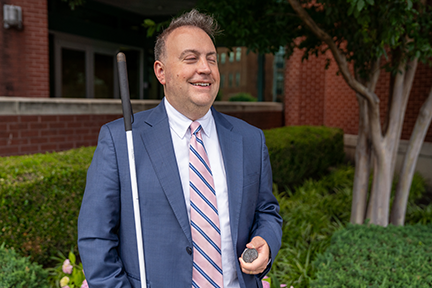 From the Editor: From November 11-13, 2024, the NFB’s Jernigan Institute hosted a conference for teachers of blind students and professionals in the field of rehabilitation. NFB President Mark Riccobono delivered the opening address.
Our nature as humans is to organize toward progress. Once we have met our basic needs, we desire, unless it is conditioned out of us, to explore, discover, and build something better than what has previously existed. Martin Luther King, Jr., said, “Human progress is neither automatic nor inevitable ... Every step toward the goal of justice requires sacrifice, suffering, and struggle; the tireless exertions and passionate concern of dedicated individuals.” It is for you who have dared to show up to seek, to redefine, and to be remarkable as blindness professionals. Thank you for being part of the dedicated core of people sacrificing to build a better future.
Winston Churchill said: “To improve is to change; to be perfect is to change often.” Of course we know that perfection is, in reality, unachievable, but his point should be well taken. Change, or evolution, is essential for progress. What is right for the time may only be partly right in the future. If we fail to change while the world changes around us, progress remains elusive. In order to make informed decisions about where to change, we need to have some core beliefs that ground us in our work.
This brings us to how we change as dedicated professionals. An African proverb tells us, “If you want to go quickly, go alone. If you want to go far, go together.” Community is essential for sustained human progress. It is my belief that the community of practice that can best serve us in our effort to dare to be remarkable is the organized blind movement. In the brief time I have this morning, I would like to discuss the outline of our evolution as blind professionals and the next phase of our work.
Throughout history, the popular narrative about blind people has not been one of progress. That narrative has been centered on the success of non-blind people in inventing methods to provide some meaning to the lives of blind people. It has been centered on charity, not equality. The expectations have been low, and any success stories among the blind were mythologized as extraordinary.
This was the foundation for the development of the vision industrial complex, which came to maturity during the last century. The lack of a true belief in blind people, combined with a vision-centered approach, has limited progress within this system to a culture that has valued blind people as recipients of charity rather than leaders of innovation. Fortunately, blind people organized and resolved to dismantle the vision industrial complex through the building of our own community, where the culture deeply believes in the inherent dignity and talent that we possess as humans who simply happen to have the characteristic of being blind. This community became a movement as the National Federation of the Blind grew on a nationwide basis. Since 1940, three generations of blind people have cultivated, tested, built, and refined our own system to raise expectations and explore the limits for blind people. And those limits remain undiscovered for us.
As we consider a fourth generation of our community, we must recognize that systems that are not continuously built will go away, even if the reduction happens slowly. We must also recognize that it is much easier to tear systems down than it is to build them up. Therefore, failure to evolve can make the future rebuilding exponentially more difficult. Today, I am calling on each of us to recommit ourselves to the revolution of blind-centered and blind-led training programs.
The Generations
The first revolution in our community-building effort was the early experiment with blind-centered training. Blind people began by making small attempts to put our shared philosophy about blindness into action. This happened through one-on-one mentoring, testing ideas, and learning by doing. These early efforts bloomed into what some called the Iowa Experiment—the successful program effort led by Dr. Kenneth Jernigan to put these ideas into formal programs of training.
Generations tend to meld together. The efforts of that first generation melded into the second generation, where our blind community developed more model programs, including innovating work with blind youth. This is best exemplified by the training programs that grew out of the Federation affiliates in Colorado, Louisiana, and Minnesota—training centers that get credit for multiple generations of highly successful blind people the world over, living the lives they want. These programs were hosting transition programs before transition was even a concept in rehabilitation and before piles of money were available for the effort. These programs intersected with work done by Federation affiliates in places such as Nebraska and New Mexico, where the blind asserted their leadership, their advocacy, and their authenticity. All of these programs are represented in our community at this conference.
The third generation of work has been best represented in the development of a new, nondiscriminatory system of accreditation, which the Federation initiated and entrusted in the National Blindness Professional Certification Board. Parallel to that effort has been the development of blind-centered university training, innovative professional development like this Dare to Be Remarkable conference, the coordination of blind-centered research questions, and the establishment of an open-access Journal of Blindness Innovation and Research. While more professional development efforts led by the blind are needed, and we are hungry for more university training programs that are rooted in the lived experience of the blind, we are emerging into the fourth generation of our blind-led professional systems. So what is next?
The emerging generation of work is building a more mature community of blind-centered practice that continues to evolve and advance the systems we have built while forging professional relationships that foster greater cooperation and partnership. Our community of practice must value sharing our blind-centered wisdom with the goal of diminishing the harmful influence of the vision industrial complex. Those of us who are committed to advancing a positive philosophy about blindness and to protecting the dignity of blind people must unite around our common aim of deconstructing the vision-centered approaches that are all too influential, even in 2024.
Building the Community
This blind wisdom community of practice will thrive if we can value challenging each other to be better without falling into the pitfalls of focusing on competing with each other. We are truly stronger together, and our deep belief in blind people is still far too rare among the vast systems that control much of the money and human resources in our field. Together, we can evolve and grow into an even more powerful force than we are today. We are the envy of those first-generation blind pioneers, but we cannot settle for what we have always done or we will be the shame of the fifth generation as it rebuilds. There are far too few of us in this community, so we have to work together to go further.
This community must be willing to test new ideas against our shared wisdom and recognize the value when those approaches fail. We must not be afraid to take risks and to evolve our approach, because that is precisely where innovation meets freedom for the blind. In testing these new ideas, the critical element is that we share in our learning, we evaluate what we could do differently, and we get right on with trying something else. As long as we stay centered on the belief that it is not the blind person who is broken, but the failure to find the right approach in the teaching, our community will continue to evolve toward being remarkable.
Let me say here that new is not always better. What makes our community particularly effective is that we are rooted in some core philosophical principles. How we apply those principles changes, but it is important that we maintain those values. Some people are always seeking the new thing, and that sometimes results in compromising the principles that serve as our foundation. The road to evolving and building our community should never—yes, I said never—begin with something other than our core belief in blind people.
Our community must stay strongly blind-centered, but it must draw inspiration, wisdom, and value from the shared knowledge of other communities. One example is the persistent idea that Braille is difficult to learn and that it is even harder for a person to become fluent in reading. Yet we have barely even utilized the best practices used to teach reading effectively in other contexts within our Braille teaching community. There are many other examples where we can borrow best practices and apply them to the shared wisdom of blind people.
Our community of practice must also lean into the idea of blind pride rather than continuing to default to non-blind norms that place blind people at a disadvantage in terms of advancement in the field. One example is that we should expect our community to grow the best blind leaders. We should expect those leaders to reach the top positions in agencies for the blind and in key government positions affecting programs for the blind. Our community should invest in raising a generation of blind leaders who are not only highly qualified to lead, but who proudly tell anyone they meet that it is respectable to be blind.
Finally, our community of practice must be prepared to be guided by the broader organized blind movement that is the National Federation of the Blind. Furthermore, each and every one of us need to be contributors to building that movement. If we stand outside the movement, if we wall off our community of practice from the diverse community of blind people, it simply becomes another system that is not truly blind-centered.
Let me call out many governmental agencies in this nation that tell blind professionals that it is a conflict of interest for staff to participate actively in the professional network that is the National Federation of the Blind, but then offer those same people paid time to participate in professional efforts such as the Association for the Education and Rehabilitation of the Blind and Visually Impaired (AERBVI). I call for an immediate end to this discriminatory and harmful practice in the field. Agencies should encourage their staff to participate actively in organizations that benefit their professional development and growth. Thank you to those agencies that already allow their staff the power to make that choice. It is no surprise that the best among these have professionals choosing to participate in the National Federation of the Blind.
To be clear, the professional development choice of any blindness professional should never interfere with the right of the people receiving services from that professional to make an “informed choice” about their own professional network. Now is the time for agency leaders to stop preventing their staff from having access to our powerful community of practice within the National Federation of the Blind. Our community has been born from and evolved with the broader organized blind movement. That connection of being shaped by and contributing to the organized blind movement is the magic of our community of practice.
Do you dare to be remarkable? The question makes it sound much harder than it is. It is a choice: a choice to be blind-centered, a choice to challenge your own assumptions, and a choice to evolve in your own professional practices, regardless of how many decades of experience you have behind you. You can choose to be remarkable by choosing to be a contributor to our blind community of practice. Thank you to each of you for making the choice to be here and to be part of this powerful community. Let us take the rest of the steps required to give every blind person the opportunity to be remarkable in their own lives by gaining access to the training and connections that will allow them to live the lives they want. Let us go build our evolving blind community of practice.