American Action Fund for Blind Children and Adults
Future Reflections Winter 2025 DARE TO BE REMARKABLE
Evolving Principles, Practices, and Philosophy at the Rehabilitation Services Administration
by Danté Allen
 Reprinted from Braille Monitor, Volume 68, Number 2, February 2025
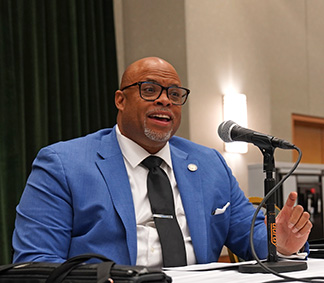
From the Editor: November 12, 2024, the second morning of the recent Dare to Be Remarkable Conference, kicked off with remarks from Danté Allen. Mr. Allen was confirmed as commissioner of the Rehabilitation Services Administration (RSA) in December of 2023. A wheelchair user due to spina bifida, he has worked in healthcare, communications, and disability policy.
Good morning, everyone! I am so pleased to join you today. I’d like to thank Mark Riccobono and Anil Lewis for inviting me to speak with you. I truly appreciate their partnership and assistance in helping me prepare for today’s event.
The theme of this conference is “Evolving Principles, Practices, and Philosophy,” which really resonates with me. It fits quite well with my view of vocational rehabilitation, and I believe it is also reflected in my priorities. However, before I dig into those priorities, I want to take a moment to address the election.
As we know, come January, there will be a change in administration. With a change in administration will likely come changes in policies and personnel. I’d like to make clear that, no matter what happens, VR [vocational rehabilitation] will endure, and the mission of our work here in RSA will endure. Those things do not change. They endure because, as a country, we recognize the basic human and civil rights of Americans with disabilities and the importance of good jobs. Those are some of the rare things that we all can agree on. No election can change our beliefs around these things: around finding people jobs; around making the workplace as accessible and available as possible to as many people as possible; around achieving competitive, integrated employment (CIE) to gain and sustain independence.
While in some ways things may be different, in some ways things will not change at all. RSA will still provide leadership and resources to assist state and other agencies in providing vocational rehabilitation and other services to help individuals with disabilities maximize their employment, independence, and integration into the community and the competitive labor market. In short, the mission will endure.
I know everyone in this room believes in the value and the power of programs such as vocational rehabilitation. You have the wisdom to help create more equitable communities and a more equitable country by ensuring individuals with disabilities, particularly individuals who are blind or who have low vision, have access to quality employment and good jobs. People like you make programs like VR tick, and for that I am deeply grateful and appreciative. Your work and the results you produce are a big deal, and I thank you for everything you do. With all of this in mind, I'd like to talk a little more about the evolution of our work—of our principles, practices, and philosophy.
Building on Our Past
There is much to build upon from our past. The civil rights and disability rights movements of years ago are still very instructive, and they resonate strongly today. These movements changed policies and laws and—just as importantly—they changed hearts, minds, and attitudes toward individuals from marginalized communities, including those with disabilities. I recognize that the National Federation of the Blind has, over many decades, led the civil rights movement for individuals who are blind. We know from experience that we will not get progress without persistently demanding it. We know from our hearts that there is nothing about us without us. We know from research and practice that a key tenet of universal design—the importance of planning for the needs of the widest possible population from the start, rather than retrofitting—is the best way to ensure a maximally inclusive society. We all know just from living our lives the fundamental importance of being able to adapt to changing circumstances. More broadly speaking, we know and appreciate the invaluable insights that come from lived experiences.
This hard-earned wisdom is also reflected in the words and actions of the leaders who preceded us. Their guidance continues to illuminate important truths for us, helping us make sense of today as we endeavor to create a better tomorrow. I’ll share with you some examples.
The early leaders of the National Federation of the Blind, Dr. Jacobus tenBroek and Dr. Kenneth Jernigan, dared to be remarkable, disrupting the common notions of blindness. Today, the organized blind movement stands firm, and blind people rally to the words, “We know who we are, and we will never go back! We are changing what it means to be blind!” Through self-advocacy and innovation, the organized blind community is driving the progress in education, rehabilitation, and legislation—assuring first-class citizenship, equal opportunity, and full integration in society.
In a speech nearly sixty years ago, Mary Switzer, the first director of the federal vocational rehabilitation system, said that we cannot accomplish our mission for individuals with disabilities “simply by doing more of the same, in the same way ... It calls for the minds and the experience and the courageous determination of many people in many places to produce and use the improvements we will need.” The NFB has been at the forefront of innovation in delivering successful programs and services in both the educational and rehabilitation realms.
More recently, disability activist Judy Heumann, in her autobiography, wrote, “Change never happens at the pace we think it should. It happens over years of people joining together, strategizing, sharing, and pulling all the levers they possibly can. Gradually, excruciatingly slowly, things start to happen, and then suddenly, seemingly out of the blue, something will tip.”
We must recalibrate our practices and mindsets to adapt to a changing world, and we must do it in partnership with, as Mary Switzer said, many people in many places. We must do it together, in a coordinated and collaborative manner, with persistence and urgency. As Judy Heumann noted, change is hard, and it typically takes time.
Knowing Our Present
I believe that we are rather clear-eyed about our present. At RSA, our expectation is that our collective efforts will result in increased numbers of competitive, integrated employment outcomes for those we serve. As many of you know, this represents a paradigm shift from years past. A big reason for this change is the Workforce Innovation and Opportunity Act (WIOA), which significantly raised expectations for employment of individuals with disabilities. No longer is just enough good enough. As a field, vocational rehabilitation is focused on maximizing quality services and employment. We don’t just want to go to school. We want credentials and degrees. We don’t just want jobs. We want careers. We don’t just want wages. We want competitive salaries. We know that quality employment outcomes come through meaningful participant engagement, informed choice, investment in postsecondary training, access to assistive technology and critical support services, work-based learning experiences and apprenticeships, and substantive partnerships within the workforce development system.
With this knowledge in mind, I set out three priorities for RSA earlier this year:
- Build true partnerships with other federal agencies and stakeholders, including VR agencies and their coalitions, to promote earlier and deeper engagement and highlight best practices to achieve the best outcomes for individuals with disabilities
- Elevate community expectations for competitive integrated employment by showcasing success stories of individuals with disabilities
- Encourage integration of assistive technology and artificial intelligence tools to fuel competitive integrated employment in the twenty-first century for individuals with disabilities.
I am pleased to report that RSA is making substantial progress on all of these priorities. We are proactively engaging with VR agencies on a weekly basis to gain insight into their successes, challenges, and goals for the future. The focus of this outreach is not to monitor agencies, but rather to let them know that we are partners in this work and will highlight their achievements and promote their best practices. On a related note, we are bright-spotting VR agencies’ success stories through our website and email listservs. Each month we are amplifying the great outcomes our agencies and participants are achieving, whether it is working as an auditor for Dell or fulfilling a lifelong dream of opening a café. The stories are piling in, and we will share as many as we can.
Building for Our Future
This brings me to my last priority, which very purposefully is focused on the future. It is intended to be a catalyst for change—for new ways of thinking. As I mentioned earlier, it is about artificial intelligence. As President Biden has said, “Responsible AI use has the potential to help solve urgent challenges, while making our world more prosperous, productive, innovative, and secure.” I believe that, and I believe we can leverage AI to help improve VR services and outcomes. Some of us may be energized about working with artificial intelligence. However, for some of us, particularly the less technologically gifted among us (and I consider myself a part of that group) it may give us pause. It is something a bit foreign and decidedly out of our comfort zone. Please do not let that stop you! In fact, now is the time to lean in—to embrace the challenge and let it invigorate or reinvigorate your work.
We can all contribute to improving access, advocacy, and employment in this new environment. To be sure, it is your experiences, your determination, your solution-oriented mindset, and your values that have driven progress in VR. We need those qualities now, and we need them more than ever to shape a better tomorrow for individuals with disabilities.
In a Dear Colleague letter released last month, RSA has identified three ways that AI has the potential to support individuals with disabilities in achieving competitive integrated employment and solve urgent challenges in the field. VR should prepare individuals with disabilities for careers in AI. VR must provide the services and supports necessary for individuals with disabilities to gain the technical skills to achieve CIE in AI-related careers, if that is the individual’s choice. VR can leverage AI to support CIE in any career field that an individual with disabilities chooses.
AI has the potential to remove longstanding barriers to CIE by providing needed accommodations and support. For example, AI-backed software applications using speech synthesis and Braille, AI navigation for blind or visually-impaired users, and reasonable accommodations that leverage AI are all now available. States may use AI to create efficiencies in the operation of VR programs. Examples of this are surfacing with increasing frequency. AI chatbot tools can help agencies improve customer service, AI algorithms can be leveraged to enhance assessment and planning services, and AI-powered smart technology can remotely deliver VR services in hard-to-reach areas.
From our vantage point at RSA, we are seeing increased interest and enthusiasm for AI-related work in VR. However, for all of this interest and enthusiasm, there are still lots of unknowns about AI, and, if we are not vigilant, lots of potential pitfalls. We must give ourselves the time and the space to fully and deliberately consider how AI and other advanced technology can best support our goal—our expectation—of competitive integrated employment for all VR participants. We know—right now, in the present—that there are more questions than answers around the use of artificial intelligence in the workplace. Therein lies the challenge: how do we answer those questions? How do we ensure that artificial intelligence tools fuel competitive integrated employment in the twenty-first century for individuals with disabilities? How do we build for the future, with AI?
We do it together, in partnership. We do it by drawing upon our experiences, our values, and our determination. We do it before answers are handed to us by those who may not share our values, our lived experiences, or our vantage points. We do it by leaving behind the status quo and the idea of retrofitting, and by focusing on active, real-time participation in the development of the AI-influenced workplace.
AI is still in the early stages of its impact on the American and global workplaces. Let’s make sure that we are not only at the table, but that our voices are heard loudly and clearly as new AI-driven technologies take shape. If we want to empower future generations of individuals with disabilities to be prosperous and productive, we must act swiftly and persistently. And to be clear: now is the time to do it.
The voices of individuals who are blind are incredibly important in general, and your voices need to be heard now, for a variety of reasons. Two come immediately to mind. Number one, innovation is part of the DNA of the NFB and the blind community in general. It is difficult to name another population that has had to create so many solutions to make this world more accessible. Those skills and abilities are vitally important in this work. Number two, the sooner we get involved, the better our chances of mitigating and eliminating potential biases. Put another way, the sooner we get involved in this work, the more likely that AI tools and resources will be maximally inclusive in their scope.
If we do this right, AI can actually help us address longstanding biases. For example, we must recognize and support the certification of blind education and rehabilitation professionals in fields such as orientation and mobility, rejecting any notions that blind persons are incapable or unsafe instructors simply because they are blind. Better orientation and mobility tools, informed by AI, can help further this cause. Let us explore how AI may intersect with our current issues—around recruitment, retention and staffing challenges for teachers of the visually impaired and rehabilitation professionals; or enhancing the standing of strong blind professionals in the workplace, for example—and how it can potentially help us do our jobs more efficiently and effectively.
From a VR professional standpoint, I am hopeful that AI will allow us to focus on those core, fundamental aspects of our careers that drew us to the blindness field and to VR in the first place. I encourage you to find ways to ensure that your voice is heard. You can always reach out to us. Our contact information is on our website, which is located at rsa.ed.gov.
To return to the words of Mary Switzer, let us harness “the minds and the experience and the courageous determination of many people in many places to produce and use the improvements we will need.” Let us work together on the evolution of our principles, practices, and philosophy to push for excellence in vocational rehabilitation, and to meet the challenges of our incredibly important mission to empower this and future generations of individuals with disabilities.
I thank you for your time and attention today. It is certainly a privilege to speak with you.