American Action Fund for Blind Children and Adults
Future Reflections Winter 2025 ADVOCACY
IEP Advocacy Academy 2024: The Work Has Just Begun
by Sanho Steele-Louchart
From the Editor: Sanho Steele-Louchart is an attorney and the Legal Program Coordinator at the National Federation of the Blind. In this article he introduces readers to an important new program that has been launched by the NFB to help blind students and their families.
The Legal Department of the National Federation of the Blind receives dozens of requests for help each year from families of blind children. Often parents feel that their blind children face discrimination from their local school districts or that they are not receiving the services to which they are entitled under the law. We can hardly be surprised. Special education administrators receive no instruction in blindness, so they have little idea how a blind student can fully take part inside and outside the classroom. Furthermore, many professionals in the field of blindness receive limited instruction regarding age- and stage-appropriate expectations for blind people. Inadequate instruction often results in Braille teachers who don’t know how to teach Braille, access technology teachers who don’t teach technology, mobility specialists who don’t teach students to be mobile, and special ed administrators who have no idea what their teachers of blind students should be teaching.
Unfortunately, it is also the case that good teachers are sometimes hampered by district administrators who believe that teaching blind children is an unnecessary inconvenience or even a legal liability. Surely, they think, it would be easier for everyone involved if the blind child just sat and listened. Fortunately, the law disagrees.
When it comes to ensuring the rights of blind children, the old adage is true: there simply are not enough hours in the day. Therefore, when calls come in, it is standard practice for us to start by directing people to local resources for assistance. “Have you contacted your NFB affiliate?” “Have you contacted your state’s protection and advocacy organization, the law firm funded by Congress to advocate for people with disabilities?” Time and time again we hear, “I have, but the people doing IEP advocacy in my affiliate have retired, and our protection and advocacy organization has never worked with a blind person before.”
Thus an idea was born. It was time for our national organization to train Individualized Education Program (IEP) advocates who could work locally on behalf of blind students.
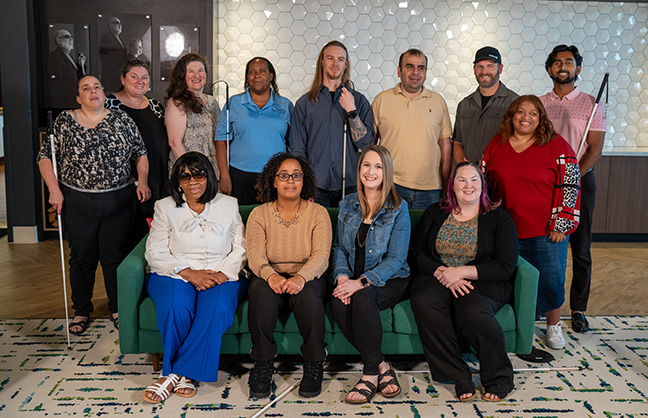
Enter Casey Robertson, a teacher of blind students; Karen Anderson, an educator and the NFB’s Education Program Coordinator; Justin Young, a doctor of higher education and a governmental affairs specialist; Carlton Cook Walker, an attorney and a teacher of blind students; and me, an attorney, our legal program coordinator, and a certified orientation and mobility specialist. Three members of this team are blind people. The other two are longtime leaders within the Federation and what we affectionately refer to as “honorary blind.” The team secured modest funding to start a training program, allowing for thirty participants across two cohorts. We created a curriculum spanning two-and-a-half days of nonstop, wall-to-wall IEP advocacy training.
We could not have predicted the interest we received! Within weeks of announcing the program, we had ten times more applications than there were openings available. Participants were carefully selected based upon location, background, and connection to blindness. Half of our eventual participants were blind people, and half were sighted parents of blind children. Although we could accept only a small percentage of our highly qualified applicants, we endeavored to ensure that people of as many backgrounds, locations, and personal skills were included.
Once we had selected our group members, the facilitators and participants gathered for an introductory call. We described the course content and the nearly three days of intensive instruction to follow. Participants left that call knowing the training would be akin to drinking out of a firehose, but that together we’d make it through.
After lots of calls, emails, and pre-teaching, the big day arrived. Time was of the essence. Our weekend in Baltimore was broken into three primary phases: foundation, strategy, and practice. The foundation phase saw participants learning about the anatomy of an IEP; the laws that control the process; and the terminology, history, and exceptions operating beneath the surface.
Next, advocates moved into the strategy phase. They learned about age-and stage-appropriate goals and how to write those goals into the IEP. They discussed the need for quality evaluations and assessments and the steps involved in client interviewing, setting realistic expectations, and handling contentious negotiations.
Finally, the participants broke into small groups, or teams, to practice IEP advocacy in real time. Having no idea what to expect, each team cycled through four real-world scenarios. In each session, the participants had an hour to assess the student’s needs, evaluate current goals, learn the relevant dynamics, and begin to negotiate a workable solution. Members, friends, and family acted out everything from coddling “helicopter teachers” who wanted to keep their students in protective bubbles, all the way to combative school officials who argued until they were blue in the face that blind children don’t need Braille, accessible technology, or mobility instruction. You can only begin to imagine the joy that rang through the halls each time our advocates left a meeting, knowing they’d gotten their pretend school districts to do the right thing. When our advocates felt uncertain, our facilitators helped them unpack, reframe, and troubleshoot to make the next session more successful.
The weekend came to a close with advocates feeling a mixture of excitement and trepidation. Everyone agreed that our practice day had gone extremely well, but the pressure was on. Could our advocates really do it? What if they made a mistake? They understood that being trusted to work with families on such sensitive issues would be both an incredible honor and a tremendous responsibility. Everyone was energized regardless. We assured one another that not only would we continue to train people before sending them into the wild, but that we could always adjust as needed. So, after tears, applause, and plenty of cookies, our advocates went home to decompress.
Training didn’t stop there. Participants who attended the national convention in July were asked to speak to the National Organization of Parents of Blind Children (NOPBC) at their annual IEP advocacy seminars. Trainees presented first on the basics of IEP advocacy, and then on the more advanced aspects. This structure allowed families with experience advocating to self-select into the session that best fit their needs. After convention, each member of the cohort was asked to do a one-on-one, one-hour interview with me to highlight any issues they might be having in their approach to advocacy. Then, in November, the participants again were broken into small groups to practice arguing around some of the most complicated issues we see.
Even now, the work is just beginning. Our IEP Advocacy Academy trainees will receive support for the foreseeable future. Families that utilize our advocates will sign releases of liability and information so that our facilitators can review draft IEPs before making any necessary suggestions. The expectation is that no IEP will be finalized by one of our advocates without first having been checked by a group facilitator. Once an IEP is checked by our facilitators and accepted by the IEP team, our advocate will remain available in case there are questions about implementation.
Consistent implementation of the IEP is vital for a child’s ongoing success. We all know that our rights are only as good as their enforcement. We encourage families to inform their advocates as soon as possible if they suspect that services aren’t being provided, minutes of instruction are being missed, or goals aren’t being met. The advocate then determines whether they should resume working on the case or need to contact the national office to see if the case can be reassigned. For those instances in which the parties believe litigation is the only option left, families can discuss their case with our legal department to consider changing the approach.
Unfortunately, we still don’t have the resources to assist with every case. Although another cohort is coming in 2025, that means we’ll have trained only thirty advocates nationwide. The reality is that programs like these require considerable financial resources, and this is just one of countless initiatives being offered through the NFB’s national office. If you would like to see programs such as these continue in the future, we urge you to donate to our cause. Contributions can be made online at nfb.org/contribute or by calling 410-659-9314 and pressing option 4. Questions about the IEP advocacy program, or IEP’s in general, can be directed to [email protected] or 410-659-9314, extension 2440.