American Action Fund for Blind Children and Adults
Future Reflections Winter 2025 ADVOCACY
Being Trained in the Law but Not Knowing How to Enforce My Right to Accessible Textbooks
by Julie Orozco
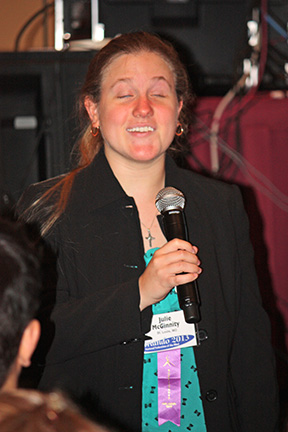 Reprinted from Braille Monitor, Volume 67, Number 8, October 2024
From the Editor: When we read a book for pleasure, we probably don’t have to know the number of the page we’re on or exactly where the fourth paragraph begins. In the classroom, however, the ability to navigate through a textbook can be crucial. In this article Julie Orozco shares the frustrating experience of struggling to use poorly formatted electronic textbooks as a law student. Even as she trained to be an advocate for others, she discovered that she needed to advocate effectively for herself.
I remember sitting in my first torts class on my second day of law school in August 2020. Torts felt like an intimidating subject, even though it was simply the study of legal wrongs like negligence. But my professor bellowed at us over Zoom as we tried to keep up. Everyone was lost and confused as he called out our names lightning fast, asking us questions we couldn’t pretend to understand, and then shouting, “Wrong!” when we couldn’t answer adequately. Then he started asking students, by name, to read sections of our textbook aloud. The moment he asked the first student to turn to page 25 and read the third paragraph, fear coursed through me. What if he called on me? What would I say? I couldn’t find page 25, and I certainly couldn’t read a paragraph out loud in front of my class. I had already answered one of his questions wrong. What would this professor think when I couldn’t do something as basic as read words in a textbook?
When I began my law school journey, I did not anticipate the accessibility battles that awaited me. After successfully completing two undergraduate degrees and a master’s degree, I was confident in my ability to advocate for the accommodations I needed in school.
I was also reassured by the nature of the law school curriculum itself. Two of my previous degrees had been in music, which required a variety of unique accommodations, including specialized Braille music software.
Law school, I thought, would be all printed text, and it couldn’t be complicated. Our law school’s accommodations office met with me multiple times before the beginning of the semester. They seemed to have a solid process in place for furnishing accessible textbooks to students and granting other accommodations. My access coordinator reassured me that the books would be in accessible formats and told me I would not need a reader for my classes because everything would be accessible for me with high-tech solutions.
I was wrong to place my trust in professionals who did not know what made a book accessible and did not understand the limits of screen reading and OCR technology for the blind. I discovered how wrong I was at the beginning of the first semester. When I tried to open my torts book, my computer froze. The PDF file our accommodations office sent to me was so large my computer could not open it. When I finally discovered a work-around for opening my book, I was astonished to find that I could not locate page numbers anywhere in the file. These huge files, containing over a thousand pages, did not include page numbers that my screen reader could read. In addition, my screen reader read the file in long blocks of text rather than paragraphs, encountered plenty of typographical errors, and would sometimes refuse to read by paragraph altogether. My torts book was the worst offender, but all of my textbooks presented similar challenges. My civil procedure book only gave me a page number at the beginning of each chapter. Most of my books omitted charts entirely, and forget about photo descriptions!
When I approached our access office about the problems I was having with the books, they brushed off my concerns and assured me that they received these books directly from the publishers. Our university believed that the publishers were sending accessible books because that was the publishers’ duty. The publisher was required to send accessible copies of print textbooks upon request and with proof of purchase. However, these books were not fully accessible. They did not give me the same reading experience my colleagues enjoyed.
Our access office listened when I sent them a panicked email after the torts class described above. I attached the book and explained that I could not read aloud because I could not find the referenced page numbers. My accommodations office suggested that they tell the professor not to ask me to read aloud. This accommodation did not sit well with me. I wanted actual solutions, not exemptions. When I mentioned to friends and family that I could not read the page numbers in my books, I was almost universally met with blasé attitudes and dismissive shrugs. Some of these individuals had to scan their own books or dealt with texts they could hardly read, and all I was complaining about amounted to a fraction of my reading experience. Was I really dying on a hill made up of inaccessible page numbers?
I chose to push back against our accommodations office about these page numbers for a few reasons. First, I paid over $200 for some of these books, and I believed that I should have the same access to the text, including page numbers, as everyone else. I wanted to make things easier for blind students to come, rather than falling in line with the inaccessible standard. Second, most of our assignments were built around page numbers. Our civil procedure professor would give us reading assignments in chapters that were hundreds of pages apart. Our torts professor gave us complicated instructions, asking us to skip some pages and read others. I didn’t know which cases and sections to read without the accommodations office speaking directly to my professors.
Page numbers are also reference points. In study groups, in class, and in office hours, we all found cases and issues we wanted to review by turning to the relevant page.
It wasn’t only about the page numbers. These books were clunky. They were formatted in such a way that I spent much longer on assignments than I should have. I wanted the conversation around these books to change, and the page numbers were an easy starting point.
Despite my advocacy, the access office seemed reluctant to reformat my books as I suggested. I started to speak to some of my academic advisors about my textbooks and get their input and support. At the same time, I began to realize that I needed a human reader as an accommodation.
In the middle of the semester, I received my first grade on a legal writing assignment. I had worked hard on this assignment, writing and revising long into the night and making all the changes my professor recommended. I was not expecting perfection, but when I saw my barely passing grade, I started to feel discouraged. Many of the errors for which my professor took off points were formatting mechanics. This was the semester when I learned about the difference between straight and curved apostrophes. Did you know there are two types of apostrophes? I also learned that the information my screen reader was giving me about heading formats was not entirely accurate. Some of my quotes were the wrong kinds of quotes. The list could go on. Some of the mistakes I made I could learn to seek out with my screen reader, but others amounted to aesthetics that I could not detect with my access technology.
I presented my disappointing legal writing grade to the accommodations office and began to lobby for a human reader. They refused. In their words, I could not have an “assistant” because it would not be fair to the other students. I attempted to explain that plenty of blind professionals use readers to adjust formatting in their written work, but the office did not budge.
At this point, I was terrified. My legal writing class was only increasing in intensity, and I didn’t want to fail a class in my first semester of law school. Since it took me longer to complete my reading, I spent additional time with our teaching assistants to work on my legal writing. I began to miss required scholarship activities and internship fairs. I knew that I couldn’t continue doing school like this, but I felt alone. I didn’t know where to go for advice. Most people seemed to understand that law school was hard, particularly during the pandemic. My battles for accommodations seemed insignificant when compared with the accessibility challenges faced by others.
I didn’t know where to begin, so I started talking to my professors on my own. My legal writing professor let me work with our teaching assistants longer than the other students did. My civil procedure professor began modifying assignments by describing videos or condensing our readings so that I could have a lighter load. I did not ask for this, and she modified these assignments for everyone. I also continued discussions with my academic advisors, who started sending emails on my behalf. Once the accommodations office started hearing from my advisors, they changed their tune about negotiating with me. It helped that I also emailed one of the assistant deans to describe my situation.
I could not do anything to change my first semester grades or experience, but in the second semester, I started to receive textbooks as Word documents, broken up by chapter with page numbers written out. The access office also granted me a human reader as an accommodation. The reader reviewed my formatting, helped me fill out inaccessible forms, and even typed out entire inaccessible sections of one of my textbooks. Not surprisingly, my grades noticeably improved in the second semester.
Throughout the remainder of my law school career, I continued to fight for the accommodations I needed. The access office experienced a lot of turnover, and its policies changed as it integrated with the undergraduate office for accessibility. For the last two years I was in law school, I was given an Aira plan instead of one human reader. Aira is a service that allows a blind person to connect with a sighted assistant via a smartphone.
I will never get back my first semester of law school. The grades I got are alive and well on my transcript. But I hope I can help other students advocate for the accommodations they know they need. Law school is a challenging environment. Students read hundreds of pages a night, preparing to be called on in class to recount all the facts and outcomes of legal cases they may not even fully understand. They face increasing pressures to find internships and build their résumé. Blind students shouldn’t be expected to spend our time worrying about how we will learn when the learning itself is hard enough.
Afterword: I am delighted to report that Julie Orozco has graduated from law school, and she passed the Bar Exam on the first try!