American Action Fund for Blind Children and Adults
Future Reflections Winter 2025 EARLY CHILDHOOD
Ten Tips to Introduce Braille to Your Baby
by Amber Bobnar
Reprinted from wonderbaby.org
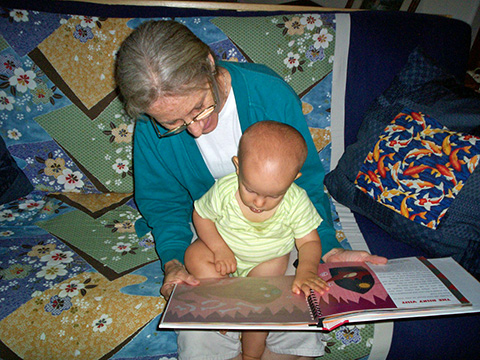 From the Editor: Sharing favorite books at bedtime, and at any other time of the day, is a pleasure for parents and children alike. For the sighted parents of young blind children, however, reading together may raise some challenging questions. In this article, Amber Bobnar offers practical tips on how sighted parents can read with their blind children and provide them with early exposure to Braille.
“Our baby is only one year old, but we already know he will be a Braille reader. Is there anything we can do now to prepare him for reading Braille later?”
YES!
Parents of sighted babies are encouraged to read to them from a very early age—some studies even suggest that reading to your baby in the womb can help boost literacy!
Braille readers also need early exposure to reading materials, but there are other special considerations to take into account. Here’s what you can do now to help get your baby off to a great start.
1. Braille Everything!
And we mean everything!
Think about how sighted children learn to read. From the moment they’re born, they’re surrounded by print words, and not just in their baby books. From TV to toys to cereal boxes, sighted children see the printed word everywhere. By the time they’re learning to read, words are already very familiar things (and they know that learning to read will unlock the code to all those words they see every day!) Why should it be any different for blind children?
Get a Braille label maker and label anything you can think of. Toys, buttons on the TV or stereo, light switches, bowls and cups, drawers and cabinets, etc. Have your baby touch the Braille around the house as well as Braille you encounter every day on elevators or signs.
Of course, you’ll also want to Braille your baby’s books. You probably have a whole shelf of beautiful baby picture books, but without Braille, they’re no better than blank pages to your baby. You can purchase baby books with Braille set over the print (these are called print/Braille books) so that both you and your child can read the books together.
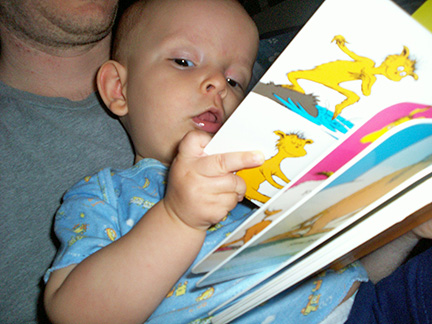 You can borrow a Perkins Brailler from your Early Intervention Program, and with some clear adhesive Braillable sheets you can Braille those books yourself! You may encounter resistance to Brailling books for your baby because, as most professionals argue, by the time your child is old enough to read Braille they won’t want to read baby books anyway. Well, by the time a sighted child is reading on their own they may not be interested in Hop on Pop, but we give them these books to read anyway. Why? Because it’s been proven again and again that exposure to reading material at an early age encourages early literacy skills. Plus, simple baby books are easy to read. It’s best to begin learning to read with easy books. This encourages fluency and speed, which in turn boost your child’s reading self-confidence.
And what if your children grow up to have sighted children of their own? Wouldn’t it be great to hand them a supply of Brailled baby books they can read to their sighted kids? What a great gift!
You may be wondering if you should use contracted or uncontracted Braille when Brailling baby books. Uncontracted Braille is a simple letter-for-letter code. The word “shout” would be Brailled s-h-o-u-t. Contracted Braille, on the other hand, uses abbreviations in order to save space. The word “shout” is reduced to three symbols: sh-ou-t. Most Braille books use contracted Braille. There are different opinions on how to teach children Braille, but most programs begin with uncontracted Braille and then gradually introduce abbreviations over time. As a parent Brailling books for your child, you should probably begin with simple books in uncontracted Braille (this will be easier for you, too). Bigger books with more words can be contracted, since your child will probably be reading them at an older age.
2. Orient Your Baby to the Book
When you first begin reading books to your baby, start the custom of having them touch the top, sides, and spine of the book. Explain that we open a book on the right and read left to right. These are cues that your child might miss without vision.
Also, read the whole book to your baby. Read the title, author, and illustrator. Read the copyright and dedication. Read the back panel and publisher’s notes. Try to fill in the gaps your child might be missing since they can’t see the book. How else will they learn how books are designed?
3. Turn the Page
Encourage your baby to turn the pages by himself. Board books are great for beginning page-turners, but even these hard pages can get a little stuck. Try gluing a small piece of soft Velcro or felt to the top right corner of each page. This will separate the pages just enough to help your baby get their fingers in there. The Velcro can also act as an orientation marker, letting your child know they are holding the book open correctly.
4. Encourage Pointing and Feeling
Your baby will need to be able to move their fingers along the Braille lines and differentiate each dot when they get older. Help them now by encouraging them to touch Braille (and other textures), so they get used to the feel.
Also, try to have your baby use each finger separately by playing with small objects or by manipulating little buttons or levers on toys. For example, encourage your baby to press buttons with the tip of their index finger rather than their whole palm.
Braille reading also requires two hands: the left usually guides and keeps your place while the right reads. Encourage your baby to play using both hands. For example, they may hold the box with their left hand while they grab the blocks out of the box with their right.
5. Read About Real Experiences
If your baby has never experienced a pig or a zebra, then a book about pigs and zebras will be pretty meaningless to him, no matter how pretty the pictures are. Try to find books on topics your baby is familiar with, such as mommies and daddies, the beach, or the pet dog—whatever fits your life. If you do have a book about pigs and zebras, maybe a trip to the local petting zoo will help make that book more meaningful for your baby.
Another approach is to bring real objects to your child while you read the book together. Goodnight Moon is a great example of a book with many real-life objects in it. As you read the book, you can touch a telephone, a balloon, mittens, a bowl, a brush, a comb, and many other simple everyday household objects. Be sure to use only real objects, because models such as a toy telephone may just confuse your baby.
6. Teach Respect
Teach your child from a very early age that books are to be respected. Keep books upright on a low shelf, turn pages carefully, and never chew on books!
7. Talk About It!
Use Braille language with your baby. Talk about “reading with your fingers,” and be very positive about the experience. Tell your baby how cool they are because they read with their fingers and how proud you are of them. Point out Braille on signs or at the park so they will understand that Braille is found everywhere and that Braille reading is an important skill.
8. Do It!
It may seem silly at first, but you can also pretend to read the Braille with your fingers while you read to your baby. Babies learn by copying what their parents do, so give your baby the impression that you read with your fingers, too. Have your baby touch your hand while you “read” the Braille so they will understand how it’s done. Don’t worry about technique at this point. You’re just trying to convey a simple message to your little baby: People read with their fingers!
As your baby becomes more accustomed to Braille, you can also take their fingers and move them over the words as you read. One great approach is to choose one or two special words in each of your baby’s favorite books and then read those words together when you get to them. For example, our son always laughed at the word lullaby in one of his favorite nighttime books. Every time we came to that page, I took his finger and helped him “read” the word. Eventually, whenever he heard the word lullaby in his book, he would lift his right hand so that I could take it and place it on the word.
9. Teach Yourself Braille
Could you teach a sighted child to read if you were illiterate? Probably not. So how can you really help your blind child learn Braille if you aren’t familiar with it yourself? You don’t need to be fluent in Braille, nor do you have to be able to read it with your fingers, but you should know the basics.
Read our article on How to Teach Yourself Braille for some good advice.
10. Read! Read! Read!
You want your baby to be exposed to as many Braille books as possible, but how can you possibly Braille all those books yourself? You are not alone! There are many great resources online for parents of blind children. Here are our favorites:
American Action Fund for Blind Children and Adults
Braille Books Program
https://www.actionfund.org/programs/braille-books-program
Each month provides a free Braille book from a popular children’s book series.
Braille Institute of America
https://www.brailleinstitute.org
Provides free Braille books for children on a monthly basis.
Braille Reading Pals Club
https://nfb.org/programs-services/early-childhood-initiatives/early-childhood-application
Introduces young blind children and their families to literacy through Braille, encourages shared reading of Braille books between blind children and their families.
National Braille Press
nbp.org
Sponsors Print-Braille Book of the Month Club for $100 per year or free for eligible families.
ReadBooks! distributes free bags of beginning Braille materials to families with blind and low-vision children ages birth to seven.
National Library Service for the Blind and Print Disabled
https://www.loc.gov/nls
Has an extensive collection of Braille titles for children and adults that can be borrowed free of charge; also allows readers to select up to five free Braille books per month that may be kept indefinitely.
Seedlings Braille Books for Children
seedlings.org
Braille children’s books in English and Spanish at reasonable prices.