American Action Fund for Blind Children and Adults
Future Reflections Winter 2025 THE GREAT OUTDOORS
All Those Amazing Little Bugs: Breaking Barriers in the Great Outdoors
by Olivia Cichowlas
 From the Editor: Olivia Cichowlas is a recent graduate of the Colorado Center for the Blind (CCB). She has attended Washington Seminars representing Colorado and Illinois. Olivia has a lifelong passion for animals and nature, which she embodies in her chosen field of nature education.
My love of the outdoors began with my interest in animals. When I was growing up everyone joked that we had a zoo at our house. At various times during my childhood I had a rabbit, some ferrets, and an assortment of hamsters. When I was in high school I even had a hedgehog. All of these pets were in addition to our family dog and cat. I wanted to be a marine biologist or a dolphin trainer when I grew up.
A wealth of outdoor experiences deepened my love of nature. I helped my mother tend our back-yard garden, played outside until the sun went down, and went on countless walks in the nearby forest preserves. Family camping trips were a high point of summer vacations. To this day I love the feeling of the sun on my face, the crunch of dry leaves underfoot, and the delight of playing in newly fallen snow.
In grade school and high school I was drawn to the sciences. I was fascinated by genetics, environmental biology, and physics. I loved to ask questions and seek out answers, and that has never changed.
Horseback riding was another fun activity. During middle school and high school I volunteered to help with kids’ parties at the stable. I also helped with programs for riders with disabilities. Ironically, I didn’t realize that I had a disability myself.
When I was growing up I had low vision due to glaucoma, but I had no accommodations to help me at school. I still had some usable vision, and I figured out ways to make it through school without Braille or access technology. Finally, when I was in college, an ophthalmologist told me I had only ten degrees of peripheral vision, meaning that I was legally blind. Looking back, I realize I had probably been blind for quite a while.
When I started at North Central University in Naperville, Illinois, I had no idea what I should study or what sort of job I could hope to find after graduation. Due to my low vision I didn’t know what sort of work I was capable of doing, but I figured I might as well major in something that truly interested me. My college offered a major in environmental science, which had three tracks to choose from: business, science, and sustainability. I chose the science track, which seemed like a good fit with my passion for the outdoors.
My major encompassed much more than the biology of plants and animals. I learned how organisms work together to keep an ecosystem healthy. I learned about the factors that can throw an ecosystem out of balance. I learned about populations in certain parts of the United States that face environmental injustice, and I studied the complex interactions between legislation and environmental factors. I was excited about all the new things I was learning, but I still had no idea what I could do with my major.
Though I loved my studies, college was a struggle in many ways. I had no idea about the nonvisual skills that could have helped me, so I experienced a lot of visual fatigue. Sometimes I feared that a career in science was not really a possibility for me. Still, I knew that my school offered some amazing opportunities, and I determined to take advantage of them.
During my junior year I took a class based on my school’s partnership with the Shedd Aquarium in Chicago. I spent every Saturday at the Shedd or at one of its suburban restoration projects. It was a very cool experience! However, at that time I didn’t have the confidence to advocate for myself in order to get the most out of the program.
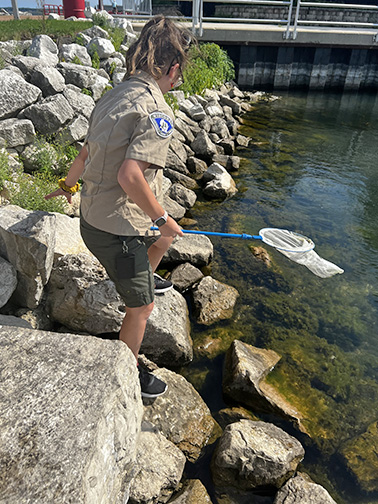
 Another wonderful opportunity through my college was a study abroad program in the rainforest of Ecuador. We prepared with a semester-long course on tropical ecology. My professor was very supportive, and we worked together to figure out how I could be fully included in the fieldwork experience. For instance, even though I was using my cane, sometimes I needed a human guide when we walked on narrow, slippery trails.
Each student in the program had to plan an experiment that could be conducted in the rainforest. I could have done something that involved plants, studying which ones grew in a particular area and how far apart they were under certain conditions. But I really wanted to do a project that involved animals. I ended up designing a study about insects called stick bugs. Some are blue, some are green, and some are brown. I wanted to determine whether insects of a particular color preferred environments with plants of that same color. My teammates found the insects and gave me the information, which I recorded and tabulated.
During the summer after my junior year at North Central I landed an internship as an environmental educator at a small state park in Milwaukee, Wisconsin. I got one day of training, and I observed two lessons. After that I was teamed with a co-teacher and sent out to teach kids about the natural world. One co-teacher had a lot of experience, and I learned a great deal from her. Sometimes, though, I was paired with a park employee who had no teaching experience, and I was the main educator. I did a lot of learning on the job!
Each day I had a brand-new group of kids, usually second- and third-graders. Most of the time they were in summer day-camp programs, and the visit to the park was a field trip for them. The day-camp counselors came with the kids, but when they got to the park, it was as though the counselors turned off their brains! My partner and I were the ones in charge. I found out that lessons seldom go the way you think they will.
That summer I learned to be more open about my blindness. I used my cane on the trails in the park, and the kids asked me a lot of questions. Once a child grabbed my cane and darted off with it! That was a bit of an adventure! Fortunately another instructor stepped in and brought my cane back.
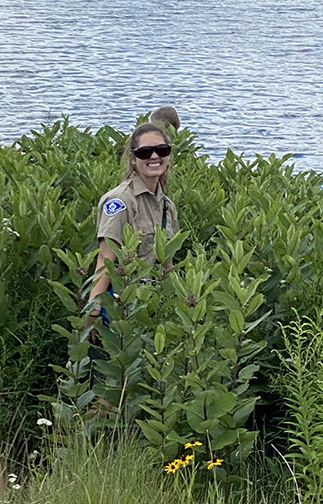
Though I faced a lot of challenges, I have some very wonderful memories of my work that summer. One day I had a girl in my group who was very afraid of insects. I showed her one of my favorite bugs, a harmless little red insect that lives on milkweed plants. I picked one up and showed it to this little girl to prove that it wouldn’t hurt her. Later, as I was busy with some other children, the little girl ran up to me, fearlessly carrying five of the little red bugs on her hand. That really made me happy!
A lot of the children I met came from inner-city neighborhoods, and they had had very little exposure to the outdoors. I could tell they were thrilled to be out in nature! They were very gentle when they handled insects and plants, as though they were in awe of everything around them.
Taking kids fishing in Lake Michigan was quite an experience for me! I discovered right away that they had to go one at a time when they cast their lines, or else it wouldn’t end well! Sometimes a child caught a fish that was an invasive species, and we had to explain that we couldn’t put it back in the lake. We’d put the fish in a bucket of water and tell the kids we were taking it up to the office for research. If we admitted we were going to put it out for the birds to eat, the kids would have been really sad.
Toward the end of the summer my boss encouraged me to design a program. I advertised a hike for blind and low-vision visitors that would focus on nonvisual aspects of the park’s environment. For example, I took people to areas of the park that had mint and other aromatic plants. We listened to bird calls and other sounds of nature.
At my college everyone in my major had to do a Capstone Project in order to graduate. My project focused on inclusivity in environmental education, drawing upon my experiences during my internship. My advisor wanted me to work with the park in Milwaukee and design something that could be used in the future. I suggested turning one of the prairie trails into a Braille trail with tactile markers and Braille plaques on some of the trees. The park turned down that idea; they didn’t want to have to maintain the trail. Then I suggested adding QR codes to the signs in the park so blind people could get access to information using their smartphones. The park didn’t want to take on that project, either. Finally I designed six lesson plans that would be inclusive for visitors with disabilities. I included ways the park could accommodate students with hearing impairments, blindness/low vision, or mobility impairments. For example, I designed a lesson on photosynthesis that included a tactile diagram.
I graduated from North Central in May of 2023, and I applied to the Colorado Center for the Blind (CCB) to get intensive training in the skills of blindness—orientation and mobility, Braille, access technology—all of the things I never really learned while I was going through school. While I was waiting to start the program in Colorado I found a job as a nature educator at Spring Valley Nature Center in the town of Schaumburg, not far from my home. I went for an interview and they hired me on the spot! It really helped that I had some experience through my internship! I only worked there for a couple of months before I got the call from CCB, letting me know I could begin my training.
I spent nine months in Boulder, and when I came back to Illinois I started to look for a full-time job. While I was searching I returned to my old part-time nature educator position. I started by going to the park to observe lessons that were being taught by other educators, and I spent time exploring with a sighted friend who showed me features I can point out when I took visitors on walks. I teach about ecosystems and how plants and animals work together. We hike around the park and identify the difference between prairie, woodland, and wetland ecosystems. We also do hands-on activities such as looking for insects and learning about plants and their seeds.
From time-to-time I struggle with the reality that some things in nature are inherently visual, and I cannot spot them right away on my own. But there is so much I can show my students—animal footprints in the snow, the textures of bark on different kinds of trees, the cocoons of insects hanging on twigs. I keep finding new strategies for working with my students, helping them experience the natural world with all of their senses. Every day is a new day, and when we explore the outdoors we can always find something interesting.