American Action Fund for Blind Children and Adults
Future Reflections Winter 2025 THE GREAT OUTDOORS
“Climb the Mountains and Get Their Good Tidings!”
by Henry Young
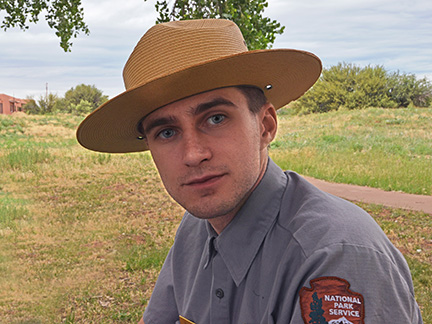 From the Editor: At the 2024 National Federation of the Blind Convention, Henry Young was awarded the Betty Allen Scholarship, one of the thirty scholarships presented by the NFB to outstanding postsecondary students each year. Each award is valued at eight thousand dollars. When he introduced himself at the meeting of the NFB’s National Board of Directors, Henry Young explained that he is preparing for a career with the National Park Service. In this article he explains how he arrived at this career choice and describes some of the work he is doing and planning to do.
I grew up in New Jersey, in the shadow of the great skyscrapers of Manhattan. It’s quite a journey from the New Jersey suburbs to the mountains of Montana, where I live today! A childhood visit to Yellowstone National Park was the key.
My experience with blindness began in December of 2014, when I was near the end of middle school. I had a lot going on already in terms of life changes, and vision loss came as a real blow. In the adjustment process I went through a lot of trial and error—especially a lot of error! I had orientation and mobility (O&M) instruction, and I learned some basic Braille. I got very good at using VoiceOver to read my textbooks, listening to everything at double speed.
After graduation from high school I attended Drew University, a small school in Madison, New Jersey, not far from my home. I did abysmally my first semester, mostly because I was having a lot of fun and wasn’t focusing on my classes. Then, during my second semester, COVID happened, and everything went online. Online education didn’t work well for me either. When the world opened up again I took courses at a community college for two years.
Ironically, COVID had some positive effects for me. It forced me to slow down. It gave me time to think about who I am and what my aspirations were.
In my room I had a poster I got at Yellowstone National Park. My trip to Yellowstone was a life-changing experience. I also had a poster of the Grand Canyon. Those posters inspired me to watch a documentary series by Ken Burns that I remembered from years before. The series was called The National Parks: America’s Best Idea. I was deeply moved by the stories of the people who created the parks and by the natural wonders the parks preserve, and I yearned to be in those environments. Somehow the parks felt authentic to the person I was and the person I wanted to become. I made up my mind to complete my college education out west.
Missoula, Montana, home to the University of Montana, is the only city in the mountain west that actually stands in the Rockies. In the lower forty-eight, Missoula is the closest city to a wilderness area. There is a two-thousand-foot peak five minutes from my front door. If you’re so inclined, you can put on a backpack, walk out of your house, and disappear for weeks on end.
The great environmentalist John Muir said, “Climb their mountains, get their good tidings, and their peace will flow into you as their breeze and their autumn leaves.” Those words describe the way I feel when I’m out there.
Missoula became home for me as soon as I arrived. I joined the hiking club on campus and connected with a group of wonderful new friends. I also made friends with people in my dorm, which was called the Tower. On weekends I visited Glacier National Park and some of the nearby Alpine lakes. Over spring break some of my friends and I went to Sedona, Arizona, and visited the Grand Canyon.
Some of my courses at the university gave me the opportunity to do very meaningful projects. Through my class on environmental history, I worked on a project with the Montana Natural History Center down the river. Most of the other students on the project sorted through old photographs, which wouldn’t work for me. I developed a project doing an accessibility review for the Natural History Center. I explored the possibility of having an audio guide to the exhibits—the animal specimens, the maps, and the videos. I felt very connected to every aspect of this project—socially, geographically, and academically.
At this point I’m a senior, with only one more semester to go. The thought of leaving breaks my heart! I love Missoula, and I dearly love the whole region. I tell people they couldn’t pay me to leave.
I hope to continue my education here by earning an MA in history. I’d like to write a thesis on the history of Americans with disabilities in the National Park Service (NPS). Actually, the National Park Service already has done some significant work in this area. They’re bringing out a handbook on how to interpret disability history throughout the parks system. There’s even a page about disability history on NPS’s website. There is serious momentum for getting those stories out to the public.
As part of my investigation, I want to look at how the idea of accessibility has evolved, going all the way back to the conception of the national park in the 1850s and 1860s. Yosemite National Park was set aside by Abraham Lincoln in 1864. If I’m not getting too ambitious, I’d like to compare the US park system with the national parks in other countries such as Canada.
I think Americans with disabilities tend to feel a lack of ownership when it comes to the parks. Part of that disconnect comes because they do not feel themselves represented in those narrative spaces. By telling the stories of people with disabilities who have played a role in the parks through the years, I can help people find themselves reflected in these spaces today.
Already I have found a few examples of people with disabilities who played important roles in the history of the parks. A wonderful man named Steven Mather, the first director of the National Park Service, had debilitating mental health episodes throughout his life. Today he might be diagnosed as having bipolar disorder. Between 1916 and 1929, he oversaw the largest expansion of the parks system in history.
I’ve learned a lot about the blind man who hiked the Appalachian Trail with his guide dog. That’s an impressive feat for anyone, blind or sighted! The trail runs more than two thousand miles, with two hundred thousand feet of elevation gain from one end to the other.
I’ve also learned about a blind woman named Clara Corbin. She managed a site in New Mexico, an ancient pueblo called Gran Quivira. She knew the site extremely well, but she also strung up cords that she could follow from place to place.
For a lot of reasons, people with disabilities have not enjoyed ready access to the parks over the years. There are monetary barriers—it’s expensive to get to a lot of these spaces, and many people with disabilities have limited incomes. During the twentieth century the parks catered to middle-class visitors; you needed a car to get there and move around.
For three months last summer I worked as a park ranger at Salinas Pueblo Missions, a small park in central New Mexico. On a daily basis I was responsible for opening the trail, the visitors’ center, and the bookstore. I raised the American flag in the morning and took it down at the end of the day. Aside from those responsibilities, I interacted with the public all day long. People arrived, full of questions about the park. I was just as curious about our visitors. I enjoyed learning everything they were willing to share about their lives, the places they came from, and the things that brought them to Salinas Pueblo.
I led tours that I designed, weaving in various narratives about the park’s history. We had tens of thousands of visitors in the course of the year, which actually is a low number compared to many of the better-known parks. I memorized the locations of points of interest in the ruins of the pueblo so I could point them out when I showed people around. Fortunately, I never ran into a rattlesnake!
Incidentally, Gran Quivira now has audio description for the park’s brochure and some of the museum exhibits and interpretive panels around the site. We also have tactile models of a couple of locations.
I think it’s tremendously important for parents to give their kids experiences in nature during their formative years—and I mean Nature, bolded and with a capital N! Early experiences can be transformative. That trip to Yellowstone when I was thirteen truly changed my life!
Working in the national parks is not the typical career choice for a blind person or for anyone with a disability. I hope that is going to change. By 2050 I hope it will be unremarkable to walk into a visitors’ center and be greeted by someone who uses a wheelchair, a long white cane, or a guide dog. Right now, though, that certainly is not the usual scenario. By working in the parks, I hope I can help blind people realize that the sky’s the limit when it comes to careers. Not everyone will want to work in the national parks, of course, but the possibilities out there go on and on.
If you would like to contact me, you can reach me at 908-577-2223 or [email protected].
Editor’s Note: The John Muir quotation can be found at https://www.nps.gov/jomu/learn/historyculture/john-muir-quotes.htm.