American Action Fund for Blind Children and Adults
Future Reflections Winter 2025 JOURNEYS
From Frustration to Freedom: How Training Gave Me Confidence in the Kitchen
by Katelyn Siple
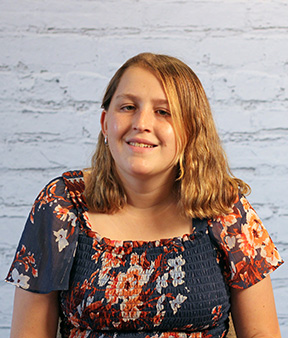 From the Editor: Katelyn Siple completed adjustment to blindness training at the Louisiana Center for the Blind in 2022. She holds a BA in communications from Lancaster Bible College, and she is active in the NFB of Maryland. In August Katelyn will leave for Honduras, where she will spend ten months teaching English and studying Spanish. With two of her friends she contributes to a blog, boldstrongandfree.com.
It was my first week of training at the Louisiana Center for the Blind (LCB), and I was searching through the West Kitchen from top to bottom. I wanted to see what I could discover in all the cabinets and drawers. I’m sure I asked my home management instructor, Cameron, a lot of questions that week, but there’s one I remember most.
“Where are all the Braille measuring cups and adaptive tools for blind people?” I asked. I expected to find knife guards, locking lids for draining, and the other implements I’d always been told were necessary for blind people who wanted to cook. I was shocked and excited when I found out there weren’t any.
My family was very hesitant to let me cook, afraid that I would get hurt or burn the house down. I wanted to help my great-grandparents with the cooking when they were alive, and I asked my grandmother endless questions while she cooked. I always wanted a job in the kitchen, and I hovered whenever someone was cooking. I didn’t really start cooking for myself, though, until the day I walked up to the stove and told my dad I was going to learn to cook, with the stubborn attitude I’ve always been known for.
Family and state rehabilitation teachers tried to show me the safest and most effective ways to cook, which often included buying the latest gadgets believed to help blind people in the kitchen. Everyone tried to help me learn what I could, but there were frustrating moments when I couldn’t figure things out because of what I didn’t know. I remember trying to drain pasta, cut out cookies at Christmas, or flip basically anything on the stove.
Despite all those frustrating moments, when I started training at the LCB, I figured I didn’t have much to learn in the kitchen. I was so wrong!
Cameron’s calm, supportive attitude and expertise in the kitchen made it easy for me to learn and become confident in my own skills. During training we were allowed to choose the things we wanted to make beyond the basics of scrambled eggs and rice. After my exploration of the kitchen, one of the first things I learned was how to use standard measuring cups and spoons, simply by memorizing their order in the stack. I conquered my fear of hot oil popping on me when I fried bacon and other meat on the stove. I had to deep fry as one of my training requirements. Although the food wasn’t healthy, it was delicious and fun to cook. I would definitely do it again!
We spent a lot of time cutting and preparing herbs, fruits, and vegetables. I learned to cut them safely and quickly, without using any guards or losing my fingers. I use my left hand as a guide, curling my fingers in to make sure they are safe while I cut. In cutting and cooking, it’s helpful to have your hand or a utensil as a guide. Cameron called this our kitchen cane, a concept that stayed with me after training.
I learned countless nonvisual techniques during training, and they are invaluable to me now. I learned to tell whether food is done by its texture when you lightly tap it with your finger or with a fork. I’ve learned to check for doneness based on the smell coming from the oven or the way the sizzling sound changes in the pan. I learned to do the things that frustrated me in the past, such as draining pasta. I even had the opportunity to bake cut-out cookies at Christmas.
During training I went through an entire carton of eggs, learning to make the perfect egg over-easy. I went through several bowls of pancake batter and survived a big mess before I made anything that remotely looked like a pancake. I also lived through the Waffle Explosion of 2021; I spent three days cleaning the waffle maker!
I learned something through those frustrating experiences. Even when I wasn’t entirely successful, such as when I grilled burgers for the first time, I learned skills that have stayed with me.
As one of my graduation requirements, I had to make a meal for eight and a meal for forty. I love cooking for others, and I was excited to have that opportunity, but I was a little nervous, too. My meal for eight was a tribute to my family and the southern cooking handed down to us through the generations, with a little of my own personality thrown in. I made chicken glazed with molasses, brown sugar, and orange juice, a dish I adapted from a recipe. I also made mashed potatoes, green beans, and my great-grandmother’s biscuit recipe, with vanilla ice cream for dessert. I put a lot of thought into the decorations, music, and invitations, and I had so much fun!
I made chicken and dumplings for my meal for forty. I chose this dish because I could throw it all into one pot, and it’s easy to make. It was a time intensive project, and I never knew that the hardest part would be cleaning up afterward.
When I came to training, I thought I would learn everything I would ever need to know in life, but that wasn’t what happened. Instead, I learned how to problem solve calmly and to figure out how to do new things on my own. I still can’t make the perfect pancake, and there are still things I haven’t learned—and that’s fine.
Since training I’ve learned to do even more in the kitchen. Those nine months in Louisiana changed my life in every way possible. Instead of being defeated by frustration, I have freedom and self-confidence in the kitchen and beyond. I will be forever grateful for the skills I learned, the role models I met, the experiences I had, and the relationships I forged during that time. They helped shape me into who I am today.