American Action Fund for Blind Children and Adults
Future Reflections Winter 2025 CANE TRAVEL
Nebraska Cane Walk 2024
by Merry-Noel Chamberlain
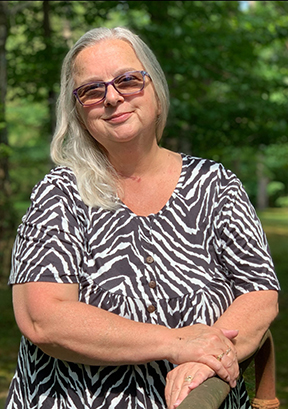 From the Editor: Dr. Merry-Noel Chamberlain is an Orientation and Mobility (O&M) instructor with the Nebraska Commission for the Blind and Visually Impaired. She has written numerous articles for Future Reflections, as well as several books. Her most recent title is Structured Discovery Cane Travel Approach to Orientation and Mobility Concepts (2023).
While I was attending the master’s program in Orientation and Mobility (O&M) at Louisiana Tech University several years ago, I went on a five-mile walk under learning shades. With other students in the program and students attending the Louisiana Center for the Blind, I walked from Ruston to the neighboring town of Grambling. The Grambling Walk involved a bit of friendly competition, and it helped all of us build confidence in our O&M skills. What a great opportunity—to walk independently, without a guide, from one town to another, using the one true mobility tool—the long white cane!
Because the walk was such a wonderful confidence-building experience for me, I longed for a comparable event in my home state of Nebraska. I wanted to find a way to encourage Nebraska students to enhance their navigational skills by using their canes. Thanks to my employer, the Educational Service Unit #3 of the Nebraska Commission for the Blind and Visually Impaired, and thanks to the help of several volunteers, the Nebraska Cane Walk was born.
The Nebraska Cane Walk was designed to promote independence for students between the ages of five and twenty-one. The Cane Walk promoted mobility via the long white cane. Participants moved independently, without the assistance of a human guide. The Cane Walk was not a competition with winners in first, second, or third place. It was simply an opportunity for participants to build confidence in their mobility skills.
The Event
The Nebraska Cane Walk was held on April 24, 2024, at the Nebraska Commission for the Blind and Visually Impaired (NCBVI). It encompassed two structured sessions. The morning session covered basic O&M skills, while the afternoon session offered more advanced O&M opportunities and challenges. Many of the stations were operated by instructors with National Orientation and Mobility Certification (NOMC) or who were Certified Orientation and Mobility Specialists (COMS). Rehabilitation counselors and staff from NCBVI, a current O&M student from the University of Nebraska/Lincoln, and blind adults who travel with the long white cane in their daily lives also staffed stations. In addition there were volunteers from the Educational Service Unit #3, Outlook Nebraska, and the public schools.
Each of the participants visited ten morning stations, and the older or more advanced participants ventured on to ten additional stations in the afternoon. Participants maneuvered independently to targeted stations, earning a variety of tactile, scented, or Braille stickers upon arrival. These rewards were placed inside passports, which the participants carried in zipper pouches attached to lanyards. Although many of the stations involved participants in activities, the main goal was for the participants to enhance their mobility and independence skills by traveling through a variety of real-life environments. At the end of the day participants received gift bags filled with fidgets and games.
The Activities
Participants took part in a variety of activities. They went “fishing,” fine tuning tactile awareness with the cane. Some played the Cardinal Direction Tic-Tac-Toe game and/or a game called Left, Center, Right. Overall, the participants were involved in the following activities during the Nebraska Cane Walk:
- Problem solving
- Locating and operating an elevator
- Using basic and advanced cardinal directions
- Using shorelines
- Seeking assistance
- Using directions (left, right, and straight)
- Following verbal directions
- Walking in step with the cane
- Walking backward using the cane
- Walking down and up stairs
- Enhancing auditory awareness
The Parents
Parents attended a roundtable discussion with Jeff Altman, NOMC, in which they learned about the alternative skills of blindness. In addition, parents learned more about O&M, the long, white cane, and Structured Discovery Cane Travel. They got new ideas on how they might help their children or students reach their mobility goals.
The Learning Shades
Participants who had any amount of usable vision wore learning shades. Wearing learning shades prevents students from trying to use inconsistent or unreliable vision. When O&M instruction includes the use of learning shades, students develop skills that they may use outside class, regardless of lighting conditions or fluctuations in their vision. By wearing learning shades at the Nebraska Cane Walk, all participants are at an equal level. The removal of the visual component supports consistency when comparing a student’s growth in confidence during future Nebraska Cane Walk events.
The Goals
The Nebraska Cane Walk event had many goals and objectives.
Participants were given an opportunity to practice their O&M skills in a challenging new environment.
Participants were given an opportunity to meet and interact with other participants outside their school district.
Parents and participants were given an opportunity to meet and learn from successful adults with visual impairments (besides their O&M instructor, in some cases).
An opportunity was given to the Nebraska Commission for the Blind and Visually Impaired to meet prospective clients.
Parents of children with visual impairments were able to meet the vocational rehabilitation agency that is serving or will serve their children.
The Donations
Several organizations were involved to help make the Nebraska Cane Walk possible. We extend a special thanks to the following: Educational Service Unit #3; Nebraska Commission for the Blind and Visually Impaired; National Federation of the Blind of Nebraska; National Federation of the Blind of Nebraska, Lincoln Chapter; and Association for Education and Rehabilitation of the Blind and Visually Impaired (AERBVI).
The Future
Following this Cane Walk, parents of the students who took part made suggestions for the next Nebraska Cane Walk. Our next Nebraska Cane Walk will be held on April 22, 2025, at NCBVI. It will include opportunities for parents to have hands-on experience using a long white cane. Our goal is eventually to include a third extended session for participants who have surpassed the afternoon skills addressed in the Nebraska Cane Walk. This remarkable session will loosely model Louisiana’s Grambling Walk with, we hope, the same amazing results. Would you like to be included? If so, contact me at [email protected].