American Action Fund for Blind Children and Adults
Future Reflections Special Issue on Technology CHALLENGES AND CHOICES
Monarch: Shaping the Future of Tactile Literacy
by Sarah Gauer
From the Editor: The Monarch is one of the most exciting new developments in the world of access technology for the blind. Developed by HumanWare and the American Printing House for the Blind (APH) with the ongoing support of the National Federation of the Blind, the Monarch offers the unique combination of tactile graphics with a multiline Braille display. In this article Sarah Gauer introduces a pilot program that has put the Monarch in the hands of a group of blind high school students across the country. Sarah Gauer serves as project manager for the Monarch Student Program at APH.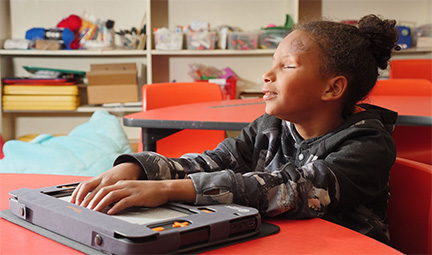
For students who read Braille, falling behind often has nothing to do with ability and everything to do with waiting. For decades, blind and low-vision students have relied on embossed Braille and tactile graphics to read textbooks, explore diagrams, and engage with classroom visuals. While hard copy Braille and graphics have opened doors for many, they come with significant limitations. Materials must be ordered weeks or months in advance, updates are nearly impossible, and staying in step with fast-paced lessons can be a challenge. A math teacher can draw a graph on the board in seconds. For a student who is blind, that same graph might arrive days later, embossed on bulky paper and offering the student limited ability to make changes.
Meet the Monarch Student Pilot Project
Monarch aims to change the status quo for tactile literacy. The first of its kind, Monarch is a dynamic tactile device that offers multiline Braille and tactile graphics, all on a single display. Developed in partnership by the American Printing House for the Blind (APH) and HumanWare, Monarch is transforming how Braille readers of all ages can read, work, and organize information in a digital world.
Monarch’s ten-line, thirty-two-cell Braille display goes far beyond traditional Braille technology devices. Users can skim through paragraphs, review math problems or computer code across multiple lines, and explore tactile graphics—all on the same device. Instead of switching between bulky volumes of a book or juggling multiple tools, users can move between text and graphics in a single, continuous flow, making it easier to take in information, stay focused, and work independently.
Thanks to the Monarch Student Pilot Project (MSPP), students and educators across the country are exploring the possibilities of Monarch in real classrooms today. The project, which was launched in the fall of 2024, is structured as a long-term loan program for students who are blind or have low vision. Students in grades six through eleven are nominated by their educators and selected to represent communities across the United States in a variety of instructional settings that include public, private, residential, and home school. Each student receives a Monarch to use through their graduation from high school. In return, students and their educators provide regular feedback about their experiences, helping to shape classroom strategies, training materials, and future improvements to Monarch.
The project is grounded in three key goals: first, to provide students with consistent, year-round access to refreshable Braille and tactile graphics—something many have never had before; second, to gather feedback from students and educators about what’s working well and where improvements are needed; and third, to identify resources, training, and support systems that will help both students and teachers make the most of Monarch. Because Monarch represents such a leap forward, it’s difficult to anticipate every way it will be used or the support that might be needed. MSPP is not only helping us understand how Monarch fits into daily instruction, but also helping us prepare for the unexpected possibilities that emerge along the way.
Early Classroom Moments with Monarch
In classrooms across the country, students and educators are discovering just how much Monarch can shift the rhythm of learning. Several students pointed to how Monarch has changed their experience with assignments, especially when lessons change on short notice. “My teachers often plan at the last minute or change plans right before class,” said an eighth grader from Washington. “Having the Monarch has helped with that because they just save it to the thumb drive, and I can do my assignments.” What once might have meant waiting days for an updated worksheet can now happen in real time—something small but powerful.
Others are noticing changes in how they read and process information. A ninth grader from Vermont shared that Monarch helped increase their reading speed and gave them a boost in Braille proficiency they didn’t expect to see so quickly. In subjects such as math and science, students are finding new independence. An eighth grader from New Mexico said, “It made me feel like I could be more independent in the future.”
These classroom moments may seem simple at first glance, but taken together, they reveal something much bigger. Monarch is helping students keep pace, build skills, and take greater ownership of their learning. In a fast-moving world, that kind of shift can make all the difference.
Monarch Outside the Classroom
As Monarch becomes part of students’ daily lives, its influence extends well beyond academics. For many, Monarch has opened the door to spontaneous leisure reading and personal growth. One student shared that Monarch gave them access to thousands of books, transforming reading from a school task into something they could truly enjoy. Another described how the Monarch allowed them to read aloud with their family, each person following along in their own format: print for some, Braille for others. A student in Oklahoma shared that they’ve been journaling daily since receiving Monarch, a habit that quickly became a meaningful part of their routine.
Monarch is also helping students experience the world in new tactile ways. After viewing a tactile graphic of a bowling alley, an eighth grader recounted, “I have bowled many times, but it made me feel more aware of how the pins were set up. It was cool.”
These early moments reflect the wide-ranging role Monarch is already playing in students’ lives. Whether reading for fun, journaling, exploring a tactile diagram, or connecting with loved ones, students are making the device their own—not just using it to learn, but to experience, reflect, and grow.
Educator Perspectives
Educators are seeing firsthand how Monarch is sparking excitement and changing students’ relationship with learning in the classroom and beyond. Its versatility and ease of use have made it a preferred tool for many students, even when other technologies are available. As one educator put it, “This is his chosen tech. He would rather use the Monarch than any other tech we have.”
That preference goes beyond functionality. Monarch is helping students rethink what learning can look like for them. By putting tactile literacy and digital flexibility into one unified experience, it empowers students to explore subjects in more dynamic, immediate ways. One teacher noted how possibility itself has become a motivating force: “The possibilities of the device are a huge factor in my student’s enthusiasm for learning.”
For students who once imagined limited futures, Monarch is shifting the horizon. One educator shared a particularly powerful reflection. “This student is hopeful that this technology will allow him to be successful in college. He has been reluctant to explore the idea of attending higher education... and he can now see that it is a possibility with the Monarch. He would be the first in his family to attend college.”
Monarch’s impact also reaches into students’ home lives. In one case, a student who had struggled with homework now works collaboratively with a parent. “Her mom has not learned Braille, and with the external monitor, she is able to help with homework. They read together now.... It has been fantastic for their relationship.”
These stories show Monarch as more than a device. It’s a catalyst for building confidence, connection, and new possibilities.
Building for the Future
While Monarch has already made a powerful impact in classrooms and beyond, it remains an evolving technology, constantly shaped by the real‑world experiences of its users. Early feedback from students, educators, and families has highlighted several key areas for refinement, and we’re moving quickly to turn suggestions into solutions.
A great example of this is the protective membrane covering the Braille cells. While the membrane has proven to be highly effective at keeping the Braille cells safe—even surviving a soda spill—many students initially dislike the feel of it. To address this, we’re collaborating with the manufacturer on a next‑generation membrane that’s thinner and more comfortable to touch without compromising on protection.
Students have shared that they want to take their Monarch with them more easily from the classroom to home, between classes, and beyond. To support that kind of portability, we’re exploring options such as carrying straps and other accessories. Such accessories can make Monarch more portable and more easily integrated into daily routines, just like any other essential learning tool.
Several educators have expressed a common wish: a simple way to create quick, on-the-fly tactile graphics for lessons that include bar graphs or pie charts, or for teaching orientation and mobility concepts. The need for fast, flexible graphic creation was anticipated early in Monarch’s development. That’s why APH has been working on Wing It, a new app designed to let users create tactile graphics on the spot, using an iPhone or iPad, and instantly send them to their Monarchs. Whether it’s drawing a quick map of a hallway or introducing the concept of bar graphs, educators will soon be able to generate dynamic graphics for a Monarch in real time.
What’s Next: Welcoming Our Fall 2025 Cohort
As the first year of MSPP draws to a close, the wealth of insights we’ve gathered is already fueling smarter hardware, richer software, and more robust support systems for Monarch. But the journey is just beginning. This fall, a new cohort of students will begin the journey with Monarch. Their real‑world experiences will be integral to refining both the device and the ecosystem around it. We look forward to partnering with these students and their educators as together we sharpen Monarch’s features, expand our support materials, and ensure that the device continues to meet the genuine needs of Braille readers in every setting.