American Action Fund for Blind Children and Adults
Future Reflections Summer 2025 TRAVEL
The Purpose and Introduction of Sleepshades During O&M Instruction
by Merry-Noel Chamberlain
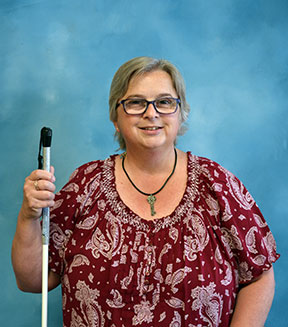 From the Editor: Dr. Merry-Noel Chamberlain teaches orientation and mobility (O&M) at the Nebraska Commission for the Blind. She is a frequent contributor to Future Reflections and the author of several books. Her most recent title is Structured Discovery Cane Travel Approach to Orientation and Mobility Concepts (2024). Some of the information in this article is excerpted from The ABCs of Structured Discovery Cane Travel for Children (2021).
Most low-vision students receiving Orientation & Mobility (O&M) instruction do not realize that their remaining vision is unreliable. Therefore, they often believe that whatever vision they have is true and dependable. However, this conviction may place the student in dangerous situations. Occlusion (a.k.a. sleepshade) training provides students with abilities and skills they can depend on, regardless of how much vision they have now or how little vision they may have in the future. The Structured Discovery Cane Travel (SDCT) curriculum requires O&M students to be occluded during instruction.
Occluding, according to Kappan (1994) and Pogrund and Griffin-Shirley (2018), is used to block or restrict visual input and build self-confidence in students while they perfect nonvisual skills. Keep in mind that spending time in total immersion helps students gain self-confidence while they focus on the development of nonvisual mobility techniques. When students learn O&M while wearing sleepshades (sometimes referred to as learning shades), the skills they obtain are maintained, regardless of how much vision is lost over time.
NOTE: Occlusion training may not be suitable for all students. Therefore, individual recommendations and training must be based on students’ physical and cognitive abilities, as well as their emotional needs.
Training under Sleepshades
According to Maurer et al. (2007) and Mino (2011), one of the most critical mental processes necessary in mobility is having confidence in the nonvisual techniques of problem solving. The SDCT curriculum focuses on mobility skills as occluded students use the long white cane, significantly reducing the overall time spent on training. When a skill is mastered without vision, students are still able to perform the task, regardless of lighting conditions or decreased level of vision over time. In contrast, if a skill is mastered relying on the limited vision the student has available, it may not be usable in poor lighting conditions. Additional training will be necessary if or when the student’s sight decreases. Therefore, students who have any remaining vision benefit from occlusion training because sleepshades allocate their attention toward learning.
The use of sleepshades:
- Blocks unreliable, distracting vision that may subconsciously affect the student’s ability to build nonvisual knowledge and skills necessary for travel (Maurer et al., 2007).
- Reduces visual fatigue that happens when attempts are made to utilize old skills while simultaneously trying to develop and perfect new ones (Maurer et al., 2007).
- Improves performance levels by removing the dependency on lighting conditions.
O&M Training for Instructors
According to Kappan (1994), minimal occluded disability awareness training possibly creates false impressions of the true capabilities of blind and/or low-vision students. Thus, prospective mobility instructors learning the SDCT curriculum spend extensive time in occluded training. Five hundred to two thousand hours of training under sleepshades (Aditya, 2004) models the Veterans Administration’s O&M training program in the 1940s (Miyagawa, 1999). Instructors who undergo this extensive occluded mobility training can demonstrate nonvisual mobility tasks actively and without hesitation. By observing the instructor’s self-confidence and ability, students may internalize their belief in the mobility skills they are striving to master. SDCT instructors can demonstrate that they have acquired the skills that they are requesting from their students, just as algebra teachers are able to demonstrate the necessary steps to complete complex mathematical formulas.
Students’ O&M Training
Through the SDCT curriculum, instructors help students build constructive problem-solving travel strategies while they are occluded. These strategies can be transferred from the lesson setting to other locations post-instruction, and students find that they can handle a myriad of travel challenges. When students have confidence in their travel abilities without using their limited or remaining vision, they are more likely to be self-motivated during off-training hours when they can use the vision they still may have. This finding was evident with blind veterans of World War II. On weekends they traveled independently to local establishments when they were on their own (Miyagawa, 1999). When people learn to pay attention to their surroundings, rather than being told what is around them, they learn to tune into their other senses. Gravel (2006) wrote this observation to his former SDCT instructor:
“I’m unafraid to venture out on my own now, even when traveling in a new city. You gave me the understanding and courage to simply ‘get the job done,’ no matter the supposed obstacles. You taught me—undeniably—that I can be dropped off anywhere, not even knowing exactly where, and still find the location where I need to go.” (pp. 23–25)
Introducing Sleepshades to Low-Vision Students
Some instructors shy away from having students wear sleepshades because wearing them may be scary. Wearing sleepshades may produce anxiety if the introduction is made too hastily. Students need time to gather enough courage to leave their comfort zone. More importantly, they must learn to trust the information their long white cane provides. The following steps have been successful with preschoolers, young school-aged students, and blind/low-vision students with additional disabilities. This program is only a guideline. Repeating steps may be necessary for some students, and that is perfectly okay! This experience needs to be fun for the student and accepted by the parents and all team members.
Prerequisite to O&M under Sleepshades
Before students are introduced to sleepshades, they need to have some positive experiences walking with the long, white cane without sleepshades. Keep in mind that these experiences need not be perfect. The student simply needs to have some general knowledge about how to use the cane and the cane’s intended purpose. Depending on their age, students need to comprehend:
- The cane is a tool, like silverware that is used for eating or a broom that is used for sweeping dirt.
- The cane is an identifier; it lets people know that the user is blind or has low vision.
- The cane is used to locate and maneuver around obstacles such as trashcans within one’s path.
- The cane is used to locate and utilize landmarks such as stairs within one’s path.
- The cane is used for terrain interpretation (i.e., hills).
- The metal tip of the cane is used to enhance and/or identify auditory information (i.e., buildings, automobiles, doors).
Introduction of the Sleepshades
Lessons Days #1 through #3: These lessons begin with the student sitting in their comfort zone. Perhaps this is their desk or workstation at school. Play simple O&M games, such as:
- Left Center Right
- Tic-Tac-Toe Cardinal Direction Game
Check out Structured Discovery Cane Travel Approach to Orientation and Mobility Concepts (2024) for more ideas.
Lesson Day #4: For this lesson, challenge the student to point to the door of the classroom with their eyes closed. Using age- and stage-appropriate vocabulary, discuss whether memory or auditory skills were used to complete the task. Display a variety of sleepshades (many are available on Amazon) to the student. Encourage the student to select a pair to wear.
Ask the student to point to the classroom door. Talk with the student about sounds around the area. Usually, students will point to items that make sounds. Discussion can lead to how near or far the objects may be.
It is important that students comprehend that sleepshades are special tools.
Depending on the age of the student, have a brief discussion on the value of the sleepshades. For instance, they permit a person to focus on their hearing and memory; they block out unreliable visual distractions.
Finally, discuss a special location where the sleepshades can be stored for future lessons. The sleepshades might be stored with the student or with the instructor.
Lesson Day #5: On this day, the student wears sleepshades while listening to a story or two being read aloud. Be sure to read a story that includes a blind or low-vision character who uses a long white cane. Repeat this step on occasion as needed, especially when the weather is bad. Here are some suggestions:
- The Night Search (1997) by Katie Chamberlin.
- Keep Your Ear On the Ball (2007) by Genevieve Petrillo.
- Flowers’ Blooming (2011) by Merry-Noel Chamberlain (found in The ABCs of SDCT for Children).
Lesson Day #6: Henceforth, students wear sleepshades during the majority of their O&M lessons. On this day, repeat an O&M game from Lesson Days #1 through #3. Keep in mind that this is done with the student seated in their comfort zone.
NOTE: If the student accidentally rolls dice off the table, the student must retrieve them. This leads to baby steps.
Baby Steps
Lesson Day #7: Repeat the previous lesson. While playing a game to encourage the student to move a step or two away from the comfort zone, creativity may be necessary. Perhaps ask the student to retrieve a toy from a shelf nearby. Review the sounds from Lesson Day #4 (i.e., ask the student to point to a nearby location). Then challenge the student to use the cane to walk to that location, provided the path is free from obstacles. If not, select a location that is free from obstacles. Repeat to another nearby location.
Bigger Steps and Beyond
Lesson Day #8: Now it is time to venture forward! Build upon each walking opportunity. Here are some ideas:
- Ask the student to give you a tour of the classroom.
- Play a talking Hide-and-Seek game in the classroom (i.e., the Eggcellent Hide ‘n’ Seek, or Silly Poopy’s Hide & Seek, found on Amazon).
- Play the “Go Fishing Game” (https://www.pdrib.com/pages/omgames).
- Ask the student to be a leader to various targeted locations within the school environment (i.e., bathroom, main office, gym, music room, library, art room).
- Walk to and play at the playground.
- Walk around the building—practice using sidewalks and stairs.
- Attend a Cane Walk!
- HAVE SLEEPSHADES AND CANE, WILL TRAVEL!
References
Aditya, R. N. A Comparison of Two Orientation and Mobility Certifications. 2004. http://studylib.net/doc/6790954/a-comparison-of-two-orientation-and-mobility-certifications.
Chamberlain, Mary N. Structured Discovery Cane Travel Approach to Orientation and Mobility Concepts. Charlotte, NC: IAP, 2024.
Gravel, Elaine. “Learning to Walk.” In Letters to My Teacher: Tributes to the People Who Have Made a Difference, edited by B. Karg and R. Sutherland, 23–25. Avon, MA: Adams Media, 2006.
Herbert, James T. “Simulation as a Learning Method to Facilitate Disability Awareness.” Journal of Experiential Education 23, no. 5(2000): 5–11. https://doi.org/10.1177/105382590002300102.
Kappan, Daniel. On Simulating Blindness. Viewpoints, 1994. https://files.eric.ed.gov/fulltext/ED378743.pdf.
Maurer, Marc M., Edward C. Bell, Eva Woods, and Roland Allen. “Structured Discovery in Cane Travel: Constructivism in Action.” 2007. https://nfb.org/images/nfb/publications/bm/bm07/bm0704/bm070405.htm.
Mino, Natalie M. “Problem-Solving in Structured Discovery Cane Travel.” Journal of Blindness Innovation and Research 1, no. 3 (2011). https://www.nfb.org/images/nfb/publications/jbir/jbir11/jbir010302abs.html.
Miyagawa, Sharon. Journey to Excellence: Development of the Military and VA Blind Rehabilitation Programs in the 20th Century. Lakeville, MN: Galde Press, 1999.
Pogrund, Rona L., and Natalie Griffin-Shirley. Partners in O&M: Supporting Orientation and Mobility for Students Who Are Visually Impaired. New York: American Foundation for the Blind Press, 2018.