American Action Fund for Blind Children and Adults
Future Reflections Summer 2025 ACCESS
Technology Accessibility in Higher-Level Education
by Alaula Sprecher
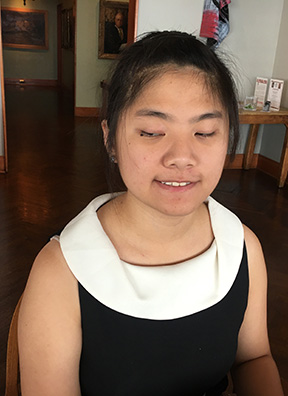 From the Editor: Alaula Sprecher has participated in numerous NFB programs over the years, from NFB BELL® Academy to STEM2U. Today she is majoring in astrophysics at a prestigious university. In this article she writes about the ongoing accessibility challenges that confront blind students who pursue higher-level studies in the sciences.
It is spring 2024, and I am standing before a lab table in a physics laboratory. At this point I am just finishing my first year in my undergraduate Astrophysics program. Today’s experiment is to help us understand how a circuit behaves over time. I begin to set up my data tables as my partner builds the circuit on the breadboard. The older student assigned to assist me with labs is setting up the computer and the software we use. They make the proper connections between the circuit modeled on the breadboard, the voltmeter (for voltage measurements), the ammeter (for current measurements), and the oscilloscope (for graphing circuit properties over time). I am taking data while they navigate the computer and modify the circuit as per our lab manual.
Notice what is happening here. I participate in the sense that I record data, keep track of the lab manual, and use my knowledge from class to understand the experiment and evaluate its results. However, I cannot manipulate the equipment or read any of the data myself. Every device has a screen, and the software is not compatible with any existing screen reader.
This experience is common for blind students in lab courses, and it extends far beyond the laboratory. In the case of software, much of the problem has to do with the technology not being updated in years by the university or the developers. This failure leaves them noncompliant with technology accessibility standards. Hardware, too, is not updated for several reasons, including compatibility, funding, and sustainability. Overall, a student’s success may depend more upon whether the technology allows them to complete the work than their understanding of the material or the lab procedure.
General Digital Accessibility
As blind people gain greater access to higher-level education, the accessibility of academic tools has become increasingly critical. One set of guidelines that addresses this challenge is the Web Content Accessibility Guidelines (WCAG), developed in 1999. These guidelines are recognized internationally, and they are used to determine the accessibility of software for individuals with disabilities. Today, the world of education is filled with Learning Management Systems (LMSs) such as Blackboard and Canvas, digital textbooks with accompanying course modules and assignments, and specific software for data analysis and coding. Yet, more than two decades later, many applications and websites still do not comply. Those that are partially compliant have pages on their websites about accessibility. After examining the website for the software we were using in my lab, I discovered that there were no mentions of accessibility for the software; anything about “access” was speaking to the ease of use for sighted individuals.
Software Accessibility
For those studying in the science, technology, engineering, and mathematics fields (STEM), accessibility presents additional challenges. Mathematics, for example, is often improperly coded for screen readers and Braille displays. This improper coding causes students to lose key details such as superscripts in exponents or numerators versus denominators for fractions. In fortunate cases, textbooks are tagged correctly, but additional materials are not. In terms of writing, students can use equation editors found in document editors, or they can learn LaTeX, an industry standard scientific writing language. Across all disciplines, the lack of image and audio descriptions is common. STEM students are told to watch videos to supplement lectures. These videos often include presenters who write silently and point to images. I have encountered only one website that implemented basic audio descriptions. Images and diagrams are especially important for students, due to the essential information they provide. Not having this information can make problem sets impossible to complete. Many higher-level texts do not include image descriptions, and the texts are often provided as inaccessible PDFs from publishers.
For data analysis, clicking and dragging seem to be the standard form of navigation, which proves to be nearly impossible for individuals who rely on keyboard commands to navigate a computer. In most cases screen readers will not interact with elements on the page, or elements are unlabeled.
Fortunately, coding is more flexible, and I have used languages such as Python to work around the challenge of data analysis. This, however, takes a significant amount of time. Students who are unfamiliar with coding may not learn these languages initially, or may never learn them as part of their curriculum. These challenges are frustrating when they come from new tools, and they are even more so coming from older systems that are not updated.
Hardware Accessibility
The challenges are not limited to software. At my university, I encountered lab computers that were several years old and equipment that was not built with accessibility in mind. Older computers may run the required software for labs, but they do not offer ways to adapt for screen readers and other assistive technology. Older operating systems struggle to run modern screen readers, and computers may not have the processing power to support these programs. I have had classes where audio output did not work at all. Some equipment only has display screens that require a sighted individual to read them aloud.
Manufacturers are not supporting older equipment, which means that there will be no accessibility improvements. These challenges exist on their own, and are only partially caused by similar challenges with outdated software.
Why Schools Keep Outdated Tools
Universities keep older equipment for a number of reasons. Cost is first among them. Associated fees come with software for licenses and training. Equipment is also expensive, so it is understandable that universities continue to use older equipment for as long as possible. Furthermore, many universities prioritize research equipment over lab equipment for undergraduate students. Through a sustainability lens, using older equipment is better than disposing of it. Not updating tools to existing, more accessible alternatives, however, causes blind students to have additional challenges when completing course materials.
Moving Forward
Given these challenges, it is important to know what equipment and software is currently being used for classes. This knowledge allows students time to become familiar with tools and materials. If accessibility challenges are present, there is additional time to find or create a solution. Ahead of class, Braille, technology fluency, and tactile graphic reading skills are instrumental. More broadly, talking to developers and publishers can be helpful in obtaining accessible tools and materials. Having these conversations increases awareness around and preparations for challenges with accessibility. Universities may also purchase these tools and use them for future students.
These challenges seem daunting. However, over the years solutions and alternatives have been created. In some cases, new approaches have been discovered to work extremely well. A few companies sell accessible lab equipment, for example, and other ways of communicating visual data have grown in popularity. Haptic feedback (vibrations) and sonification (audio tones) are used in talking graphing calculators and graphing software. One of my professors took an interest in the tools I used and sponsored a research project where I researched sonification techniques. I am currently developing a sonification and basic data analysis program with a peer.
Some universities support initiatives dedicated to making labs accessible. These challenges seem insurmountable, but it is possible to work around them by working with others to find solutions, speaking with the creators of these tools, and asking universities to invest in newer tools to assist with accessibility.